• Disclaimer: Hello Guest, Doberman Chat Forums presents the opinions and material on these pages as a service to its membership and to the general public but does not endorse those materials, nor does it guarantee the accuracy of any opinions or information contained therein. The opinions expressed in the materials are strictly the opinion of the writer and do not represent the opinion of, nor are they endorsed by, Doberman Chat Forums. Health and medical articles are intended as an aid to those seeking health information and are not intended to replace the informed opinion of a qualified Veterinarian.”

Inbreeding; How much is too much?

StateOfMine

Hot Topics Subscriber
I'm trying to understand pedigrees and smart breeding better and I came across a pedigree that, to me, looked disastrous, but there were big kennel names in it and I had to wonder. I know all purebred dogs are inbred to an extent, but where is the line drawn?

The dog in question has great grandparents that are almost the same on both the mother and father's side. I'm not necessarily wanting to put anyone on blast here, so if needed I'll recreate the pedigree using different names just to create a visual.

What is an acceptable level of inbreeding? Some of these kennel names are highly recommended by doberman buyers and other breeders, so I'm curious as to the answer to this. Thanks!
 
I don’t know a lot about this topic but I have seen it come up before. Search “COI” Coefficient of Inbreeding on here to see those threads.
 
Not many breeders here so not sure you will get an answer. I'm not a breeder but I am interested in the topic and educating myself.

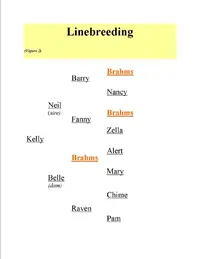
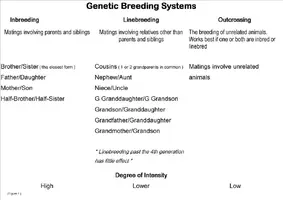
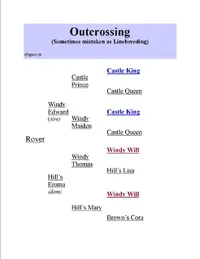
Linebreeding is a thing, which is probably what you saw, not inbreeding although linebreeding is a form of inbreeding it is more diluted and not used to describe what you are seeing. Linebreeding allows a breeder to lock down on traits - temperament, structure or health included. They'll linebreed to get what they want then outcross in a few generations to bring diversity back in. Outcross breeding is always a gamble on what you will get, including health. So outcross doesn't necessarily mean healthier. But that proves why health testing breed stock is so important.

figure-2-linebreeding1.jpg

Inbreeding is breeding parents and siblings to one another.

figure-1-genetic-breeding-systems1.jpg


Outcross
figure-3-outcrossing.jpg
 
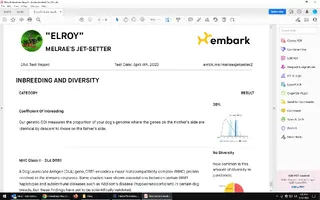
Because the Doberman has such a tight genetic pool and their COI is averaging 35 - 40+, it's WAY above most other purebred breeds, which usually are in the 20's. Any dog with a full panel Embark test will be given a COI. I personally think that breeders should be striving to lower the COI of the Doberman breed, but that's just me. Because of the bottleneck of Doberman breeding, even when there are no same dogs for 3 generations they can still be in the 40's because going back 5 or 7 or 9 generations they are related. COI is much more informative than pedigree in that respect.
 
Because the Doberman has such a tight genetic pool and their COI is averaging 35 - 40+, it's WAY above most other purebred breeds, which usually are in the 20's. Any dog with a full panel Embark test will be given a COI. I personally think that breeders should be striving to lower the COI of the Doberman breed, but that's just me. Because of the bottleneck of Doberman breeding, even when there are no same dogs for 3 generations they can still be in the 40's because going back 5 or 7 or 9 generations they are related. COI is much more informative than pedigree in that respect.
I didn't know Embark would give the COI... I've been planning to get it for gilly and just have been dragging my feet.
 
I didn't know Embark would give the COI... I've been planning to get it for gilly and just have been dragging my feet.
They have several different tests, and when you look at details just see if "genetic diversity measurement" is listed.
 
I didn't know Embark would give the COI... I've been planning to get it for gilly and just have been dragging my feet.

It's not calculated from percentages of inheritance due to common ancestry from a pedigree, as with Wright's or Hardiman's methods of calculating COI. I'm not sure about the science behind a COI calculated from genome analysis, while it might work well enough and match the pedigree-calculated COI, I'd think it wouldn't be quite as accurate in actually identifying COI in a population with extremely poor genetic diversity, such as the Doberman.

Well, it's either that, or maybe it's really much better, since it is looking at what's in front of the observer. The pedigree-based research is highly dependent on identifying the same ancestor(s) over and over, going at least a few generations back. That research obviously would miss the boat completely if it went back, say, 5 generations, in which there was no common ancestry, but there was heavy inbreeding from the 6th generation going further back. Genetic COI would see through that since it's blind to pedigree and only sees the diversity (or lack thereof).

IR (inter relatedness) values are also limited to only what is seen in the genetic test, and uses the rest of the breed (whichever have been tested to the date of the assessment) as a point of reference, so it doesn't really measure how absolutely inbred/outbred a particular animal may be.
 

Back
Top