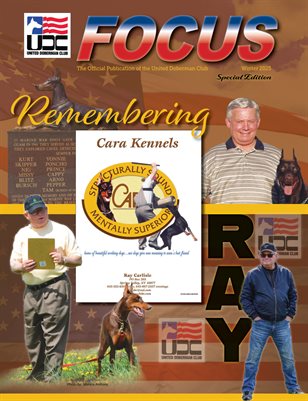

Wanted to share this here. Any one who's been here a while knows how much I love the sport of Schutzhund and the Doberman is my only breed. This guy is mostly responsible for that. I saw articles by or about him in dog magazines way back in the '80's or '90's and decided that's what I wanted to do. Of course life took me in other directions but I never ever lost my interest in SchH, then IPO, and now IGP - same sport different names. When I was approved for the litter that produced Asha I was researching the pedigree of her mother and probably squealed out loud when I saw Ray's kennel name in the 4th generation and Alida's name in the 6th.
This is the man who lived to keep the Doberman in America in the working world.
*Edited to say this was posted by Alison Kollenberg
REMEMBERING THE LIFE OF AN AMERICAN LEGEND
VALE RAY CARLISLE 20.08.1941 - 03.05.2025
News came in from the USA informing my husband Jens and myself of the passing of Ray Carlisle earlier this month. I missed his memorials, where I am sure his American colleagues could best speak to Ray’s life in his country. But I’ve put together a personal story to commemorate our own relationship with this intelligent and visionary man, whom over his lifetime made a difference within the American Doberman community, taking his breeding on journey that in hindsight was quite a revolutionary path back in the day.
Ray had a lot to say and to do him justice this eulogy will take a lot of words too. So fasten your seat belts. Others better qualified can cover Ray’s contributions to the Doberman Pinscher Club of America and his leadership going forward in co-founding of the United Doberman Club, with its goal of promoting both conformation and working titles on American Dobermans. I mainly intend to focus on the interesting crossroads of our shared personal history with him, that developed into a lifelong camaraderie which crossed oceans in the meeting of minds in eliciting a new understanding and appreciation of each other’s histories and values, bringing together new opportunities for breed fanciers globally.
The earliest meeting with Ray was back in 1988, in Los Angeles. Jens had been invited to judge in Los Angeles and New York and the LA show was a controversial event, being the first time a German Specialist Working and ZTP (Breed Survey) Judge had been invited to the USA since...well, since anyone alive could remember! Jens met Ray for the first time judging the Los Angeles Doberman Pinscher Club Specialty.
Inviting a (scary) German judge from the breed’s home country saw people’s curiosity balloon; it was a well attended event. And for spectators and competitors alike, the experience didn’t disappoint. There was controversy from the start, as Jens went down the lines of Champions, sending to the end of the line some of the breed’s most highly profiled show dogs for temperament insufficiency. Dismissing show dogs because of temperament issues was unheard of and supporters of the dismissed dogs were soon raising questions whether evaluating a dog’s firmness of character had any place in a show ring at all.
This issue blew up from there, people took sides and there were outpourings of opinions from breed experts and laymen alike - Letters to the Editor and from the editor etc, all dissecting the German VS American issue over the course of the year within the pages of the two leading American breed journals, Doberman Quarterly and Doberman World - a noise that would do justice to any online partisan political forum today.
Jens and Ray crossed swords on the German VS American issue early and sparks flew. As a former President of the Doberman Pinscher Club of America, Ray’s opinion was that Americans had “saved” the breed from the deprivations of WW2 and thus from extinction; that they had purchased the best stock and improved on the “wild” German temperaments to breed the world a better Doberman as a result. Jens counter argument was simple; that Ray didn’t know what he was talking about (“you don’t miss what you never use”) and all Americans had succeeded in doing with their early German imports was to ruin the breed. It was gloves off.
To understand the basis of their conflicted opinions, you have to understand they were worlds apart in background, experiences and histories. The accepted American view of history was American Doberman Pinschers had been bred separately since 1941, admittedly, were coming out of four main European lines and due to the war, had long separated from the country of origin; thus realizing American pedigrees and breeding records as the most reliable in the world.
Trusted American historians also claimed the German Dobermannpinscher had the shorter recorded history. Alleging Germany’s Breed Registry only began in 1949. Their reasoning was that WW2 had devastated even more of the breed than in WW1 (1914-18). Allegations were that not only were these dogs destroyed "eliminated" in Germany in WW2 between 1939 - 1945, but the breed itself was largely destroyed throughout Europe.
Jens response to this uniquely American viewpoint was to demonstrate that German Stud Books existed in an unbroken line right back to the original registration of Landgraf in 1986! That in fact, German records show between 1919-1924, approximately 20,000 Dobermannspinschers were entered in the German Studbooks, with another 20,000 registered over the following 5 five years. Jens pointed out this meant 40,000 Dobermannpinschers had been overlooked by American historians when claiming in their writings that the breed was just about “eliminated” in Germany. Further, official records show that in the USA this same decade, the new breed was founded with approximately 750 Doberman Pinscher registrations between 1919-1924. In the following five years a further 2,650 Doberman Pinschers were registered with the AKC. So the actual comparisons were 40,000 to 3,400!
Just to rub it in, these historical inaccuracies were not helped by another false American claim, that Phillip Grueing’s book (pub. 1932) was “never available in the language of its writing” (it was, we have a copy), compounded by the fact the translation of the book had failed to note the German author’s timely advice for his American counterparts, which was summed up in a chapter from “Der Dobermannpinscher in Amerika” (pub 1939) by Gruenig’s close friend, Howard Mohr, who wrote (quote), “the development of the breed in this country (USA) is severely handicapped, caused by the breeders neglecting scientific knowledge concerning breeding rules, as well as a lack of knowledge and also inadequate knowledge by the judges, connected with petty politics and jealousy.”
It was against this backdrop my husband and Ray came together in opposition over Ray’s claim of national superiority. After the dust settled, Jens explained to Ray the workings of the German system of breeding dogs, that incorporated mandatory working titles, breed surveys for breeding permissions and individual supervision of the regulations for both breeding and registering litters.
These concepts were all new territory for Ray, and to give Ray’s smarts his due, he was listening and saw an opportunity for both the breed and his kennel that others didn’t. He followed up by travelling to Germany and buying himself the first German National Champion female (Bundessiegerin) to travel to the USA since the importation of the famous 1937 Reichsigerin, Jessy v.d. Sonnenhoehe (ZB 49753/1934). NB: Jessy was sired by Cherloc v. Raufelsen (ZB 47216) and she was imported to the USA by the famous American breeder, Mr. Fleitmann of the Westphalia Kennels. Of Jessy’s children remaining in Germany, her son Frido v. Raufelsen (sire was World Sieger Troll v.d. Engelsburg) became a sire of enormous influence in Europe. Frido’s litter mates, Ferry and Freya, both won Sieger titles and were sold to the USA, becoming influential producers in that country.
Why this breed history matters to our own and Ray’s story, is the first German Siegerin imported to the USA since Jessy, was owned + trained and titled by our kennel (me
 ). The story of the hand that Jens had in the making her famous litter is an interesting saga on its own. But as our pick bitch, she was soon a VDH/ German + Int. Champion, Bundessiegerin, DV Siegerin.
Her name was Alida v.d. Flandrischen Loewen SchH3, FH2 (sire: Ch. & Bundessieger Ali v. Langenhorst SchH3, Angekoert dam: Ch. & Bundessiegerin Alexa vom Heiderhof SchH3) and she carried a direct male line right back to the first registered Dobermann, Landgraf (1896). Within her genes she carried an astounding 445 crosses to her early Siegerin forebear, Jessy! Blood will tell and these were bloodlines that endured through generations, on both sides of the planet.
The only difference between Alida and Jessy, was Alida was the first Sieger dog imported by Americans that also had working titles attached (SchH3, FH2) and had passed a German Fit For Breeding test (V1A/Excellent Select.)
Through his importation of Alida and motivated by an adventuring spirit, Ray became an innovative pathfinder for the breed in the USA in his pursuit of his "total Doberman." Alida's first USA mating was to Jens Winner Dog from the Los Angeles Speciality; Ch. Electra’s the Wind Walker. This was followed by a second litter to Ch. Akela’s the Vindicator. Her get from her 3 litters; first the German litter from our vom Norden Stamm kennel, sired by Ch. & Sieger Ebo v.d. Groote Maat SchH1, and followed by Ray’s two Cara litters; together included 12 Champions, 9 Schutzhund titled, 4 C.D. and 1 CDX titled progeny.
Ray continued with Alida’s line through her grandson, Clemens v. Falltor SchH3 and her daughter, Cara’s Forget Me Not, as well as having several grandchildren that were special to him around all the time.
Ray’s eulogy in regards Alida incorporates his Road to Damascus moment of conversion in breeding, with a phrase he coined, “the total Doberman”. Noting his experience that (quote), “the depth of pedigree now meant breeding for working ability AND conformation, was totally different from breeding only for physical beauty.”
It was Alida that introduced Ray to the sport of Schutzhund, that came up against a strong opposition from within the DPCA fraternity. But Ray the innovator and pathfinder trusted his instincts. Undeterred, his new goals gave him a new lease on life from which sprung his desire to form an organization that encompassed both shows and working trials for Dobermans in the form of the United Doberman Club of America.
Alida & Ray were inseparable companions and when her time came, he buried the 10 year old Alida underneath the old oak tree in her favourite playground on his property in Washingtonville, New York.
Ray's own roots went back to North Carolina. Born in Fort Bragg, Ray grew up in Arkadelphia, Arkansas, graduated from Castle Heights Military Academy, went to Henderson State Business College where he married Myrna Gellman in 1969, leaving his mark on the world through his six children and 8 grandkids.
Ray told me he’d always had dogs in his life and purchased his first Doberman in 1961. Jens was older, purchasing his first Dobermann in 1958. But since Ray’s activities in Dobermanns is so extensive, I’ll only address the more high profile achievements.
Ray served as DPCA President, Vice-President and Director, he was UDC President and eventually President of the American Working Dog Federation. He was the publisher of Top Dobe and The World of the Working Dog magazines and in 1973 he originated the “Top 20” event, later bequeathing it to the DPCA.
Ray became an AKC Judge in 1981, served on the DPCA Judge’s Education Committee, judged countless National Specialities around the world as well as the DPCA Top 20; he was an active member in Dog Show Judges of America and Senior Conformation Judges Association, and co-chaired the War Dog Committee.
After purchasing Alida, Ray became very active in the Schutzhund sport, served as the DPCA Schutzhund Chair, was a competitor as well as an officiating officer in the UDC as a ZTP & conformation Judge and ROM evaluator. Later he was principle promoter bankrolling the by-invitation-only $10,000 prize money for the USA Masters World Dog Sport Tournament, starring leading Schutzhund competitors from around the world. And it was a proud day for Ray at the "AWDF Battle of the Breeds" - the only time the Doberman team won, that two out of the 3 teams were Cara Dobermans - one owned and handled by himself.
We had both been recently thinking of Ray as we not heard from him for a while. It was very hard to hear from Ray’s son, Mark, of his mental deterioration over the last years of his life. Mark explained Ray had been sick for some time, then his heart got bad and he was in home hospice for a while before Mark brought him down to Florida to be around his family, and where most of the family lived. Mark's words of his father were that he’d truly lived a full, happy life and did what he wanted to do; his passion for the Doberman and for his business remaining undiminished throughout. RIP old friend.
This is the man who lived to keep the Doberman in America in the working world.
*Edited to say this was posted by Alison Kollenberg
REMEMBERING THE LIFE OF AN AMERICAN LEGEND
VALE RAY CARLISLE 20.08.1941 - 03.05.2025
News came in from the USA informing my husband Jens and myself of the passing of Ray Carlisle earlier this month. I missed his memorials, where I am sure his American colleagues could best speak to Ray’s life in his country. But I’ve put together a personal story to commemorate our own relationship with this intelligent and visionary man, whom over his lifetime made a difference within the American Doberman community, taking his breeding on journey that in hindsight was quite a revolutionary path back in the day.
Ray had a lot to say and to do him justice this eulogy will take a lot of words too. So fasten your seat belts. Others better qualified can cover Ray’s contributions to the Doberman Pinscher Club of America and his leadership going forward in co-founding of the United Doberman Club, with its goal of promoting both conformation and working titles on American Dobermans. I mainly intend to focus on the interesting crossroads of our shared personal history with him, that developed into a lifelong camaraderie which crossed oceans in the meeting of minds in eliciting a new understanding and appreciation of each other’s histories and values, bringing together new opportunities for breed fanciers globally.
The earliest meeting with Ray was back in 1988, in Los Angeles. Jens had been invited to judge in Los Angeles and New York and the LA show was a controversial event, being the first time a German Specialist Working and ZTP (Breed Survey) Judge had been invited to the USA since...well, since anyone alive could remember! Jens met Ray for the first time judging the Los Angeles Doberman Pinscher Club Specialty.
Inviting a (scary) German judge from the breed’s home country saw people’s curiosity balloon; it was a well attended event. And for spectators and competitors alike, the experience didn’t disappoint. There was controversy from the start, as Jens went down the lines of Champions, sending to the end of the line some of the breed’s most highly profiled show dogs for temperament insufficiency. Dismissing show dogs because of temperament issues was unheard of and supporters of the dismissed dogs were soon raising questions whether evaluating a dog’s firmness of character had any place in a show ring at all.
This issue blew up from there, people took sides and there were outpourings of opinions from breed experts and laymen alike - Letters to the Editor and from the editor etc, all dissecting the German VS American issue over the course of the year within the pages of the two leading American breed journals, Doberman Quarterly and Doberman World - a noise that would do justice to any online partisan political forum today.
Jens and Ray crossed swords on the German VS American issue early and sparks flew. As a former President of the Doberman Pinscher Club of America, Ray’s opinion was that Americans had “saved” the breed from the deprivations of WW2 and thus from extinction; that they had purchased the best stock and improved on the “wild” German temperaments to breed the world a better Doberman as a result. Jens counter argument was simple; that Ray didn’t know what he was talking about (“you don’t miss what you never use”) and all Americans had succeeded in doing with their early German imports was to ruin the breed. It was gloves off.
To understand the basis of their conflicted opinions, you have to understand they were worlds apart in background, experiences and histories. The accepted American view of history was American Doberman Pinschers had been bred separately since 1941, admittedly, were coming out of four main European lines and due to the war, had long separated from the country of origin; thus realizing American pedigrees and breeding records as the most reliable in the world.
Trusted American historians also claimed the German Dobermannpinscher had the shorter recorded history. Alleging Germany’s Breed Registry only began in 1949. Their reasoning was that WW2 had devastated even more of the breed than in WW1 (1914-18). Allegations were that not only were these dogs destroyed "eliminated" in Germany in WW2 between 1939 - 1945, but the breed itself was largely destroyed throughout Europe.
Jens response to this uniquely American viewpoint was to demonstrate that German Stud Books existed in an unbroken line right back to the original registration of Landgraf in 1986! That in fact, German records show between 1919-1924, approximately 20,000 Dobermannspinschers were entered in the German Studbooks, with another 20,000 registered over the following 5 five years. Jens pointed out this meant 40,000 Dobermannpinschers had been overlooked by American historians when claiming in their writings that the breed was just about “eliminated” in Germany. Further, official records show that in the USA this same decade, the new breed was founded with approximately 750 Doberman Pinscher registrations between 1919-1924. In the following five years a further 2,650 Doberman Pinschers were registered with the AKC. So the actual comparisons were 40,000 to 3,400!
Just to rub it in, these historical inaccuracies were not helped by another false American claim, that Phillip Grueing’s book (pub. 1932) was “never available in the language of its writing” (it was, we have a copy), compounded by the fact the translation of the book had failed to note the German author’s timely advice for his American counterparts, which was summed up in a chapter from “Der Dobermannpinscher in Amerika” (pub 1939) by Gruenig’s close friend, Howard Mohr, who wrote (quote), “the development of the breed in this country (USA) is severely handicapped, caused by the breeders neglecting scientific knowledge concerning breeding rules, as well as a lack of knowledge and also inadequate knowledge by the judges, connected with petty politics and jealousy.”
It was against this backdrop my husband and Ray came together in opposition over Ray’s claim of national superiority. After the dust settled, Jens explained to Ray the workings of the German system of breeding dogs, that incorporated mandatory working titles, breed surveys for breeding permissions and individual supervision of the regulations for both breeding and registering litters.
These concepts were all new territory for Ray, and to give Ray’s smarts his due, he was listening and saw an opportunity for both the breed and his kennel that others didn’t. He followed up by travelling to Germany and buying himself the first German National Champion female (Bundessiegerin) to travel to the USA since the importation of the famous 1937 Reichsigerin, Jessy v.d. Sonnenhoehe (ZB 49753/1934). NB: Jessy was sired by Cherloc v. Raufelsen (ZB 47216) and she was imported to the USA by the famous American breeder, Mr. Fleitmann of the Westphalia Kennels. Of Jessy’s children remaining in Germany, her son Frido v. Raufelsen (sire was World Sieger Troll v.d. Engelsburg) became a sire of enormous influence in Europe. Frido’s litter mates, Ferry and Freya, both won Sieger titles and were sold to the USA, becoming influential producers in that country.
Why this breed history matters to our own and Ray’s story, is the first German Siegerin imported to the USA since Jessy, was owned + trained and titled by our kennel (me
Her name was Alida v.d. Flandrischen Loewen SchH3, FH2 (sire: Ch. & Bundessieger Ali v. Langenhorst SchH3, Angekoert dam: Ch. & Bundessiegerin Alexa vom Heiderhof SchH3) and she carried a direct male line right back to the first registered Dobermann, Landgraf (1896). Within her genes she carried an astounding 445 crosses to her early Siegerin forebear, Jessy! Blood will tell and these were bloodlines that endured through generations, on both sides of the planet.
The only difference between Alida and Jessy, was Alida was the first Sieger dog imported by Americans that also had working titles attached (SchH3, FH2) and had passed a German Fit For Breeding test (V1A/Excellent Select.)
Through his importation of Alida and motivated by an adventuring spirit, Ray became an innovative pathfinder for the breed in the USA in his pursuit of his "total Doberman." Alida's first USA mating was to Jens Winner Dog from the Los Angeles Speciality; Ch. Electra’s the Wind Walker. This was followed by a second litter to Ch. Akela’s the Vindicator. Her get from her 3 litters; first the German litter from our vom Norden Stamm kennel, sired by Ch. & Sieger Ebo v.d. Groote Maat SchH1, and followed by Ray’s two Cara litters; together included 12 Champions, 9 Schutzhund titled, 4 C.D. and 1 CDX titled progeny.
Ray continued with Alida’s line through her grandson, Clemens v. Falltor SchH3 and her daughter, Cara’s Forget Me Not, as well as having several grandchildren that were special to him around all the time.
Ray’s eulogy in regards Alida incorporates his Road to Damascus moment of conversion in breeding, with a phrase he coined, “the total Doberman”. Noting his experience that (quote), “the depth of pedigree now meant breeding for working ability AND conformation, was totally different from breeding only for physical beauty.”
It was Alida that introduced Ray to the sport of Schutzhund, that came up against a strong opposition from within the DPCA fraternity. But Ray the innovator and pathfinder trusted his instincts. Undeterred, his new goals gave him a new lease on life from which sprung his desire to form an organization that encompassed both shows and working trials for Dobermans in the form of the United Doberman Club of America.
Alida & Ray were inseparable companions and when her time came, he buried the 10 year old Alida underneath the old oak tree in her favourite playground on his property in Washingtonville, New York.
Ray's own roots went back to North Carolina. Born in Fort Bragg, Ray grew up in Arkadelphia, Arkansas, graduated from Castle Heights Military Academy, went to Henderson State Business College where he married Myrna Gellman in 1969, leaving his mark on the world through his six children and 8 grandkids.
Ray told me he’d always had dogs in his life and purchased his first Doberman in 1961. Jens was older, purchasing his first Dobermann in 1958. But since Ray’s activities in Dobermanns is so extensive, I’ll only address the more high profile achievements.
Ray served as DPCA President, Vice-President and Director, he was UDC President and eventually President of the American Working Dog Federation. He was the publisher of Top Dobe and The World of the Working Dog magazines and in 1973 he originated the “Top 20” event, later bequeathing it to the DPCA.
Ray became an AKC Judge in 1981, served on the DPCA Judge’s Education Committee, judged countless National Specialities around the world as well as the DPCA Top 20; he was an active member in Dog Show Judges of America and Senior Conformation Judges Association, and co-chaired the War Dog Committee.
After purchasing Alida, Ray became very active in the Schutzhund sport, served as the DPCA Schutzhund Chair, was a competitor as well as an officiating officer in the UDC as a ZTP & conformation Judge and ROM evaluator. Later he was principle promoter bankrolling the by-invitation-only $10,000 prize money for the USA Masters World Dog Sport Tournament, starring leading Schutzhund competitors from around the world. And it was a proud day for Ray at the "AWDF Battle of the Breeds" - the only time the Doberman team won, that two out of the 3 teams were Cara Dobermans - one owned and handled by himself.
We had both been recently thinking of Ray as we not heard from him for a while. It was very hard to hear from Ray’s son, Mark, of his mental deterioration over the last years of his life. Mark explained Ray had been sick for some time, then his heart got bad and he was in home hospice for a while before Mark brought him down to Florida to be around his family, and where most of the family lived. Mark's words of his father were that he’d truly lived a full, happy life and did what he wanted to do; his passion for the Doberman and for his business remaining undiminished throughout. RIP old friend.
Last edited:


 ) about this breed not being the same as it use to be, this article took me down memory lane. The photos of her and her CH offspring make me wonder how anyone thinks that look needs to be improved upon.
 Even tho spelled differently...