An in depth study of the Doberman Standard [AKC]

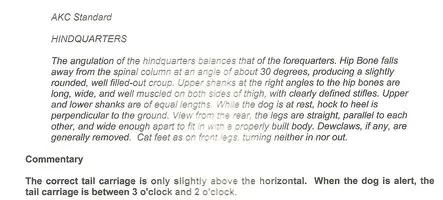
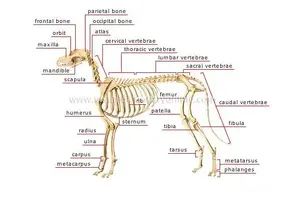
The croup is the top blade of the hip bone and determines the tail set - . For example in the dog shown above with a flat topline and flat croup the tail is gay!!! Correct tail set should be at 1 o'clock position not straight up and 2 o'clock when moving approximately. It is the Blade bone that holds the joint and hip socket - the position of that is the croup and how it slants or is positioned determines the croup. I know this is hard to describe when the picture does not label the croup. Hope you can see what I am trying to say. It breaks the spinal column from the tail which is why it influences the tail set.
skeleton-dog.webp

Here I have tried to point to the bone that makes up the croup

skeleton-croup.webp
 

Attachments

  • skeleton-croup.webp
    skeleton-croup.webp
    17.4 KB · Views: 4
I know we're talking American bred Doberman's here but isn't what they call "excessive slope" desirable in the Euros?

I've seen a lot of the high croup in horses and it does throw their balance off.
 
From the FCI standard it calls for a SLIGHT or lightly ascending from the croup. The croup is not the topline. It does not call for an exaggerated slope as that puts way too much pressure on the rear end in working. from the FCI standard:

Withers Well pronounced especially in males. The height and length are determinant for the dorsal top line that is lightly ascending starting from the croup.
Back (dorsal region)
The back is firm, strong and of proportionate length covered with well developed muscles.
Loins Of good length and well covered with muscles. In the females the loins can be a little longer to allow room for the breast.

Croup A hardly perceptible inclination, starting from the sacrum to the tail root. The croup appears well rounded with a good width and covered with strong muscles. From a top line view it should not be either perfectly straight or noticeably inclined. From the top it calls for balance not straight and not noticeably inclined.

Chest and ThoraxThe height and the depth of the thorax must be well proportionated to the withers' height and to the length of the body. The ribs are lightly curved so that the thorax height is almost equal to half of the withers' height. The chest is of a good width with an especially developed fore chest.

Underline Starting from the sternum's posterior edge and arriving to the pelvis the ventral line of the abdomen is well tacked in. Notice it calls for a nice tuck up yet many of the Euros are more straight across.

Tail The tail is highly set and docked short so that 2 caudal vertebrae are still visible. In those countries where docking is illegal the tail may remain intact.
 
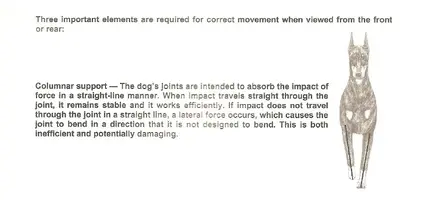
Gate from the front: In a working breed balance, structure and movement are critical to the overall ability of the dog to work in balance in running on the attack, coordination on the attack and in holding on in the fight which is why we have a longer muzzle than the Rottweiler for example. Everything about our breed was designed to provide optimum performance in a hand to hand combat with man. You do not want a dog that trips over its own feet.
DP Front Gate.webp


DP Front Gate2.webp
 
Rib spring:

If you go back and look at the pictures from the top looking down on the back you can see good examples of rib spring - It is important because it means the dog has room for all the vital organs so they are not cramped or restricted.

DP Rib Spring.webp
 
Neck Tie into shoulders:
View attachment 37048
Haven't read the standard for years. Have to say I'm surprised by the hip description. It says the hips should be broad and about equal in width the the rib cage and shoulders.

Back when I had my first Dobe, a BYB (but an extraordinary Dobe!) I observed that his hip assembly was larger and wider than what I saw in the show ring. I surmised that my boy was probably more powerful back there than those Dobes I saw with the narrow hips.

Yes, he was plenty strong. Example: He loved to pull so much that one day I let him pull me on my Harley Sportster from a dead stop up to 14 miles per hour. I've got Polaroids.

Enter my next Dobe from working lines. He had narrower hips, though maybe not as narrow as I sometimes see. Well, believe it or not, I found him to be not just as strong, but stronger than, my previous Dobe – and this at the age of 6 months!

So I now have less doubt of the strength of what I perceive as a "narrow-hipped" Doberman.

But I am still surprised that the standard calls for the width to be the same as that of the rib cage and shoulders. That seems pretty wide.
 
I would use great caution if you are getting a 6 month old to pull anything with weight. Bones, joints, muscle, tendons and growth plates are not closed or mature yet. If I misread I apologize.

When you set a dog up the back legs should be set just outside the front legs (wider) When you drop a plum line down from the hip bone it should drop down to the front of the toe. Just as a plum line dropped from the shoulder should touch the front of the toe on the front legs.

If the dog is too wide they loose strength and drive same as if too narrow. The drive comes from the rear end so too much width will defuse the drive and too little will crimp the drive. Because the Doberman is to be a very balanced dog if the width of the rib cage and shoulders are equal in width then the dog needs that width to balance the back end and have the strength necessary to drive the load of the front end. Balance balance balance - the Doberman is all about symmetrical balance in both temperament and conformation.
 
. For example in the dog shown above with a flat topline and flat croup the tail is gay!!!

I'm asking because I don't know.
In automotive speak ignition timing can be advanced or retarded to adjust to optimal.
Is "gay" a term used in dog language to describe tail set?
 
Yes - it applies to nothing else in this case but gay tail set. I did not name it and afraid to ask where it came from or if it is a reference to anything else - ROFLOL

The correct tail set should stand at the 1 o'clock position not straight up in the air.
 
I just got back from the show. For lack of a better term, I saw a lot of Collie heads. I saw several with domed back skulls and low earsets.

I understand the concern about the lower jaw as well. I've heard of many picky eaters and now I'm wondering if any of that is related to the muzzle shape and small incisors. It's hard to pick up kibble if your teeth are tiny and set back.

I'd love to compare notes on the red Russian dog. The Serbian was a no show yesterday. The working class dog is very nice.
Again I am no expert, but only as a comment and being a dentist, got to say that it's the size of the jaw which determines the size and number of the teeth just like in humans some people hasn't third molars or lateral incisors, some times they just don't have it or they do not erupt and usually is related to the size of the maxilla and jaw. So my theory is that some breeders are making dogs with small muzzles and therefore the dogs has less teeth and shorter teeth.

Also here in my country a lot of the dobermans I have seen shows has tiny muzzles and are tiny dogs in general, it is like a tendency or something... I promise I'll post pictures next time
 
Yes it is directly related to the size of the jaw and that is why we are loosing both size of teeth because way too many lack a strong under jaw. But we have to remember breeding is a balancing act. Since herding breeds were used we have the throwbacks that pop up every now and again.

You can not breed successfully to maintain an entire standard if you only breed for one thing.
 
You can not breed successfully to maintain an entire standard if you only breed for one thing.
Same can be said if you put to much emphises on the big picture.. Its imperative to know not only your dogs strengths but it might be more important to know their weaknesses. You breed the total Doberman by focusing on your foundation (assuming its good) and build from its faults.
 
And that is exactly why I work, train and show my dogs to learn their real strengths and weaknesses. I want to understand every single word in the standard and then how it applies back to the flesh and blood dog standing in front of me. I would prefer more emphasis be put on the big picture than just one facet if it were up to me!!! At least the big picture involves MORE of the total dog.

For a working breed we should not have a glaring division between Bred for conformation and bred for working. It splits the dog in half. JMHO
 
For a working breed we should not have a glaring division between Bred for conformation and bred for working. It splits the dog in half. JMHO
Unfortunately that's not just a problem for Dobermans or exclusive to working breeds. This is another corner breeders have painted themselves in to. I just dont think anyone person has the time, money or energy to breed the total package.. Those that try are ridiculed by their own peers. These are the same people that say it cant be done, etc.. Its certain the consumer wants the total doberman with perfect conformation and workability that puts a Belgian Malinois to shame but even working breeders find it difficult to match the kind of intensity a Mal brings to the table. I think the best way to breed a conformationally sound hardcore working Dobermann is to network with other breeders. Possibly mating Working Females with Show Studs for multiple generations.. (I dunno just thinking out loud now) New problem most breeders refuse to share a spotlight.. Our programs are our programs..

If you have never seen a doberman or a picture and tried to draw a picture based on the written standard alone we would all likely come up with something very different however there is also no doubt we would all find similarities in our renditions. Point being is we all interpret the standard in our own ways.. No ten people are going to think the same single dog represents the standard best.. they also would likely have at least a half dozen different opinions..
 
No ten people are going to think the same single dog represents the standard best.. they also would likely have at least a half dozen different opinions..


Probably more like 10 different opinions. I found that out first hand. I have taken my dog as well as 2 of D4E's dogs in the ring. It's like anything, people key in on what they like and ignore what they don't. If they dislike something enough, they tend to make it bigger than it is. Which is why I will always do this for fun. I know people that will only show their dog under certain judges because they know what the judges likes. Where's the value in that?
 
Where's the value in that?
Depends.. Lots of value in that kind of knowledge when its a piece of your livelihood. no value what so ever if your there to blow a weekend with your dogs and good friends. Although im with you.. If and when i do compete my dogs again. (Been Years) we will do it for the experiences not notoriety. lol i wont lie though ill take the accolades to. :)
 
Here is the picture of the ideal dog - I was going to post it at the end but will post it now also.
View attachment 37187
Please pardon the interruption, way out of league here.

Newbie question and observation. Whose Doberman Standard is depicted in the image? (American, European, Doberman Organization) Seeing that image after seeing many photos (with comments) in various threads rules out any American styled Doberman. Is this a correct assumption? Assuming here, that American style is taller and leaner than European.

This thread has shown just how near impossible to breed dogs and achieve the "perfect" image. One in 1/2 a million? Won't be able to see a Doberman again without looking for standard features even tho my pleasure is in a dogs temperament.
 

Back
Top