Weekend Clinic - with Christian Gomez

I'd get a dogjoring harness designed for that like from "non-stop dogwear" and not a leather harness with a big breastplate that is often used in protection. @remy would have more feedback on the dogjoring harnesses!
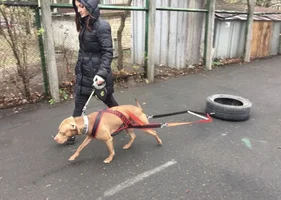
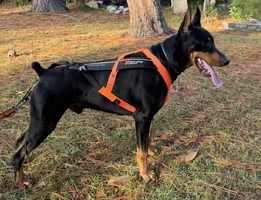
@BGpa For trotting alongside the bike I use a regular y-front harness, as there is no pulling involved. For bikejoring I use the Free Motion 5.0 harness from Non-stop Dogwear. I believe Remy’s is a size 7. It’s very important to use a harness designed for pulling when bikejoring! Also, I think I saw weight pull mentioned when I skimmed the comments, so I wanted to say that it’s not recommended to use a bikejoring harness for weight pull (and vice versa). Weight pull harnesses have longer straps and typically a bar also.

Here’s a picture of a weight pull harness. IMG_8648.webp Remy in his bikejoring harness. (The orange part with the carabiner is the bungee leash that is attached to the bike.) You can see how much further the side straps extend past the body on the weight pull harness.IMG_8649.webp
 
How we trained years ago was through compulsion. How I trained GSDs has no bearing on how I train my dogs today. Different methods, different breeds, different motivating drives and levels thereof.

Real quick, logic:
It's not considered a good idea to use pain when building drive, especially so in a young or inexperienced dog.

Using a prong collar for agitation is called 'spiking drive', the pressure intended to move the dog into fight drive to get a full bite. If you have any logic and reasoning you will see that using a prong collar for any other purpose, in training, for correction, etc. is not going to work as intended because you have conditioned the dog to ignore the prong pressure on the neck, to amp up into fight when pressure is applied, to push forward and it will be rewarded for doing so. Think about what you are teaching the dog to do in response to the stimulus and pressure.

If restraining the dog with agitation harness and agitation collar is not enough, you will want to work on building drive in the dog, and there are many honest ways to do this, through toys, tugs, possession games, etc.

Some dogs(maybe most) lack the drive necessary for competitive IGP. However, resorting to spiking drive through pain with either an e-collar or prong collar in a companion dog doing IGP for a fun outlet is not only irresponsible but completely asinine.

Cautionary advice: Be careful of the training techniques that you experiment with, as you can easily do more harm than good. Try to think things through before doing or following someone else's training techniques and style, and how that might have repercussions in your situation and the bond with your dog. The bond and trust I have with my dogs is paramount in how I train today. That's all I'm going to say.

I have zero interest in participating in IGP with my Doberman. Zero, even if I had access to a club, which I don't. I use Ivan Balabanov's methods for training today. In the 70's, my trainer was the famous (or infamous) Bill Koehler, worlds apart. Doberman doing IGP, to me, as with BRT, not a good fit, like trying to push a square peg through a round hole.
 
I think I saw weight pull mentioned when I skimmed the comments, so I wanted to say that it’s not recommended to use a bikejoring harness for weight pull (and vice versa). Weight pull harnesses have longer straps and typically a bar also.
Our weight pull instructor was explaining the differences too and how important it is to use the right harness for each different thing you are doing.
I bought a regular Julius K9 harness for nosework but the instructor for that class said a flat collar will work too and long as it's something you only use for nosework so they associate it with "time to sniff".
 
Doberman doing IGP, to me, as with BRT, not a good fit, like trying to push a square peg through a round hole.
A rare experienced opinion from someone with both herding and terrier breed insight, that is highly valuable.
I keep returning to this hunch the multi breed history of the doberman invites deeper discussion on drives in combination, and the challenge to apply deep insights from single breed experts.
I have zero interest in participating in IGP with my Doberman. Zero, even if I had access to a club, which I don't. I use Ivan Balabanov's methods for training today.
The bond and trust I have with my dogs is paramount in how I train today. That's all I'm going to say.

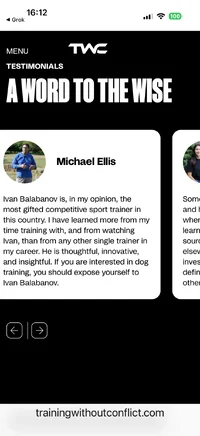
@MikeP has recommended Balabanov elsewhere, and like Ellis, one has to bow in deep respect for the accomplishments of two world class legends.
Two thoughts:
1.Ellis now runs a train the trainer school. He talks about how its not enough to be a great trainer of dogs, that one must become a great communicator and trainer of the humans.
2. Balabanov is more esoteric, and I've struggled with his convoluted discussions on youtube, that seemed at the time more philosophical debate between two senseis...so until now, have concluded its like a white belt listening in...
much more hands on to be done first.

And that brings me back to @Ravenbird who is much further ahead on that IGP path, and her example of the rewards for doing so, with the challenges in time and cost to get to that hands on training.

I'm weighing that on next dog, function, commitment required, extracting what works from one trainer, and weighing against other takes.

The part about "bond and trust" also speaks to me, in some of the same way as in horses.
Nods to the Many here who know way more about that but its clearly an thing in this breed.

I won't ask more but I think I get it, and look forward to more stories on Rollo, including if you can, Balabanov tricks and tips without specifically saying so...dont give away the recipe on the secret sauce, just how your cooking is worrking? 😉

thank you, @Nordika again for the detailed reply.
 
Last edited:
@BGpa For trotting alongside the bike I use a regular y-front harness, as there is no pulling involved. For bikejoring I use the Free Motion 5.0 harness from Non-stop Dogwear. I believe Remy’s is a size 7. It’s very important to use a harness designed for pulling when bikejoring! Also, I think I saw weight pull mentioned when I skimmed the comments, so I wanted to say that it’s not recommended to use a bikejoring harness for weight pull (and vice versa). Weight pull harnesses have longer straps and typically a bar also.

Here’s a picture of a weight pull harness. View attachment 163434 Remy in his bikejoring harness. (The orange part with the carabiner is the bungee leash that is attached to the bike.) You can see how much further the side straps extend past the body on the weight pull harness.View attachment 163435
Thank you!
 
Our weight pull instructor was explaining the differences too and how important it is to use the right harness for each different thing you are doing.
I bought a regular Julius K9 harness for nosework but the instructor for that class said a flat collar will work too and long as it's something you only use for nosework so they associate it with "time to sniff".
Thank you!
 
I don't do any bite sports work with any of my dogs. It's not that I am not interested in it, and I really respect the people who have chosen to do it, and do it correctly, it's just that I haven't found it close to me, and admittedly, I am not searching it out. So I can't help you with any equipment selection. I could help with a show lead, or what you might want before trying precision coursing. My next purchase I think will be a wide, well-built collar with a handle on it for the PC competitions. I think that would help at the holding line. But PC trials are show up when you can and they take you and your'e done in 5 minutes (in my experience so far), so it won't be a fourth collar for her to wear at once to stir up any controversy about whether my dog "looks" like it's out of control or not.
Thank you!
I'm probably at the same place now, on IGP, for next dog...so the other fun stuff that fits the dobe is likely next: Fast Cat, PC, Nosework, etc...depends on the dog, which circles back to what can I sustain, and what I need for the useful life of the dog...
At my biblical 3 score and ten...🤨
 
Kevin ….the assessment of Bonnie being a “runner” at 10 months might have been premature depending on the level of pressure applied to incite —>defence —>fight or avoidance. In the absence of a foundation of prey drive developed through motivational play and a development of confidence as the win game of tug and +Reinforcement then in a situation where a 'green' pup is exposed to innocent threat (as viewed from the human perspective) then yes it most likely will run. No escape Table training comes to mind.

I'll take the liberty to offer a unsolicited advice and link to Marko Koskensalo and Sarah Prelle CanEmo site // GET TRAINING | Canemo Dog Training and the free in-depth learning videos — of which BTW I am an advocate of their measures — for the sole purpose of the preliminary steps required along your journey to the world of dog sport with a prospective new recruit. I strongly advise and encourage to take the time to follow through on EACH of the series of free vids. The 'catch' to the freebie highly invaluable and entertaining duo's content is a once only view and therefore an impatient scroll through advances to the next series of videos. Therefore taking the time and dedication to store into the warehouse of useful knowledge the training principles for optimal results will pay huge dividends down the line. Create a 'no pressure' account — other than an email now and then — enables access.


The IGP agitation harness also doubles as a tracking harness is available through Fordogtrainers. The explicit purpose such harness is to message the dog once it is strapped on is that 'it's now game on' in the sense it’s now time to 'work'. Hopefully then extrapolate from that, then it’s not what you want for dual purpose such as bike- jouring with the same dog (your new pending recruit) concurrent with IGP and bitework. For Bonnie she would look impressive suited in one, yet you might get a few cursory rude glances with onlookers eyeballs rolled up. Underline impressive IYKWIM if you walk or bike the streets of big city USA after dark. Odds are a thousand to one neither you nor Bonnie will encounter anything other than that skunk tormenting Bonnie nightly. Lastly, the sturdy authentic 100 bucks a pop all purpose Julius brand is what I use for the laid back leg weary purposes such as bike-jouring and trailing and tracking scent work in hometown big city as the suitable modus operandi during the current trajectory of the sunset of life.🥸

In the common bond of Dobermans/Dobermanns ……Mikel
Thanks @MikeP !
CANEMO, bookmarked and saved for careful note taking, in order.

Also the harness tips.

Hows the bike rig working for ya?
Pics?
 
If you have any logic and reasoning you will see that using a prong collar for any other purpose, in training, for correction, etc. is not going to work as intended because you have conditioned the dog to ignore the prong pressure on the neck, to amp up into fight when pressure is applied, to push forward and it will be rewarded for doing so. Think about what you are teaching the dog to do in response to the stimulus and pressure.
Every dog might have different results, but it never changed anything on my dogs response to the use of the collar in other situations. As I was saying about equipment being indicative to the job ahead, but also being very savvy to the picture in front of her, she knows that walking downtown on a busy sidewalk is no place to be leaning into the prong color, but if a decoy is teasing with the sleeve then that's a different picture. I also mentioned that this dog is pretty insensitive to pressure and she knows when she's invited to play hard.

The bond and trust I have with my dogs is paramount in how I train today.
Same here. I would pack up and leave if my dog was not having a good time, but the highlight of her life was training, whether it was ob or tracking or protection, she literally would shove her head into any collar to get out and go do. We did club for a little over a year I think, then just went to AKC obedience and scent work, with a few trips to do a weekend of bite work with a guest helper at the club, just so she could have fun.
She's now 7 and we're down to just scent work for trialing, and hiking a little in the forest where I live.

Doberman doing IGP, to me, as with BRT, not a good fit, like trying to push a square peg through a round hole.
Depends on the Doberman, just like not all GSDs are made for it. The ones I've seen that are successful at IGP thrive on it. Others love tracking and obedience but just can't take the pressure of the protection phase or have the drive to enjoy it. The few that I know that do ring sport and PSA, the dogs look like they are having the time of their lives, they love the challenge.
I do agree, sadly, most Dobermans are not cut out for it and no dog of any breed should be doing protection sports if they don't love it.

I also totally agree with your statement about being careful about trying new things and the people you have to trust to decoy/train your dog in IGP, things can backfire in a hurry. I was very aware of that and was hyper-alert to many in the working dog circles just not liking Dobermans. A couple of years ago I went to a helper day at a club and we had a good time, but I didn't like the roughness of the decoy. Asha didn't care, but I wouldn't ever go back. A friend had invited me to come, that the club was trying to get a new guy but he needed more dogs to make the trip, so I said OK, it'll be fun for Asha. And it was, but I knew I'd never bring her back for a fun day if that decoy was there.
 
A rare experienced opinion from someone with both herding and terrier breed insight, that is highly valuable.
I keep returning to this hunch the multi breed history of the doberman invites deeper discussion on drives in combination, and the challenge to apply deep insights from single breed experts.


@MikeP has recommended Balabanov elsewhere, and like Ellis, one has to bow in deep respect for the accomplishments of two world class legends.
Two thoughts:
1.Ellis now runs a train the trainer school. He talks about how its not enough to be a great trainer of dogs, that one must become a great communicator and trainer of the humans.
2. Balabanov is more esoteric, and I've struggled with his convoluted discussions on youtube, that seemed at the time more philosophical debate between two senseis...so until now, have concluded its like a white belt listening in...
much more hands on to be done first.

And that brings me back to @Ravenbird who is much further ahead on that IGP path, and her example of the rewards for doing so, with the challenges in time and cost to get to that hands on training.

I'm weighing that on next dog, function, commitment required, extracting what works from one trainer, and weighing against other takes.

The part about "bond and trust" also speaks to me, in some of the same way as in horses.
Nods to the Many here who know way more about that but its clearly an thing in this breed.

I won't ask more but I think I get it, and look forward to more stories on Rollo, including if you can, Balabanov tricks and tips without specifically saying so...dont give away the recipe on the secret sauce, just how your cooking is worrking? 😉

thank you, @Nordika again for the detailed reply.
First, I would say it may be beneficial to you to listen to this intro to understand that Ivan has a unique approach to training and I think here he is easy to understand.

If you really want to understand and apply the concepts when training your dog(s) then I'd suggest the Training without Conflict Practitioner Certification, mainly because it's the whole package of Ivan's knowledge, expertise and experience. It's not cheap, but it really is worth so much more, priceless. It's applicable to any dog, any breed, and any purpose.


The future breed for me will most likely be the German Pinscher as they have all the qualities that I like in a slightly smaller dog, aka medium size dog, with good health and longevity that I would like to downsize to, and related to my two favorite breeds, Schnauzers and Dobermans.

Life is short, enjoy the relationships you build.
 
First, I would say it may be beneficial to you to listen to this intro to understand that Ivan has a unique approach to training and I think here he is easy to understand.

If you really want to understand and apply the concepts when training your dog(s) then I'd suggest the Training without Conflict Practitioner Certification, mainly because it's the whole package of Ivan's knowledge, expertise and experience. It's not cheap, but it really is worth so much more, priceless. It's applicable to any dog, any breed, and any purpose.


The future breed for me will most likely be the German Pinscher as they have all the qualities that I like in a slightly smaller dog, aka medium size dog, with good health and longevity that I would like to downsize to, and related to my two favorite breeds, Schnauzers and Dobermans.

Life is short, enjoy the relationships you build.
Thanks @Nordika, exactly what I hoped to get.
 

Attachments

  • IMG_2082.webp
    IMG_2082.webp
    90.8 KB · Views: 1
  • IMG_2083.webp
    IMG_2083.webp
    83.3 KB · Views: 1

Back
Top