

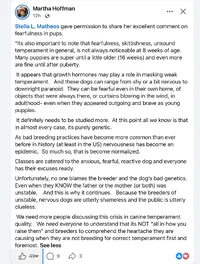
This is a current topic on Martha Hoffmans FB page. She studies dog behavior and trains service dogs, specializing in dogs that come from shelters. The comments and her conversation with the comments are just as enlightening. I agree with her 100% that you can help fearful dogs but deep down you will never erase that flaw completely. For those who aren't familiar with her, she lives in Bali and has been studying the behavior of Street Dogs for years. These dogs have homes but roam the streets and are basically shared and loved by the people and the dogs have distinct personalities and hierarchies in their packs. Too much to try to describe here, but these thoughts (of several on fearful dogs) are worth the read.
I appreciate that fearfulness and reactivity are grouped together because both just different approaches by the dog to deal with "normal" things by over-reacting.
Interesting stuff, if you're into this kind of thing.
**********************
Breeders who are inexperienced or just trying to make money, think a dog that was fearful as a pup, that they carefully with great effort, raised and socialized and were able to get it to act almost normal, is suitable for breeding. It is not.
The most telling remark: "OH, the dog doesn't have a Championship because it doesn't like to show".
Dog shows are an important temperament test. A dog that loves showing and show situations probably has a non-fearful temperament. At least it should be tolerant and relaxed at a show.
I study the primitive Bali Heritage Dogs and have watched many litters develop with not much human interference beyond owners or neighbors feeding them. The moms have superb maternal instincts and often raise a litter by themselves on their first estrus.
Fearfulness beyond the normal cautiousness of the breed/landrace is something I often observe at 5 weeks. The pup almost always remains very fearful as an adult. Many litters have a mix of very social and confident siblings and very fearful.
Following many litters to several months old or to adulthood, I have seen pairs that grew up on the same lane with same owner or adopted by neighbors, or as unowned dogs, often living with their mother.
The fearful stay fearful. The bold stay bold, with both types showing caution learned through bad experiences.
The dams influence pups by alarm barking at any danger. Pups at about 5 weeks instinctively run for the nest or den or any dark place to hide when they hear the Huff or alarm bark. They do not need to be aware of the situation that caused the dam to alarm bark and Huff.
In the next few weeks, the pups start associating whatever was going on when the dam barked, with danger. Then they start avoiding me as I observe them.
This is why I never want a pup from a fearful mother.
And yet, in a litter, there are pups who panic and run when the dam barks an alarm, and there also might be pups who ignore her signals and continue playing or run up to greet me and get treats. These are confident and and do not heed mom's warnings much.
Fearfulness is the number one cause of failure in Service, Guide and Hearing Dog programs: Steve Grunow's Ph.D thesis gathering statistics from many programs.
That is why Guide Dog programs rigorously screen out fearful dogs from breeding stock. And the pups they produce often have such good temperaments that they never go through a fear period, or just get a little hesitant for a few weeks.
Most Malinois are the opposite of sound fearful. They have been selected for at least 100 years for positive attraction to loud sounds, often with some aggressive excitement.
The well-bred are usually not fearful. They can be taught to ignore sounds and be neutral, as required in IGP and Ringsports during obedience and temperament testing.
But the Ringsports have exercises where the dog must charge and bite while the decoy fires 9mm blanks. Those are really loud!
Many Malinois will charge at loud sounds. Again, no fear component. Although, badly bred Malinois can be very fearful.
Martha Hoffman
I appreciate that fearfulness and reactivity are grouped together because both just different approaches by the dog to deal with "normal" things by over-reacting.
Interesting stuff, if you're into this kind of thing.
**********************
Breeders who are inexperienced or just trying to make money, think a dog that was fearful as a pup, that they carefully with great effort, raised and socialized and were able to get it to act almost normal, is suitable for breeding. It is not.
The most telling remark: "OH, the dog doesn't have a Championship because it doesn't like to show".
Dog shows are an important temperament test. A dog that loves showing and show situations probably has a non-fearful temperament. At least it should be tolerant and relaxed at a show.
I study the primitive Bali Heritage Dogs and have watched many litters develop with not much human interference beyond owners or neighbors feeding them. The moms have superb maternal instincts and often raise a litter by themselves on their first estrus.
Fearfulness beyond the normal cautiousness of the breed/landrace is something I often observe at 5 weeks. The pup almost always remains very fearful as an adult. Many litters have a mix of very social and confident siblings and very fearful.
Following many litters to several months old or to adulthood, I have seen pairs that grew up on the same lane with same owner or adopted by neighbors, or as unowned dogs, often living with their mother.
The fearful stay fearful. The bold stay bold, with both types showing caution learned through bad experiences.
The dams influence pups by alarm barking at any danger. Pups at about 5 weeks instinctively run for the nest or den or any dark place to hide when they hear the Huff or alarm bark. They do not need to be aware of the situation that caused the dam to alarm bark and Huff.
In the next few weeks, the pups start associating whatever was going on when the dam barked, with danger. Then they start avoiding me as I observe them.
This is why I never want a pup from a fearful mother.
And yet, in a litter, there are pups who panic and run when the dam barks an alarm, and there also might be pups who ignore her signals and continue playing or run up to greet me and get treats. These are confident and and do not heed mom's warnings much.
Fearfulness is the number one cause of failure in Service, Guide and Hearing Dog programs: Steve Grunow's Ph.D thesis gathering statistics from many programs.
That is why Guide Dog programs rigorously screen out fearful dogs from breeding stock. And the pups they produce often have such good temperaments that they never go through a fear period, or just get a little hesitant for a few weeks.
Most Malinois are the opposite of sound fearful. They have been selected for at least 100 years for positive attraction to loud sounds, often with some aggressive excitement.
The well-bred are usually not fearful. They can be taught to ignore sounds and be neutral, as required in IGP and Ringsports during obedience and temperament testing.
But the Ringsports have exercises where the dog must charge and bite while the decoy fires 9mm blanks. Those are really loud!
Many Malinois will charge at loud sounds. Again, no fear component. Although, badly bred Malinois can be very fearful.
Martha Hoffman


