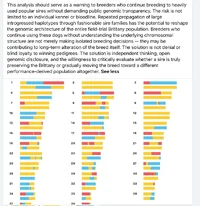
Is the doberman doomed?

And speaking of why it's so very difficult to get more diversity in the Doberman, I read once that Muck von Brunia (green line in the above pedigree) is in about 90% of every Dobermans pedigree. So go on Dobequest and keep going backward on your own dogs pedigree starting with the tail male (very top line) sire line to the 1920's. I did this and found Muck down almost every male line in the whole pedigree. That was years ago, may have even been my 1990's dog, before I got Asha... Time consuming, but eye opening. All roads lead to Muck.
 
And speaking of why it's so very difficult to get more diversity in the Doberman, I read once that Muck von Brunia (green line in the above pedigree) is in about 90% of every Dobermans pedigree. So go on Dobequest and keep going backward on your own dogs pedigree starting with the tail male (very top line) sire line to the 1920's. I did this and found Muck down almost every male line in the whole pedigree. That was years ago, may have even been my 1990's dog, before I got Asha... Time consuming, but eye opening. All roads lead to Muck.
Not sure what that dog died from, but that dog was 13 when he died. Not bad at least by today's standards. Maybe not so much for the 1930s.

I can't remember off the top of my head who the 7 sires were, or whether they had Muck behind them.
 
He was a great dog, for sure. The point was that this is one of the reasons that the relatedness of Dobermans can't be avoided. Even the best dogs can still be used too much, as later down the pike you can't get away from it as it's in every pedigree. I'll double check on the 7 sires, but bet they all go back to him.
 
And speaking of why it's so very difficult to get more diversity in the Doberman, I read once that Muck von Brunia (green line in the above pedigree) is in about 90% of every Dobermans pedigree. So go on Dobequest and keep going backward on your own dogs pedigree starting with the tail male (very top line) sire line to the 1920's. I did this and found Muck down almost every male line in the whole pedigree. That was years ago, may have even been my 1990's dog, before I got Asha... Time consuming, but eye opening. All roads lead to Muck.
Very interesting. There was a poster here or at the other forum, and at reddit named "@kaloric" who like you, @Ravenbird rued the narrowing of diversity due to "Popular Sire" syndrome, naming "Eddie" as another example, iirc.

Thanks for the Pedigree.com reminder; colors highlighting makes it easier for a visual learner to "see" the pattern.

I have a lot of work to do understanding how to parse these databanks. It would be interesting to somehow integrate them, or automate to cross reference the data siloed in each, maybe by AI? And color code a view format

so one could "see" some lines absent in others, and how that pattern shows up in data of dogs as it crosses oceans, etc.

From that DPCA article:
"
Quote from an old book entitled The Doberman Pinscher by Milo Denlinger 1953:

“Three of the famous 7 died as a result of heart attacks. Domossi at age of 7, Emperor at age 8, and Alcor shortly before his 10th birthday. Uranus, Rameses, & Favoriet lived to the age of 10. Illena was still alive at this writing at the age of 12.


“The year 1941 was the golden year of the American Doberman. That year alone gave birth to Illena and the younger four of the Seven Sires: Emperor and Favoriet in the spring, and Alcor and Dictator in the fall, the latter two within a day of each other. All of the five were sired by the older three except Dictator, who was Domossi’s younger brother. Rameses, the oldest was whelped in 1938, Domossi and Uranus in 1939. THREE OF THE FAMOUS SEVEN DIED AS A RESULT OF HEART ATTACKS:

  • Domossi, at the age of 7
  • Emperor, at the age of 8
  • Alcor shortly before his tenth birthday.
  • Uranus, Rameses and Favoriet lived to the age of ten."
So, bottomline it for me- what do you look for to avoid very inbred lines, and how,

To primarily weight health/screen for as little DCM as COD, plus longevity?

I personally would give up on perfect head, or swan neck, or best record in IGP if I had to for longer healthy life...

That may not be rewarded in the show ring or working trials...but may be the preference of a type of buyer thats worth developing a new breeder developing a line towards, correct?

 
Last edited:
So, bottomline it for me- what do you look for to avoid very inbred lines, and how,

To primarily weight health/screen for as little DCM as COD, plus longevity?
I've narrowed it down to longevity in the pedigree, period. No matter if it is cancer, DCM, bloat, accident, I don't care. COD cancer at age 7 is not any better than getting DCM at age 7. And not just the sire/dams, but the siblings of those. Knowledge is power. Perhaps inbreeding of dogs that live to 13 would be good, but most males are not collected and most females have their last litter by age 7, so we've automatically eliminated "most" breedings to long-lived dogs.

The worst thing is, is so many BYB dogs are AKC, but not in Dobequest database, and how many are not even registered? If Dobequest is lacking 50% of the dogs how do we even know if they aren't out living the ones that are on Dobequest? If they aren't in the database, the database is completely inaccurate by percentage.
 
Then the extinction of the species (as they define it) is on them if it happens. I hope not, but if they're going to be fussy about it... Do they not understand what's at stake? Goodness, even the UK Royal family started accepting "outsiders" to keep the genetics viable.
ISWYDT...🤣
I was just reading the tea leaves on the Kings visit to the US and DailyMail reporting on Prince William and family. My guess is the handoff is coming soon.
 
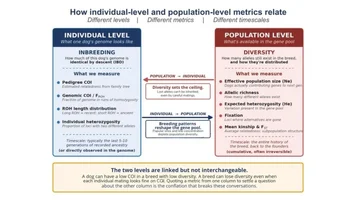
I sometimes get lost on understanding all the science of breeding for diversity but this written explain and a very visual color-coded graph lit my dim lightbulb. This is what you get and learn to understand in the UCDavis program and how you can plan a more diverse mating. Simplified, you'd look at your bitches "color chart" and find a sire with as many differences as possible, then look at his picture (LOL). I agree, there are some that I'd have to pass on no matter what. But if a breeder is serious about improving diversity, you have to be in it for the long run. Whether breeding for the show ring or bite sports, you can breed back what you lost fairly quickly with more robust dogs who have few health problems.

As an after-thought, if one is committed, you'd be in the program, find a dog you'd love to breed to and ask if they would put that gorgeous dog in the program so you could evaluate the match together! In other words get more breeders on the bandwagon with you.


Paul Rosevear.webp
 
COI and Diversity.webp

Effective population size was another ligthbulb that lit up for me.

The Doberman was created in a relatively short period of time by basically one man and a very few dogs that he had on hand before the book was closed. 20 - 30 years max? Other breeds, especially hunting types were all being improved and tested over many years, BYB's crossing over with other BYB's dogs that they saw in the field, so essentially was made up of hundreds of dogs from several overlapping populations. So once their book was closed on a breed, it was genetically pretty diverse. Inbreeding or line breeding to tighten up the type was not damaging because the pool was already pretty diverse.

It's a familiar thing to lots of people that the Thoroughbred horse had 3 founding sires, but the kicker is that the mares used were riding horses, hackney fancy ladies horses, wagon horses all as well as some gentleman's cross-country sport horses. And also why there is no "set" type in thoroughbreds.

So all of a sudden I realized exactly why breeding Dobermans of different pedigree lines may not make any difference in their genetics. If you don't use the genetic markers as the key to "mixing it up" it's still going to be the same health crises.
 
Thanks @Ravenbird for this...my lightbulb is glowing weakly but this visual of "genetics" vs "genomics" is a good explanation for me, and I'm so glad to see independent thinking in the hunting breeds where big money demands field performance.

What exact source do you recommend "on the UC Davis program" for further reading.

The genetic science is deep but one by one, by buzzword and unfamiliar scientific term, I'm determined to understand.

Then I can talk intelligently with breeders to determine who is actually using the tools in order to screen down to those breeding (in my view) truly for ethic, responsible preservation of the breed, for health and longevity first,
in addition to good looks, field performance.

I dont pretend to be someone who knows the ins and outs of the fancy or working worlds
- not a trainer, handler, breeder etc...

But I can become an informed consumer and reward with my $$$ the ones who share my values, call it "total doberman" bred to function: calm confident family guardian that thinks for itself, but biddable and highly trainable if done right, as a "man protector".

So thanks again for all the info and patient explanations - including the breeders who share (at risk to the barbs from others who may not agree).

You know who you are; another bow of respect 🙏 and thanks from this dobe noob!
 

Back
Top