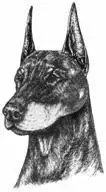
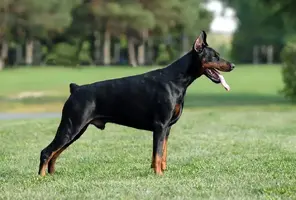
I love reading the illustrated standard. Helps me be able to train my eye!

dpca.org

The Doberman’s head is essential to breed type. There are a few criteria that must be met for the head to conform to the standard. However, it is possible for all of these criteria to be met and still have correct heads that are appreciably different from one another in overall look.
The head must be long (but always in balance with the neck and body) and dry. The term “dry” means that there should be no looseness of skin. As with the body, Dobermans should have tight-fitting skin on the head, with few or no wrinkles when the dogs are fully alert.
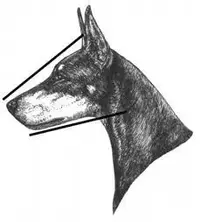
The shape of the head is a blunt wedge that should be apparent when viewed from the front or from the side. The wedge can vary in width. Typically, a heavily-built dog will have more breadth to the head and therefore a wider wedge than a more slightly-built dog, which generally has a narrower wedge. What matters is that the width of the head be in proportion to the dog’s overall conformation.

When approaching the Doberman head on, two flat planes fitting flush with the sides of the head should be visible. The head widens from the nose to the ears in a nearly straight line.
Eyes are almond shaped and dark — the darker, the better. Common faults are light eyes, round eyes, and oblique eyes. Round eyes seem to be much more prevalent than oblique eyes. The Doberman is a protection dog and should have eyes that convey alertness, determination, watchfulness and unmistakable fearlessness. Round eyes can create a soft, gentle appearance that deviates from the Doberman’s ideal appearance. Similarly, light eyes and bird-of-prey eyes are deviations from the standard.
Ears are normally cropped and carried erect. “Normally cropped” means cropped in a normal manner. Normally cropped does not mean “usually cropped.” Cropped ears will always be carried erect on a fully mature Doberman. The upper attachment of the ear to the head should be level with the top of the backskull when the dog is alert. The shape of cropped ears can vary because veterinarians exert their own vision on the final shape.
From his inception, the Doberman has been cropped. It is an essential breed characteristic. Cropped ears impart an appearance of alertness, determination, and watchfulness, and they aid in multi-directional hearing. In our standard, we do not describe an uncropped ear because this is a cropped breed. Dobermans with uncropped ears deviate from the standard twice — first by not having cropped ears, as required by the standard, and second by not having an erect ear carriage.

The top of the skull is flat, as are the cheeks. These surfaces, along with the slight stop, create the impression of planes and angles. Curves can give a softer look to the head, which is contrary to the characteristic appearance of the Doberman.
The muzzle is parallel to the backskull. Although the standard does not address muzzle length, the length of the muzzle should be equal to the length of the backskull. The muzzle is strong and powerful with a fully developed underjaw, which should be clearly apparent when viewing the head in profile. The lips, including the flews, should be tight-fitting.
Prominent frontal arch

Dish Faced

Roman Nose
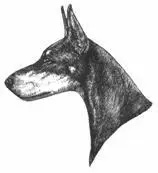
Down face too little stop

Short Coarse Muzzle

Snipey Muzzle

Wet Lippy Muzzle

Ideal

Low ear set

Cheeky