American VS European Doberman

  • Thread starter Thread starter FredC
  • Start date Start date

I think it has to do with the breeder he came from, not necessarily cause he's euro, especially since you said it's wavy? Either way, like DV and Maureen said, it's not like it matters since you won't be showing or breeding your dog...love them regardless and enjoy their wet dober kisses! :)
I agree here. I think there's certain lines that have this longer hair.
 
Having gone outside early in in my breeding I heard that the English have a much longer coat and yes it can be wavy. It usually straightens out by the time they are 6 months to a year old, but still tends to be thicker. There is no a disqualification for coat. These are the preferred and what one should stive for.

AKC
Smooth-haired, short, hard, thick and close lying. Invisible gray undercoat on neck permissible.​

FDI COAT: HAIR The hair is short, hard and thicken It lies tight and smooth and is equally distributed over the whole surface. Undercoat is not allowed.
 
There is no a disqualification for coat. These are the preferred and what one should stive for.

Not exactly true in European ring...
FCI Dobermann standards list below details in Disqualifying Faults section

Coat : White spots; pronounced long and wavy hair; pronounced thin coat or large bald patches.

shorter coat is the preference for judges in european show ring


FCI standard defines coat as
Hair TextureThe hair is short, hard, thick, smooth, shiny, tight and uniformly distributed over the whole body. Undercoat is not allowed.
 
Thanks Iceman I did not even check disqualifications bsed on the AKD only having a disqualification for teeth but we don't have the longer wavey hair here . Does Europe have a big problem with the wavey hair??? If so I wonder where it came from? I know my early English litters had longer wavey hair but it went away as they grew and usually by a years was not wavey or excessively long.

I will add that I think we also have to consider that both sides of the continent are have split the dogs into show lines and working lines with it being more pronounced in N/A.. Schutzhind has never been the big thing like it is even today in Europe so American's wanted to produce dogs you could live with. A Euro is most happy working and takes a little more effort. I hate to say it but Americans (THE PEOPLE ) don't want to put a lot into training. Not all but the majority pet owners.

I have found a few good working NA dogs . I believe that part of the problem is also how they are raised.
 
Since this thread is titled "American vs Euro", how does South America fit in to this discussion? I had two dogs with grandparents from South America and the breeder from whom I got Cooper occasionally sends her dogs to South America.
 
Ob I too have a little SA in my pedigree and like the English dogs you do not see a focus on working, but primarily on showing. I have seen some nice drives in SA dogs. So it is anyones guess as to how that would play out. They did bring some nice things to the table - Bigger teeth for one which is a problem in NA dogs that we needed to improve and a little more underjaw. While a little unbalanced in structure when bred to NA bitches they seem to produce more moderation. They do tend to pace or paddle which I hate!!! But when crossed correctly you can get some good things and hopefully miss some of the things you would prefer to miss.
 
Thanks Iceman I did not even check disqualifications bsed on the AKD only having a disqualification for teeth but we don't have the longer wavey hair here . Does Europe have a big problem with the wavey hair??? If so I wonder where it came from? I know my early English litters had longer wavey hair but it went away as they grew and usually by a years was not wavey or excessively long.

I will add that I think we also have to consider that both sides of the continent are have split the dogs into show lines and working lines with it being more pronounced in N/A.. Schutzhind has never been the big thing like it is even today in Europe so American's wanted to produce dogs you could live with. A Euro is most happy working and takes a little more effort. I hate to say it but Americans (THE PEOPLE ) don't want to put a lot into training. Not all but the majority pet owners.

I have found a few good working NA dogs . I believe that part of the problem is also how they are raised.

I wouldn't say there is a big problem with long hair in Europe, but it does exist and as i mentioned on my earlier post the judges preference at shows is towards shorter hair..
My Kaiser's coat has very short and thick hair...so short it looks/feels like velvet...
Nika's hair is slightly longer than Kaisers, but still not to the extent of being wavey..
As to why longer hair does exists...I don't have a definate explanation but it could be something to do with certain lines originating from extremely cold countries..(just my personal guess)

I dont know how it works out in the States but we don't tend to split the breed into show & work line in Europe..
Dobermann is classified as a working dog and according to FCI rules, no matter how beautifull it might look in appearence it cannot win the CH title without a working title.
So each and every dobermann who wishes to advance in the ring MUST be capable to obtain a minimum IPO1 working title.

Our dogs love working...the drive to work is in their nature,but providing they get sufficient daily exercise, this doesn't take anything away from their ability to live a family life indoors with us.
 
I wouldn't say there is a big problem with long hair in Europe, but it does exist and as i mentioned on my earlier post the judges preference at shows is towards shorter hair..
My Kaiser's coat has very short and thick hair...so short it looks/feels like velvet...
Nika's hair is slightly longer than Kaisers, but still not to the extent of being wavey..
As to why longer hair does exists...I don't have a definate explanation but it could be something to do with certain lines originating from extremely cold countries..(just my personal guess) dont know how it works out in the States but we don't tend to split the breed into show & work line in Europe..
Dobermann is classified as a working dog and according to FCI rules, no matter how beautifull it might look in appearence it cannot win the CH title without a working title.
So each and every dobermann who wishes to advance in the ring MUST be capable to obtain a minimum IPO1 working title.

Our dogs love working...the drive to work is in their nature,but providing they get sufficient daily exercise, this doesn't take anything away from their ability to live a family life indoors with us.

The longer hair is a genetic throw back to the breeds of origin which is why its a fault if it shows up... The rottwiellers and the Beauceron, the Gordon Sellter which are in there... a 100 years ago, but the genes will always be there since they are the foundation of the breed.
The genes are there and can and do show up every now and then...
Ice:
I am not sure if you personally know any 'European Breeders of working lines", but If you asked the "Working lines" Dobermann breeders in Europe if there is a difference? You will get a definite yes to that question... I have been in on these discussions with them and made the same argument you just made and I was laughed at and scoffed at and I was told I obviously do not know what I am talking about.... IPO 1 is achieved quite easily (according to THESE breeders) and an IPO I means nothing to them... they are working dogs and if the dog is not able to achieve an IPO III more than once? It is not a 'working line'....
so for clarity sake, not all "Europeans Doberman lovers and breeders" AGREE with your statement Ice and the top show dogs like: Altobello are NOT considered working lines and or 'working type" and are not esteemed by the "WORKING lines" breeders and enthusiasts out there as being a working dog...
they think that the show lines are all fluff and have lost their edge, lost their drive and are really just glorified couch potato's..... this is all from the breeders and WORKING line enthusiasts who are out there! and They will tell you that the bigger heavier show line dogs are not what the dog was bred for and not how they are supposed to look.. I hear this every single day in these Groups and I hear if mostly from Norwegian/Swedish/Dutch owners/breeders and its a hotly debated topic wherever you go...
I personally agree with you... but I am not familar with the 'working lines' and breeders that they are referring too and I am not fond of the way the dogs look in the Scandinavian countries where the majority of the argument 'makers' are.
 
Ice: I am only telling you what I have been told... because the differences to the breeders are huge, and if you ask a Show breeder in Europe if they have 'working lines"? they will tell you no.... and the working breeders say the same thing if you ask them if they have "SHOW" Lines.. you get a resounding no...
I asked both varieties and got a "NO" for an answer... so the breeders of working dogs consider their version to be 'what the breed is supposed to be' and not vice versa...
the show breeders say the same thing, the battle goes on with regards to type, appearance and ability...
What FCI designates and what the breeders themselves consider themselves to be may be two different things...
I for one, feel that the breed is the breed and it is a working breed and if one particular dog or line has more 'drive' than another, it is what it is...
so do not shoot the messenger... I am the messenger!
 
If I had thought about it the best way to describe it is close to the Rottie hair and that is most likely where it came from. I would assume the undercoat sometimes on the neck came from the shepherds used. Regardless Herr Dobermann IMHO was a master are creating the perfect breed regardless of where we find them on the planet earth.
 
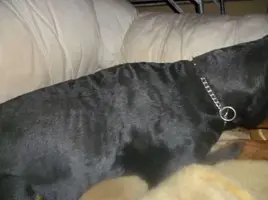
I have a euro question, for all those who have eruo bloodline dogs; rooster has euro blood and your can definitely see it. He is stocky, has a big, filled out head, dark red/rust markings and the 'straight line' body conformation. But theres one that that I havnt seen in any other dobie and it's kind of worrying me. He is 5.5 months, and his hair seems longer than it should be on his back. I thought it was just the puppy coat but it just keeps growing.. It's thickest on the spot between his shoulder blades and is long enough now that it's started to 'wave' (just short of an inch long) I'll post pictures tomorrow on this thread but I'm wondering why his coat is like this? It's shiny and healthy and his head, chest, legs are normal length. I mean it doesnt really matter I guess, I mean it doesn't effect him health wise (actually it probably helps keep him warm) but it looks odd. Our friend has an American dobie (same age) and she has a sleek coat from her nose to tail..

I read recently that the hair on the back that becomes longer and sometimes wavey is because of the Rottweiler in the lines coming out.
 
Here is a pic of his coat:

I don't think he has long hair... or I just don't see it in the picture.
His hair may look shorter when he is mature. His body will grow into his hair :)
Gino had a bit longer hair on his back when he was 6-8 months old. Now his coat looks perfect.

Euros have thicker and a bit longer hair than NA Dobermans.
 
Since this thread is titled "American vs Euro", how does South America fit in to this discussion? I had two dogs with grandparents from South America and the breeder from whom I got Cooper occasionally sends her dogs to South America.

After looking at her pedigree, Ashra is 87.5% Argentinean/SA & 12.5% European lines. I always thought of SA lines as being classified as American lines? I guess I'm wrong?
 
By the way, why is it that whenever people use photos to compare American vs Euro dobermans, the Euro always has its mouth open? It doesn't allow for an accurate comparison.
 

Back
Top