• Disclaimer: Hello Guest, Doberman Chat Forums presents the opinions and material on these pages as a service to its membership and to the general public but does not endorse those materials, nor does it guarantee the accuracy of any opinions or information contained therein. The opinions expressed in the materials are strictly the opinion of the writer and do not represent the opinion of, nor are they endorsed by, Doberman Chat Forums. Health and medical articles are intended as an aid to those seeking health information and are not intended to replace the informed opinion of a qualified Veterinarian.”

Scabs On Nose And Ears? [SOLVED = K9 Pemphigus]

  • Thread starter Thread starter FredC
  • Start date Start date

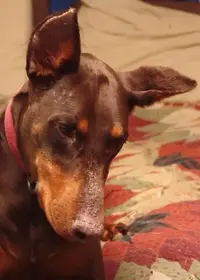
Wow looking back at that picture brought tears to my eyes to think that was a happy he's still with us shot.. he really was a mess and is certainly much healthier but we still have a ways to go before he's 100% and still no closer to knowing what's wrong with him for sure..
Oh I totally understand. Been there a few times now with Archer! It's horribly scary to be in that constant state of worry if your kid is going to be alright.

I know you know this, but a little reiteration never hurts. You're doing all you can for him and you're a great Doberdad. When Archer first became sick and we were going through all the testing our vet thanked us for being such great parents. When I told him thanks and joked about what else I would do, he told me some people would have just put their dog down. I was thinking WTF?!?! Mars is in great hands with you. It's easy to forget that when you're dealing with a problem head on.

Thinking of you two. Continue to keep us posted :)
 
Well i wanted to come back to this and give an update in case someone else finds the information helpful..

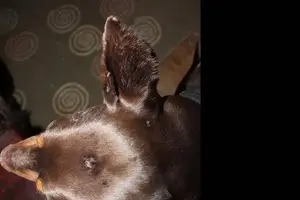
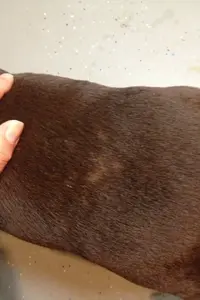
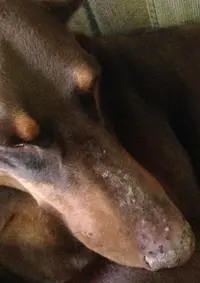
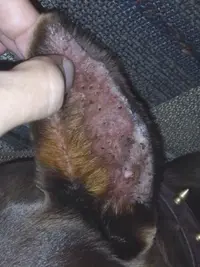
Mars is basically 100% he still has ears full of scabs inside and out and his nose really doesnt look much better then the original picture o posted but he seems physically healthy and active but most importantly his old happy go lucky attitude is back..

Still not entirely sure what we are up against but now leaning towards allergies of some sort.. (Grains Likely, possibly even Chicken) To rule out somethings and systematically figure out what is/was going on i started to reduce the amount of Thyroid medications he was on (.40mg - 5x .8mg tabs daily) until a couple weeks ago when he was taken off the medication entirely with (so far) no negative reactions.

Now we suspect a food allergy of some sort but pinpointing a specific ingredient is very difficult although we persist. Likely a grain. Not sure if its corn or what since for the better part of or year or more hes been eating a Chicken and Rice formula. Although there is corn in the kibble.. We have since switched to a grain free diet that he seems to be doing well on however Kali hates the stuff and refuses to touch it and actually went a full week without eating a single nugget from her bowl So we switched her back to Pro Plan but i really want to find a single kibble that they all thrive on and enjoy eating..

I know he still looks pretty beat up but his spirits are back and thats what counts to me.. Im hoping that its just a matter of it taking so long for him to get so bad that its just taking time to get back to 100%
photo480px.webp
 
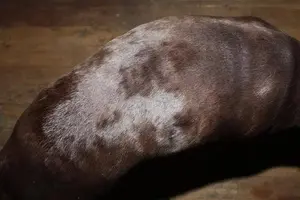
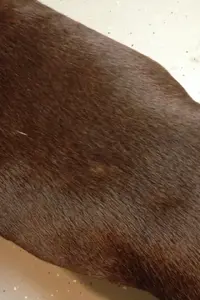
These are from today.. I know he still looks rough but compared to what he looked like last summer he is actually looking fantastic.. We came oh so close to losing him to a fever.. The vet said he wouldn't have made it another day had we not brought him in.. I was actually very lucky because my regular vet who was treating him (for thyroid) was on vacation and i had to take him to our Alt vet, that actually determined he likely did not have a thyroid problem so its possible to .40mg of thyroid medication he was on had a part in almost losing him..
IMG_0123.webp
IMG_0125.webp
 
Looking at it,it does look like a much more severe case of what Daisy went through as a youngster,maybe a year?
It was corn.She still has the scars.image.webp image.webpRecheck the food ingredient list.I just don't do corn or corn gluten.
Check the treats too.You never know,it may be a combination of ingredients he's allergic to.
Why would the food he's on,being a chicken and rice formula have corn?

I know it's expensive as hell,but maybe try the BB lamb and rice we have Daisy on?I switched her cold turkey when we figured it out,she showed major improvement within a week and a half.At that point I was willing to risk and or deal with runny stools as she was just scabby.I was worried about secondary infection,worried about scarring,just :censored:worried in general.
 
-Upon further inspection it seems he has some more of these scabs on his belly..

-the scabs have moved all over his body including the inside of his mouth and pads of his feet

-Im almost certain he is or at least spent the weekend with a fever to.. And last but not least it seems he has fluid in his ears which are also aggravating him to no end

-Its on his belly, ears, nose, eyes, back, etc, etc...

-Turns out he is running a fever of 105 and his entire body is either raw or coated in scabs

Von, going back and requoting details of what Mars is going through (poor guy :(), this really sounds like Canine Pemphigus. There are 4 different types so a biopsy of the mouth lesions and a blood test would have to be done to confirm the type.


Breeds Affected
Pemphigus foliaceus is most common in Akitas, chow chows, dachsunds, bearded collies, Doberman pinschers, schipperkes, Finnish spritzes, and Newfoundland dogs. Pemphigus is most likely in middle-aged dogs (4 years).

Symptoms
Pemphigus disorders cause scaling of the skin, scabs, and pustules with crusting. Early on, lesions are often limited to the head, including the skin near the ears and mouth, and the feet, including the planum and nailbed. As the diseases progress, lesions spread to other parts of the body and blisters form. Blisters in pemphigus can rupture easily, leaving a generalized crusting, and may be hard to detect.

The nose in pemphigus is also susceptible to pigment loss, similar to the changes seen in canine lupus. Other symptoms include fever and loss of appetite. When the foot pads are affected, difficulty in walking may be observed.

Diagnosis
A physical examination reveals the presence of blistering eruptions in pemphigoid disorders. The presence of mouth lesions is highly suggestive of pemphigus. A biopsy of the lesion is necessary for a definitive diagnosis of the subtype.

It’s important to determine the subtype present to determine the prognosis and optimal course of treatment. It’s also important to differentiate pemphigus from discoid lupus erythematosus. Immunohistochemical or direct immunofluorescent testing may also be used to determine desmoglein distribution. An altered distribution is seen in some cases of pemphigus foliaceus.

Blood tests for desmoglein and anti-plakin antibodies can also be used to help diagnose pemphigus.


Treatment
Most cases of pemphigus require the lifelong use of oral corticosteroids, such as prednisone and prednisolone, along with immunosuppressant medications such as azathioprine. Topical corticosteroids and tacrolimus are also used. In cats, chloramphenicol is used in place of azathioprine. After the symptoms are brought into control, the starting dosage can usually be lowered. Because these medications can cause serious side effects, the lowest dose needed to keep symptoms in control is used.

There have been reports of improvement noted with dietary changes, including a raw foods diet. Because sunburn can exacerbate symptoms, sun should be avoided and canine sun blocks are recommended.

Source: https://suite101.com/a/canine-pemphigus-a66098

 
Von, going back and requoting details of what Mars is going through (poor guy :(), this really sounds like Canine Pemphigus. There are 4 different types so a biopsy of the mouth lesions and a blood test would have to be done to confirm the type.


Breeds Affected
Pemphigus foliaceus is most common in Akitas, chow chows, dachsunds, bearded collies, Doberman pinschers, schipperkes, Finnish spritzes, and Newfoundland dogs. Pemphigus is most likely in middle-aged dogs (4 years).

Symptoms
Pemphigus disorders cause scaling of the skin, scabs, and pustules with crusting. Early on, lesions are often limited to the head, including the skin near the ears and mouth, and the feet, including the planum and nailbed. As the diseases progress, lesions spread to other parts of the body and blisters form. Blisters in pemphigus can rupture easily, leaving a generalized crusting, and may be hard to detect.

The nose in pemphigus is also susceptible to pigment loss, similar to the changes seen in canine lupus. Other symptoms include fever and loss of appetite. When the foot pads are affected, difficulty in walking may be observed.

Diagnosis
A physical examination reveals the presence of blistering eruptions in pemphigoid disorders. The presence of mouth lesions is highly suggestive of pemphigus. A biopsy of the lesion is necessary for a definitive diagnosis of the subtype.

It’s important to determine the subtype present to determine the prognosis and optimal course of treatment. It’s also important to differentiate pemphigus from discoid lupus erythematosus. Immunohistochemical or direct immunofluorescent testing may also be used to determine desmoglein distribution. An altered distribution is seen in some cases of pemphigus foliaceus.

Blood tests for desmoglein and anti-plakin antibodies can also be used to help diagnose pemphigus.


Treatment
Most cases of pemphigus require the lifelong use of oral corticosteroids, such as prednisone and prednisolone, along with immunosuppressant medications such as azathioprine. Topical corticosteroids and tacrolimus are also used. In cats, chloramphenicol is used in place of azathioprine. After the symptoms are brought into control, the starting dosage can usually be lowered. Because these medications can cause serious side effects, the lowest dose needed to keep symptoms in control is used.

There have been reports of improvement noted with dietary changes, including a raw foods diet. Because sunburn can exacerbate symptoms, sun should be avoided and canine sun blocks are recommended.

Source: https://suite101.com/a/canine-pemphigus-a66098
Wow!
That sounds pretty close.

VonDoom !!
 
Von, going back and requoting details of what Mars is going through (poor guy :(), this really sounds like Canine Pemphigus. There are 4 different types so a biopsy of the mouth lesions and a blood test would have to be done to confirm the type........
Just seeing this Rits, Thanks will follow up..

Wow re reading this thread again was quite a roller coaster ride..

May as well post an update while im here.. Since switching Mars to Canidae he has not had any serious issues and it seems like his condition is getting better but the going is so slow its really hard to tell for sure.. We still dont know what the real issue at hand is but so far the Corn allergy theory seems to be the most plausible considering what has and hasn't produced results over the last year.. Mars still has blisters that come and go daily on his nose he rubs them off on the furniture (i know gross) and scabs return its their place.. His ears are still coated in scabs and blisters but mostly on the insides anymore, the outside are mostly all healed as is the rest of his body.. He still seems to have a hot spot on his leg that i cant get him to leave alone so i catch him limping on it from time to time.. Not sure if the hot spot is related or not.. His Mother is Blue so i suspect that doesn't help him out much and this ultimately stems from him being bred by people that have no business breeding..

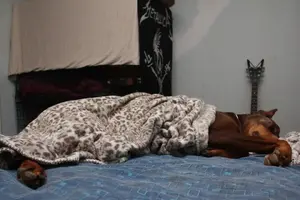
For a period he was gaining his weight back quite rapidly which we all thought was a good thing until he started getting overweight, so now hes on a diet and really looking pretty darn good considering the crazy roller coaster hes been on for the last cpl years..
image.webp image.webp
 
Von, going back and requoting details of what Mars is going through (poor guy :(), this really sounds like Canine Pemphigus. There are 4 different types so a biopsy of the mouth lesions and a blood test would have to be done to confirm the type.


Breeds Affected
Pemphigus foliaceus is most common in Akitas, chow chows, dachsunds, bearded collies, Doberman pinschers, schipperkes, Finnish spritzes, and Newfoundland dogs. Pemphigus is most likely in middle-aged dogs (4 years).

Symptoms
Pemphigus disorders cause scaling of the skin, scabs, and pustules with crusting. Early on, lesions are often limited to the head, including the skin near the ears and mouth, and the feet, including the planum and nailbed. As the diseases progress, lesions spread to other parts of the body and blisters form. Blisters in pemphigus can rupture easily, leaving a generalized crusting, and may be hard to detect.

The nose in pemphigus is also susceptible to pigment loss, similar to the changes seen in canine lupus. Other symptoms include fever and loss of appetite. When the foot pads are affected, difficulty in walking may be observed.

Diagnosis
A physical examination reveals the presence of blistering eruptions in pemphigoid disorders. The presence of mouth lesions is highly suggestive of pemphigus. A biopsy of the lesion is necessary for a definitive diagnosis of the subtype.

It’s important to determine the subtype present to determine the prognosis and optimal course of treatment. It’s also important to differentiate pemphigus from discoid lupus erythematosus. Immunohistochemical or direct immunofluorescent testing may also be used to determine desmoglein distribution. An altered distribution is seen in some cases of pemphigus foliaceus.

Blood tests for desmoglein and anti-plakin antibodies can also be used to help diagnose pemphigus.


Treatment
Most cases of pemphigus require the lifelong use of oral corticosteroids, such as prednisone and prednisolone, along with immunosuppressant medications such as azathioprine. Topical corticosteroids and tacrolimus are also used. In cats, chloramphenicol is used in place of azathioprine. After the symptoms are brought into control, the starting dosage can usually be lowered. Because these medications can cause serious side effects, the lowest dose needed to keep symptoms in control is used.

There have been reports of improvement noted with dietary changes, including a raw foods diet. Because sunburn can exacerbate symptoms, sun should be avoided and canine sun blocks are recommended.

Source: https://suite101.com/a/canine-pemphigus-a66098
The Vet confirmed Pemphigus a cpl weeks ago.. However the steroids seem not to be doing its magic this time around.. I truly fear the worst.
i suppose i should make a thread about Pemphigus.. Its potentially fatal and i would hate for it to take three years to diagnose in another members dog. So hopefully going through this with Mars and documenting the case will help someone in the future and save them from years of questions and trials.

K9 Pemphigus is no joke it is potentially fatal and at best a large lifestyle change.. I know this thread is nine pages of misdiagnosis, but i hope our journey helps others to avoid all the things this thread has chronicled before we got answers. and as you can see even knowing what it is we are up against doesn't always wield the positive results we hope for..

If its not to much trouble id like to ask for prayers for Mars.. He just had a big break through and milestone in his personal life this weekend and its killing me that Monday rolls around and all that awesomeness was replaced by more lesions.
IMG_0421.webp
 
Last edited by a moderator:
Monday rolls around and all that awesomeness was replaced by more lesions.

Not what I was hoping to hear. I know it was really hot this weekend...was hoping that didn't bother his nose too much. What are the next steps beyond steroids? I'm really sorry and Ill be continuing to pray for your buddy Mars. :(
 
What are the next steps beyond steroids?
Medications that have worse side effects then the disease itself.. the vet doesn't recommend going down that road.. he also indicated that authentic treatment would be more expensive then even he could afford on his salary.. I guess that was his nice way of telling me, no freaking way could i afford it. Sadly im putting money away now in case things get really bad and hes needs to be PTS.. Ugh so full of negativity right now i just cant see any lights at the end of the tunnel right now.. I really hope that changes.. We need something positive.. his flare ups. err.... i just dont know what to do.. :(
[DOUBLEPOST=1431359717][/DOUBLEPOST]
I know it was really hot this weekend...was hoping that didn't bother his nose too much
I think im responsible for this most recent flare up.. It was cloudy and rainy all weekend so i let him stay outside longer then usual.. I dont think it mattered that it was cloudy..
 
Definitely, man. Prayers said, and I will continue to think of you and yours and Mars. I hadn't seen this thread yet. I didn't know.
 

Back
Top