Is there a particular book or web source that walks through that in laymans language?
Never read it, so can't recommend it personally, but it is written in layman's terms and you may find it useful.
One LineCanine structure and movement in an easy-to-understand format.OverviewLearn about canine structure and movement in an easy-to-understand format, with numerous drawings and photos. The book is designed to be an introduction for the novice and a review for experienced judges and breeders. W...

shop.akc.org
Technically speaking: Canine anatomy is specialized for agility, featuring a digitigrade stance where dogs walk on their toes, with front legs that are loose and flexible and rear legs that are rigid and sturdy to propel rapid movement. The skeletal system consists of approximately 319 to 320 bones, divided into the axial skeleton (skull, spine, ribcage) and the appendicular skeleton (limbs and girdles), which is significantly more numerous than the human skeleton to allow for greater flexibility.
The spine is highly mobile, comprising 7 cervical, 13 thoracic, 7 lumbar, and 3 sacral vertebrae, plus a variable number of caudal vertebrae, enabling complex twisting and bending motions essential for hunting and running. The forelimbs are attached to the torso primarily by muscles, tendons, and ligaments rather than a rigid clavicle, allowing the scapulae to move freely and absorb impact, while the hindlimbs provide the primary driving force for acceleration and jumping.
Muscle anatomy accounts for about 30% of a dog's body weight, with 230 muscles facilitating both voluntary movement and stabilization. Key muscle groups include the epaxial muscles along the spine for back stability and the hindlimb muscles (such as the quadriceps and gluteals) for power, while forelimb muscles (like the triceps and biceps) manage lifting and pulling actions. This structural organization allows dogs to exhibit exceptional speed, endurance, and directional changes, tailored to their specific breeding purposes such as herding, hunting, or companionship.
And repeating myself here:
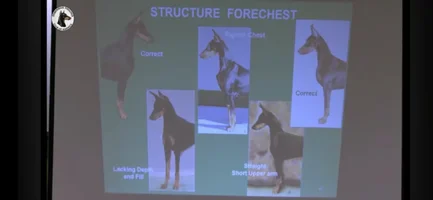
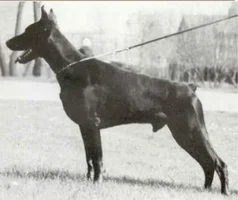
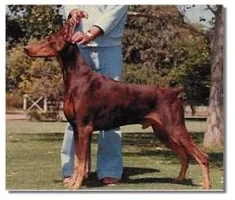
The Doberman standards call for a well defined/developed forechest, which has a prominent prosternum that extends forward of the point of the shoulder,
providing essential leverage for the pectoral muscles to enable a deep, free forward reach and efficient scapula movement.
What does well defined mean, and why it's important:
A well-defined chest is characterized by a deep, broad, and well-muscled structure that provides ample space for the expansion of the heart and lungs, directly supporting stamina and endurance.
Example: different breed, but you can see the musculature of a well defined forechest from the front view.

The average canine structure is ratio of 10:9 length to height, i.e. slightly longer than tall.
Doberman standard calls for a square body, the difference in body type:
Square Body (Height ≈ Length): Breeds with square body type are optimized for power, agility, and tight turns. The compact, muscular structure allows for rapid acceleration and the ability to head off bolting animals or opponents in confined spaces.
Rectangular Body (Length > Height): Breeds with a rectangular build are optimized for endurance, reach, and speed. The longer torso provides more room for lung expansion and the extended stride necessary for sustained running or "floating gait" over long distances. (Note above that the well defined forechest, and the deep and broad chest provides the Doberman with adequate room for heart and lung expansion)
In summary, the "advantage" depends entirely on the breed's specific function: square bodies favor burst power and maneuverability, while rectangular bodies favor speed and stamina.
The Doberman is crafted to have burst power, agility, speed, strength and endurance. A jack-of-all traits.
On a square body type, the front and rear assemblies must be in harmony, i.e. the reason the standard has 90° for front and rear. Anything off of that will show in the movement i.e. cause problems or inefficiency in the gait.
As an example I'll use my own dog here, has an excellent front and over-angulated rear, which often results in the rear paw coming in before the forepaw is out of the way.
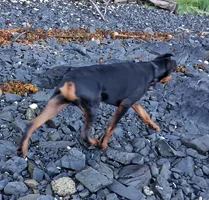
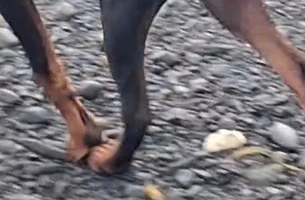
He is still young and growing, and dogs lose angulation as they grow/age, so we'll see.
Conformation judging consists of judging the whole dog, not nickpicking single traits, as no dog is perfect, ideally, the dog which comes closer to the standard based on the whole dog, is the dog that should 'win'. The Doberman breed standard has very few faults that would be a disqualification.
Don't have any photos of stacked, but this is close. Has a nice deep and broad well defined chest, good layback of shoulder and return of upper arm of equal length. Can also notice the over angulation of the rear. (You all can argue if it's a pigeon chest or overdone, it's neither

)
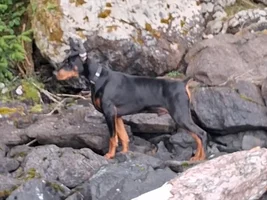
The shape of the chest is important, a barrel chest would prevent maneuverability, such as a crouch when seeing prey
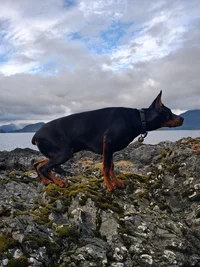
Or movement over uneven terrain
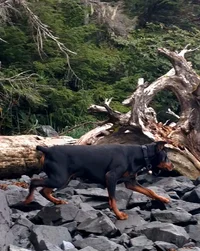
I tend to want a dog that can do a job...and be healthy and long lived for ten+ years.
And this goes to what job YOU want/need the dog to do, or perform and the breed characteristic traits or expectations of.
Very few of my dogs have lived over 10 years, they have all been large dogs, and that does effect longevity. My largest dog, almost 200lbs, lived to 11, the longest lived dog I have had personally, and was pts because of mobility, we just couldn't carry him everywhere.
My personal criteria when choosing my Dobermans is always for correct structure first and foremost, as incorrect structure cannot survive here, period. Health and temperament follow. I prefer dogs that are dual purpose bred, for work and show. I want a well built athlete with strong work ethics.