Opinions on conformation?

I'm always trying to learn, thanks for a more in-depth description @Nordika. My initial post here was asking which picture in the illustration most matches the profile of the photograph of a real dog. To me the front outline perfectly matches the pigeon chest. As you say, one photo does not and cannot define totality of conformation. As a newcomer to the world of conformation I look at win photos and look at the standard and I see conflict in my head. Thus, asking these questions, always searching for answers.
 
I'm always trying to learn, thanks for a more in-depth description @Nordika. My initial post here was asking which picture in the illustration most matches the profile of the photograph of a real dog. To me the front outline perfectly matches the pigeon chest. As you say, one photo does not and cannot define totality of conformation. As a newcomer to the world of conformation I look at win photos and look at the standard and I see conflict in my head. Thus, asking these questions, always searching for answers.
It doesn't look like a pigeon chest to my eye since there isn't a bone protrusion and falling away. To me, the chest appears well defined. The illustrated standard was written for judges and therefore lacking in their description as judges should absolutely know what the terms mean. So when a judge first sees the dogs, it's a 3/4 view, they see the front and side, then the side profile, if you thought this dog had a pigeon chest, what would you look for?

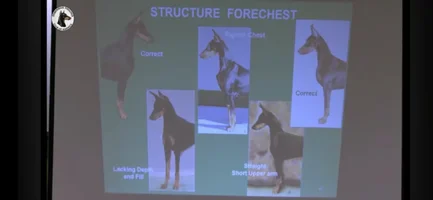
It would be more informative to the general public if they included actual pictures of the faults on actual dogs, however the illustrations are not for that purpose. They do this in the seminar for judges. I'd suggest watching this full video, but to get at the two faults that you're thinking here, topline and pigeon chest, the presentation goes from topline to chest, the presenter gives a rudimentary explanation with photos and illustration. Starting at 30:00 minutes in. I think you'll find it most helpful.


1000034441.webp
 
It doesn't look like a pigeon chest to my eye since there isn't a bone protrusion and falling away. To me, the chest appears well defined. The illustrated standard was written for judges and therefore lacking in their description as judges should absolutely know what the terms mean. So when a judge first sees the dogs, it's a 3/4 view, they see the front and side, then the side profile, if you thought this dog had a pigeon chest, what would you look for?

It would be more informative to the general public if they included actual pictures of the faults on actual dogs, however the illustrations are not for that purpose. They do this in the seminar for judges. I'd suggest watching this full video, but to get at the two faults that you're thinking here, topline and pigeon chest, the presentation goes from topline to chest, the presenter gives a rudimentary explanation with photos and illustration. Starting at 30:00 minutes in. I think you'll find it most helpful.


View attachment 163264
Thanks @Nordika for the explanation of how judges speak to judges (or experienced owners) in a way that the average beginner finds confusing. This is the same video as whay @MikeP linked up thread, and so I've re-watched Fran S' review of history and how breeders tried to develop the standard, so I get a more solid understanding of function.

Can you or anyone explain how the desired "90 degree" angle works in conjunction with large protruding chest? Is there a particular book or web source that walks through that in laymans language?

I think I understand the ideal- show should develop the breed standard for function: how the dog moves, etc and do the job all day....

So where does the over protruding chest start to get in the way of movement, not just in the show ring, trotting in a circle, or going out and back or a triangle for the confo judges closer look, with a handler dangling the dog on a snake for elegant swan neck, high head up, thats completely un-natural when in the field?

What additional "proofs" on the working side speak to ideal musculo-skeletal ideals in terms of actual movement as a fast, agile, balanced in size and efficiency to do the job all day long?

Again; To my noob understanding- confo is to set a standard that both looks good but more important creates a dog that can do the job.

So there is the point of debate, and speaking as a layperson looking for how to DIY decide on balance I tend to want a dog that can do a job...and be healthy and long lived for ten+ years.
 
Is there a particular book or web source that walks through that in laymans language?
Never read it, so can't recommend it personally, but it is written in layman's terms and you may find it useful.

Technically speaking: Canine anatomy is specialized for agility, featuring a digitigrade stance where dogs walk on their toes, with front legs that are loose and flexible and rear legs that are rigid and sturdy to propel rapid movement. The skeletal system consists of approximately 319 to 320 bones, divided into the axial skeleton (skull, spine, ribcage) and the appendicular skeleton (limbs and girdles), which is significantly more numerous than the human skeleton to allow for greater flexibility.

The spine is highly mobile, comprising 7 cervical, 13 thoracic, 7 lumbar, and 3 sacral vertebrae, plus a variable number of caudal vertebrae, enabling complex twisting and bending motions essential for hunting and running. The forelimbs are attached to the torso primarily by muscles, tendons, and ligaments rather than a rigid clavicle, allowing the scapulae to move freely and absorb impact, while the hindlimbs provide the primary driving force for acceleration and jumping.

Muscle anatomy accounts for about 30% of a dog's body weight, with 230 muscles facilitating both voluntary movement and stabilization. Key muscle groups include the epaxial muscles along the spine for back stability and the hindlimb muscles (such as the quadriceps and gluteals) for power, while forelimb muscles (like the triceps and biceps) manage lifting and pulling actions. This structural organization allows dogs to exhibit exceptional speed, endurance, and directional changes, tailored to their specific breeding purposes such as herding, hunting, or companionship.

And repeating myself here:

The Doberman standards call for a well defined/developed forechest, which has a prominent prosternum that extends forward of the point of the shoulder, providing essential leverage for the pectoral muscles to enable a deep, free forward reach and efficient scapula movement.

What does well defined mean, and why it's important: A well-defined chest is characterized by a deep, broad, and well-muscled structure that provides ample space for the expansion of the heart and lungs, directly supporting stamina and endurance.
Example: different breed, but you can see the musculature of a well defined forechest from the front view.
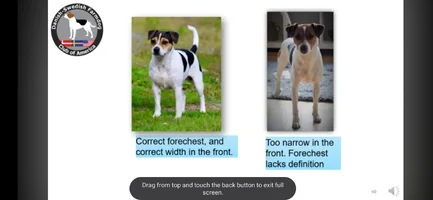
1000034357.webp
The average canine structure is ratio of 10:9 length to height, i.e. slightly longer than tall.

Doberman standard calls for a square body, the difference in body type:

Square Body (Height ≈ Length): Breeds with square body type are optimized for power, agility, and tight turns. The compact, muscular structure allows for rapid acceleration and the ability to head off bolting animals or opponents in confined spaces.

Rectangular Body (Length > Height): Breeds with a rectangular build are optimized for endurance, reach, and speed. The longer torso provides more room for lung expansion and the extended stride necessary for sustained running or "floating gait" over long distances. (Note above that the well defined forechest, and the deep and broad chest provides the Doberman with adequate room for heart and lung expansion)

In summary, the "advantage" depends entirely on the breed's specific function: square bodies favor burst power and maneuverability, while rectangular bodies favor speed and stamina.

The Doberman is crafted to have burst power, agility, speed, strength and endurance. A jack-of-all traits.

On a square body type, the front and rear assemblies must be in harmony, i.e. the reason the standard has 90° for front and rear. Anything off of that will show in the movement i.e. cause problems or inefficiency in the gait.

As an example I'll use my own dog here, has an excellent front and over-angulated rear, which often results in the rear paw coming in before the forepaw is out of the way.
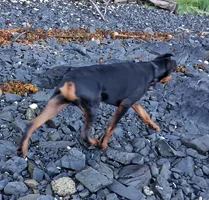
1000032464.webp
1000034449.webp
He is still young and growing, and dogs lose angulation as they grow/age, so we'll see.
Conformation judging consists of judging the whole dog, not nickpicking single traits, as no dog is perfect, ideally, the dog which comes closer to the standard based on the whole dog, is the dog that should 'win'. The Doberman breed standard has very few faults that would be a disqualification.

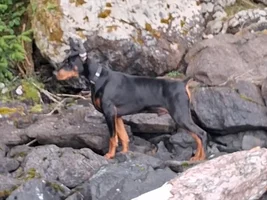
Don't have any photos of stacked, but this is close. Has a nice deep and broad well defined chest, good layback of shoulder and return of upper arm of equal length. Can also notice the over angulation of the rear. (You all can argue if it's a pigeon chest or overdone, it's neither 😄)
1000028971.webp
The shape of the chest is important, a barrel chest would prevent maneuverability, such as a crouch when seeing prey
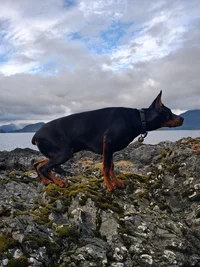
1000033696.webp
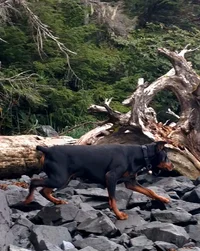
Or movement over uneven terrain
1000034359.webp
I tend to want a dog that can do a job...and be healthy and long lived for ten+ years.
And this goes to what job YOU want/need the dog to do, or perform and the breed characteristic traits or expectations of.

Very few of my dogs have lived over 10 years, they have all been large dogs, and that does effect longevity. My largest dog, almost 200lbs, lived to 11, the longest lived dog I have had personally, and was pts because of mobility, we just couldn't carry him everywhere.

My personal criteria when choosing my Dobermans is always for correct structure first and foremost, as incorrect structure cannot survive here, period. Health and temperament follow. I prefer dogs that are dual purpose bred, for work and show. I want a well built athlete with strong work ethics.

 
TY! @Nordika Excellent explanation with the pic of forechest, broad enough but not barrel chested to get in the way of movement.

How do you @Nordika select for proof on working line to fit the function you seek, in your environment?

I can see the athleticism, and curious how you quantify "strong work ethics".

In my opinion, 10 years is a rational expectation on well chosen well bred documented pedigree dobe, subject of course to "life happens".

PS: thanks for the AKC book, on order, more homework.
Note that is closest to the dobe specific Illustrated Breed Standard, plus this available on DPCA

 
Last edited:
TY! @Nordika Excellent explanation with the pic of forechest, broad enough but not barrel chested to get in the way of movement.

How do you @Nordika select for proof on working line to fit the function you seek, in your environment?

I can see the athleticism, and curious how you quantify "strong work ethics".

In my opinion, 10 years is a rational expectation on well chosen well bred documented pedigree dobe, subject of course to "life happens".

PS: thanks for the AKC book, on order, more homework.
Note that is closest to the dobe specific Illustrated Breed Standard, plus this available on DPCA


How do you @Nordika select for proof on working line to fit the function you seek, in your environment?

I can see the athleticism, and curious how you quantify "strong work ethics".

Let's just say I would be sporting a pair of Gordon Setters if not for my spouse knowing my weakness for black and tan Dobermann 😉

As for working qualities fit for my purpose, I need a dog that is bidable with a good nose and physical traits or ability to cover rough ground. I can reasonably expect to find that in Schutzhund, IPO, IGP titles, because they also include obedience and tracking. I can also look to AKC titles in Obedience and Tracking. Discussing tracking, obedience or other activities of dogs that don't have titles with the breeder. Not everyone has the time or inclination for competition at a level to title a dog, doesn't mean they don't work the dogs. I trained my female BRT in KNPV, we didn't travel across the world to compete. She was the greatest working dog I've ever had.

A dog that has a good innate prey drive, in my opinion, and with my training techniques, is easiest to train. The desire to work, the dog that must have a job to do = strong work ethics. More dog than most people need or want. High drive, high energy, no off switch. So currently I've basically got a Belgian Malinois in a Doberman suit that is just starting to taper off the maligator, a little. He would be a great IGP prospect, but we're channeling that drive to SAR training instead, as it's what we need here.

I don't know if this answers your questions, always trying to do my best at explaining, expressing, etc.
 
Let's just say I would be sporting a pair of Gordon Setters if not for my spouse knowing my weakness for black and tan Dobermann 😉

As for working qualities fit for my purpose, I need a dog that is bidable with a good nose and physical traits or ability to cover rough ground. I can reasonably expect to find that in Schutzhund, IPO, IGP titles, because they also include obedience and tracking. I can also look to AKC titles in Obedience and Tracking. Discussing tracking, obedience or other activities of dogs that don't have titles with the breeder. Not everyone has the time or inclination for competition at a level to title a dog, doesn't mean they don't work the dogs. I trained my female BRT in KNPV, we didn't travel across the world to compete. She was the greatest working dog I've ever had.

A dog that has a good innate prey drive, in my opinion, and with my training techniques, is easiest to train. The desire to work, the dog that must have a job to do = strong work ethics. More dog than most people need or want. High drive, high energy, no off switch. So currently I've basically got a Belgian Malinois in a Doberman suit that is just starting to taper off the maligator, a little. He would be a great IGP prospect, but we're channeling that drive to SAR training instead, as it's what we need here.

I don't know if this answers your questions, always trying to do my best at explaining, expressing, etc.
Great answers. Very complete and concise.
SAR to find alive but lost, or corpse recovery?

Lots more to followup on but will wait a bit so I'm giving others a chance to jump in.
 

Back
Top