Doberman Cross Breeding Project

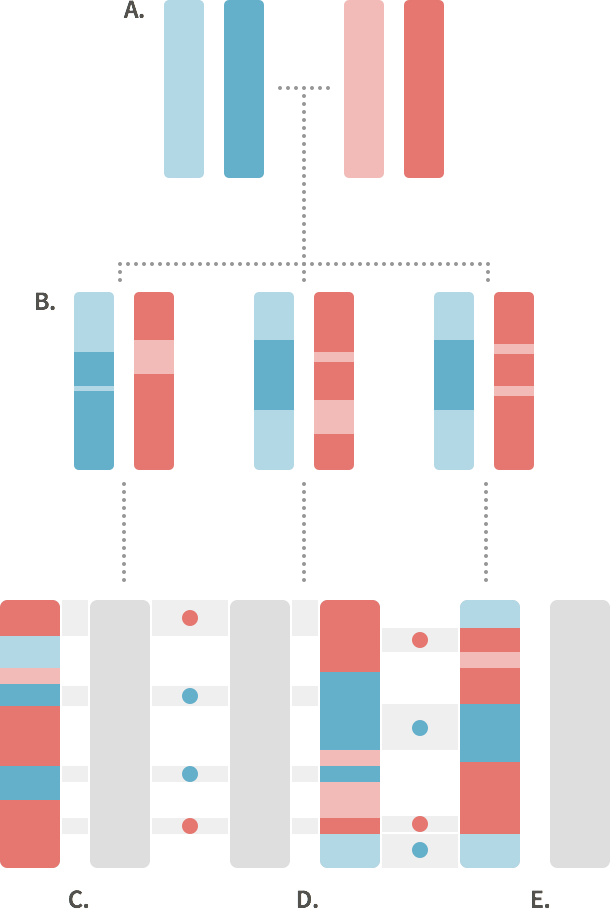
The easiest way to explain this is that the DNA is like a barcode. No matter how all those barcodes look, each one represents a different item. Once the Doberman became its own breed and they closed the book on other breeds, they got their own defining "bar code". The barcode of the Beauceron is different. Embark through it's DNA magic can see these differences and also magically tell you if it's a mix and what breeds and approximate percentages.

Here is another useful explanation, for me at least:
 
Me too, @Ddski5 in re: "i haz questions?"
and 🙌 good idea to start a new thread dedicated to this project.

I too am very interested to learn "what exactly are they targeting as a trait, as a specific improvement to bring to the dobe breed?"

And how? What tools and methodology?
Genetics vs genomics?

I'm assuming there is something that speaks to health, specifically DCM, given how much attention its garnered over the years.

Comparing this FKC "Fix the Dobes" Plan to the now terminated DDP (that frankly to me looked like another attempt to justify hypertrope Bandoggery...🧐)

And other debates (remember the squawking and clucking at the youtuber interview of Dr Sophie Liu on the Wade study) ...?

Speaking for myself here is a legit effort that at least allows this weird old fart in the peanut gallery to discuss ideas openly without the gatekeeping typical in purist show circles to shutdown the very mention of the elephant in the room.

One thing I find fascinating in tribal politics is how the various groups see themselves. Look up "suomi" as the key point of pride for the Finns national identity.

Its like the honey badger memes...on teh innertoobs.
I am about to get a Dobie puppy and my breeder is fanatical about genetics. Her research indicates that the goal is not specific new "traits" in and of themselves, but pretty much entirely around strengthening and broadening the genetic diversity of the Doberman breed before inbreeding makes it extinct. Breeder told me that the plan is to crossbreed in those other breeds and then breed them back out over some number of generations while hanging onto the added gene diversity (probably a few years of work I am guessing). No plans to change the breed in any material way aside from more genetic diversity. o time will tell but with some genetic studies in my background (waaay back), I find it hard to believe it won't have some impact on the breed that will be hard to predict. But man plans and God laughs. I suspect that I am not telling anyone anything new when I mention that the breed as a whole has one of the the highest COI's of mainstream breeds at about 42% with only a few near or above like 26% for Nova Scotia Duck Tolling Retrievers and as much as 37% for Polish Hounds, 58% for Bull Terriers, around 45% for some Collies (and who the heck has heard of a Nova Scotia Duck Tolling Retriever??), and the outlier is the Lundehund at almost 80%. The next well known mainstream breed with a "high" COI is the Great Dane with an average of about 9% (my last guy was a big ol' goofy GD, absent friends... 😢🥰). I found a study that said there are an estimated 70 (high risk) to 235 (long term risk) effectively unrelated genetic templates of the Doberman breed. My coming pup comes from a relatively estimated COI litter at 22%, so I am hopeful that he will be a long laster with fewer problems but will love him regardless.
 
@BGpa Those are all good reads and pretty easy to read. Sometimes my head explodes after too much science-speak!
I know, its pretty deep for me.

I'm struggling to understand half of thst Embark link you sent, as it is!

The practical challenge, after is in the application- "what do the best breeders use, and how do I understand the use of the tools well enough to ask questions and rank breeders by answers.?"

Along with the rest of the criteria for choosing a breeder, the dogs parents/grandparents performance in shows, trials, and health and longevity, and my own research on lines (as you have suggested should go five deep).

So far the DPCA's "how to choose a breeder" the DPCA, and UDC referral lists and the names here and other sources by replies, that I've collated are my starting checklist.

@Rits and a couple others have been very helpful in putting things in context and thanks to you all here who have given so many tips as well.

I've definitely got more reading ahead on the genetics.
 
I am about to get a Dobie puppy and my breeder is fanatical about genetics. Her research indicates that the goal is not specific new "traits" in and of themselves, but pretty much entirely around strengthening and broadening the genetic diversity of the Doberman breed before inbreeding makes it extinct. Breeder told me that the plan is to crossbreed in those other breeds and then breed them back out over some number of generations while hanging onto the added gene diversity (probably a few years of work I am guessing). No plans to change the breed in any material way aside from more genetic diversity. o time will tell but with some genetic studies in my background (waaay back), I find it hard to believe it won't have some impact on the breed that will be hard to predict. But man plans and God laughs. I suspect that I am not telling anyone anything new when I mention that the breed as a whole has one of the the highest COI's of mainstream breeds at about 42% with only a few near or above like 26% for Nova Scotia Duck Tolling Retrievers and as much as 37% for Polish Hounds, 58% for Bull Terriers, around 45% for some Collies (and who the heck has heard of a Nova Scotia Duck Tolling Retriever??), and the outlier is the Lundehund at almost 80%. The next well known mainstream breed with a "high" COI is the Great Dane with an average of about 9% (my last guy was a big ol' goofy GD, absent friends... 😢🥰). I found a study that said there are an estimated 70 (high risk) to 235 (long term risk) effectively unrelated genetic templates of the Doberman breed. My coming pup comes from a relatively estimated COI litter at 22%, so I am hopeful that he will be a long laster with fewer problems but will love him regardless.
@web_creator Welcome!
Would love to see pics of pup when you can and learn more of your progress.

Do you happen to have a link to share for those studies you cited? Thanks!
 
@web_creator Welcome!
Would love to see pics of pup when you can and learn more of your progress.

Do you happen to have a link to share for those studies you cited? Thanks!
Happy to help. <<Wade, C.M., Nuttall, R., & Liu, S. (2023). Comprehensive analysis of geographic and breed-purpose influences on genetic diversity and inherited disease risk in the Doberman dog breed. Canine Medicine and Genetics, 10(1): 1–17.>> Comprehensive analysis of geographic and breed-purpose influences on genetic diversity and inherited disease risk in the Doberman dog breed - PMC

A little from the Finnish Kennel club - Cross breeding

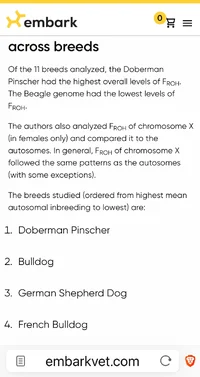
Following is one that shows a significant list of breeds and COI's. And while we are geeking out on alla this, the high numbers (and apparently more accurate ones but who knows who will wax religious on this) are genomic inbreeding (F_ROH), measured from actual homozygosity runs on the genome compared to Pedigree-based COI's, which only capture inbreeding accumulated from the pedigree horizon and miss the deep breed-founder bottleneck. But if you want to see the really ugly numbers, then: Actual Inbreeding of Purebred Dog Breeds

And now for a few pictures and happy to share going forward. I am new to this forum and you are a heavy poster and responder in many areas of my interest, so I might take the liberty of pinging on occasion :). The pics are from one day and about four weeks. The nine week pic is the current profile pic...
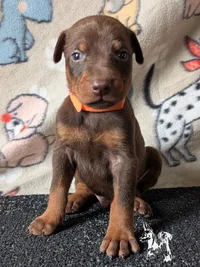
~~Jim
 

Attachments

  • Digger - Four Weeks Old.webp
    Digger - Four Weeks Old.webp
    360.6 KB · Views: 0
  • Digger - One Day Old.webp
    Digger - One Day Old.webp
    76.9 KB · Views: 0

Back
Top