Dobequest & DPCA

Thank you for that - it does help to get input from people like you that have actually been there/done that.

But there is no record of breedings in either AKC or DPCA unless the bitch owner submits a litter registration?
Correct. The AKC is a registry so they only record what is registered. I'm not sure you can request this information "how many dogs a stud has bred" I haven't bred a stud dog yet but I imagine the information is at least available privately to the stud owner on their AKC account like it is for a bitch.
 
I imagine the information is at least available privately to the stud owner on their AKC account like it is for a bitch.
I should look that up since Elroy did sire the one litter and I did have to sign for it.
 
- a continuation of the horse Acclimation ( I just used him because he was first by alphabetical listing) ... There is the Jockey Club info which is the registry, like AKC is the registry for dogs, not DPCA.
Then the BloodHorse, which is more like a magazine of facts and updates and advertising, and they publish the Stallion registry every year, plus other stat reports. Think Show Dog magazine (I'm not sure if there is a DPCA publication for just Doberman?) or UDC - which by the way does publish their UDC trial results with scores and passes/fails for temperament tests, so pretty transparent by my observation.

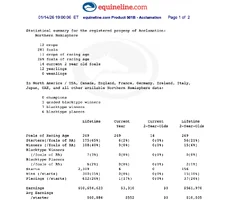
Then there is EquineLine which is yet another source of information, which I assume is a combination of the registrations and racing information and public sales auctions to sum up a sires success (or not) as a breeding choice. Much of this is not applicable or comparable but I just want to point out what kind of picture you can create when you have accurate numbers and results of tests, whether it's racing or health results.

The first part, 12 crops (with horses since they can only have 1 foal per year, is called a crop) then broken down to foals of racing age, how many started on the race track, how many were champions (think Nationals - GCH in show dogs, IGP3 CH in working lines?) graded black type could be compared to multiple GCH winners or IGP3 more than once, black type winners could be local CH and placers could be reserve CH or club level IGP. And I expect the percentages might be the same for show or working dogs - IT IS HARD to get the cream of the crop, whether you are a breeder or a handler! In ANYthing! whether working sports, scent work, conformation whatever. It's never a cakewalk.

***The main reason I'm posting this is to think about dogs at stud and the popular dog syndrome that creates a problem with diversity especially concerning the Dobermans health issues. If all we see is the big number of Champions, not the total number of puppies on the ground we aren't seeing how great (or not so great) the sire actually is. Obviously the quality of the female enters the picture and the stud owner limiting to only exceptional bitches works backwards when we are trying to improve "plain janes" and lower COI.

Here is Acclimation compared with a much higher class stallion named Quality Road with a similar number of crops. The average earnings per starter are "only" about twice as much for the Quality Road stallion, but the number of black type winners, graded bt winners and champions is greatly increased.

Again, nobody can do this kind of math without ALL the information whether we are talking about % of Grand CH show dogs produced or number of DCM offspring. We cannot make accurate predictions without accurate numbers.

Think about it.


Screenshot 2026-01-15 at 7.54.47 AM.webpScreenshot 2026-01-15 at 7.55.55 AM.webp
 
Then there is the stallion registry from the Bloodhorse. Here's a sample of information available if you want to look at stats on a stallion for your mare: Every one of those icons in red open up a whole new stat page. The information to someone in the business is "normal". This is what I spent 20 years observing as a trainer, not a breeder. I was dumbfounded that information about dogs was pretty much non existent. Granted, nobody seemed interested in it, so why put it out? In addition to performance though, it could be health and longevity, COIs and CODs. Companion dogs should not detract from performance since we acknowledge that most Dobermans are just that, and it also is an important piece of information about our breed.

I wonder how racing greyhound databases compare to racing horses?

I think this is what you're getting at above but Horses are much bigger money in risk and reward so the folks involved probably want AS MUCH data as possible? Plus you have the spectators betting on horses. "Gamblers" (breeders and spectators) demand to have as much information as possible to think the cards are in their favor, after all.

I follow a few OTTB sites that advertise horses that either didn't pan out on the track or had successful racing careers and are looking for their second, but I'm always shocked at how reasonable their 'adoption' fee's are. I would generalize $1,500 - $5,000. I know they can come in to their second career 'spicy' but that price just seems so low. For instance:

$3000 - I'll take 3, please

1768499095083.webp

I would venture a guess dogs are more accessible (way less resources required than for a horse) and with accessibility comes ignorance, I fear. Although I'm super uneducated how a "normal" person goes about getting a "normal" horse, if that makes sense? lol The horses I remember my grandparents having were horses other folks were getting rid of for one reason or another. I'm sure if you know where to look, it's easy to find?
 
Yes, all the information about TB's is wholly due to paramutal betting. Not just for the betting public, but for legitimacy. It is highly regulated throughout the world in different ways, but regulated tightly no matter which country you look at. They use to be tattooed, now they're microchipped. The tattoos were always checked in the saddling paddock so in front of the public, I'm assuming the chip reader is done in the saddling paddock now.


I'm mainly showing these stats because IF someone wanted to know the facts about dogs they are breeding, these are the things that could be published, because from some of the replies here, some of these numbers ARE reported. Someone has records, several different places maybe but if the records are there, why can't they be published for everyone's benefit, most of all the breeders so they can make better choices? Especially the health stats. I have little to no expectations that there will ever be a data base for dogs remotely like this - I'm just saying it's been done like this by hand since the TB was developed in the 1700's. No AI needed, just pen & paper and good record keeping. LOL, I'm basically saying "don't tell me it can't be done" to the ones who think it would take too much effort. It's already mostly done if it's a registered litter all that's needed is compilation in a data base. If you have a bitch who is a vWD carrier and want to breed only to a vWD Clear male, and also prefer black color and a GCH that has both parents live to 10 years, you could search by checking those 3 boxes. That's where the idea of all those links on the stallion page come up - they aren't one data base but several companies that keep different records. With dogs I think this wouldn't be nearly as complicated.

You picked a nice horse there from CANTER. x 3 :thumbsup: Yes, owners in the business want racehorses that can at least break even, the horses that aren't fast they'd rather take a loss once than keep losing. CANTER is a great organization, I use to peruse their horses on a regular basis.
 

Back
Top