For those interested here are the things you must pass for a CGCA and a CGCU
CGCA:
To earn the CGCA title, the dog must:
- be registered or listed with AKC (AKC number, PAL, or AKC Canine Partners number) and,
- already have a Canine Good Citizen award/title on record.
Dogs must pass all 10 items of the test to receive the CGCA title.
- Dog stands, sits or lies down and waits under control while the owner:
- sits at the registration table and fills out paperwork, or,
- if the test is done in the community, dog waits while the owner sits and has a snack or visits with another person (e.g., at a park)
- Walks on a loose leash in a natural situation (not in a ring) — does not pull.
- left turn
- right turn
- stop
- fast and slow pace
- Walks on loose leash through a crowd:
- at a show or in class, this item is tested in a real crowd, not in a ring
- in the community, dog walks on sidewalk, through a crowd at a community fair, park, on a trail, through a busy hallway, etc.
- Dog walks past distraction dogs present; does not pull.
This item may be tested along with #3 if there are dogs in the crowd, etc.
- at a show or class, dog walks by dogs waiting in the crowd–dogs 2 ft. apart
- in the community, dog walks by other dogs on a trail, sidewalk, in a hallway, etc.
- Sit-stay in small group (two other people with dogs, total of 3 people, 3 dogs in group).
- Dog allows person who is carrying something (backpack, computer bag, etc.) to approach and pet it.
“May I pet your dog?” (Item is placed on floor/ground before the person pets the dog)
- “Leave it.” Dog walks by food and follows owner instructions, “Leave it.”
This can be food placed by the evaluator on the floor or ground in a food dish with a wire cover as in Rally.
- Down or sit stay — distance (owner’s choice).
Dog is on 20–ft line, owner walks away with back to dog, picks up an item (e.g., backpack, training bag, clipboard, folder etc.) placed on the floor/chair/ground by the evaluator and returns to the dog.
- Recall with distractions present (coming when called). Handler goes out 20–ft. **(off center) and calls dog.
Dog is on the 20–ft. line from #8 above.
- Dog will sit or stand stay (owner’s choice) while owner enters/exits a doorway or narrow passageway. Owner calls dog through door when ready.
Owner may also choose to:
- send the dog through first and have the dog wait for the owner, or
- the owner may choose to have the dog go through the doorway at the owner’s side.
- Whichever method is used, the dog must not pull the owner and must be under good control. Think of the handler having the leash in one hand and a cup of coffee in the other.Doorway or gate can be real or simulated with ring gates, two chairs, or a natural passageway (e.g., entrance to trail) in the community.
CGCU:
AKC Urban CGC requires that the dog demonstrate CGC skills and beyond in an urban setting. As with Canine Good Citizen, AKC Urban CGC has a 10-step test of skills that dogs must pass to earn the official AKC Urban CGC title. This is a title that appears on the dog’s title record at AKC.
AKC Approved CGC Evaluators administer the AKC Urban CGC test.
Get your Test Summary Form here.
Age Requirements for Dogs
There is no age limit for dogs taking the AKC Urban CGC test. The CGC test and Urban CGC may be taken on the same day. However, when taken on the same day, both forms should be sent to AKC in one envelope so the CGC can be entered first.
Collar, Leashes and Equipment
All tests must be performed on leash. Dogs should wear well-fitting buckle or slip collars (including martingales) or body harnesses. Body harnesses should not restrict the movement of the dog. Special training equipment such as pinch collars and head collars are not permitted. The leash should be made of either leather or fabric. Retractable leashes may not be used in the test.
We recognize that special training collars may be valuable equipment in the beginning stages of dog training, however, we feel that dogs are ready to be tested after they have been transitioned to a slip or buckle collar (body harnesses are also acceptable). If an evaluator is teaching classes and does not feel comfortable with one of the permitted collars, students may be required to take the test in the type of collar used in class (as long as it is permitted by AKC for testing). If the test is advertised for the general public, all of the permitted collar types and body harnesses should be allowed in the test.
Fees
Test-giving organizations and individual evaluators may charge a fee for conducting an AKC Urban CGC test. Fees are used to cover the costs of test kits, mailing, copying, and advertising related to the test. Private trainers sometimes charge a fee for a testing session that is commensurate with their hourly rate of service. There is a $32.00 processing fee that the dog owner will pay to the AKC for the AKC Urban CGC title.
Food
Handlers are not permitted to use food as a reward during the AKC Urban CGC Test. While we recognize that food is an effective reinforcer during training, it should not be used in the test. As with CGC, the purpose of the AKC Urban CGC test is to determine if the dog relates to the owner and if it can be controlled without food during the short duration of the test.
Handler/Dog Interactions During Test
Handlers may talk to their dogs and provide praise throughout the test. The test items should be conducted in an urban, city, or town setting where there are streets to cross, noises, sidewalks, etc. Evaluators should encourage the test to be fun.
Evaluators may remind handlers to communicate with their dogs. Evaluators should not make the test easier by eliminating test items, nor should they require a higher level of performance than the test requires. Of course, evaluators may choose to teach or practice more advanced skills in their classes.
AKC Urban CGC Test Items
- Exit/enter doorway with no pulling in dog-friendly buildings. Exit building to start test, additional Public buildings items are below.
- Walk through a crowd on a busy urban sidewalk.
- People come toward the dog from 1-ft. away
- Tolerate distractions (people wearing hats, coats, men, women, etc).
- Appropriate reaction to city distractions. This includes movement, noises, and walking on a variety of surfaces. Examples:
- Noises: horns, sirens, construction noise, etc.
- Moving objects: skateboard, bike, carts, person running
- Surfaces: concrete, grass, grates, plastic tarp, wet sidewalk
- Crossing street: Stop at corner, stand or sit to wait and cross with no pulling (on leash, with owner). Crosses street under control.
- Ignore food on sidewalk. (Dropped food, or cups, bags, cans, in which food was wrapped).
- Person walks up and pets the dog. May be carrying an item such as a small dog in a bag, a computer bag, etc. Person does not put the bag down to pet the dog.
- Public Building (that is dog friendly). Walks under control in building (slick surface, carpeted floor). Down stay (3 min) in lobby or outdoor area, or waits while owner has a meal or snack.
- Stairs, steps, or elevator under control.
- Steps (at least 3 – up and down)
- Elevator (Enters under control, exits, rides under control)
- Housetrained for apartment, condo, city living. Owner may verify this item. Evaluator may also observe in public buildings, or have observed in training classes.
- Transportation. Owner’s choice depending on transportation needs.
- Car. Enters/exits, remains under control during the ride. (Crate? Seatbelt?)
- Subway. Small dog in bag for ride. (large dogs are not always permitted; know and abide by the Transit Policies in your area).
- Dog friendly (enters/exits or allows to be put in/taken out) under control.
To pass the CGCU test, dogs must pass all 10 items of the test.


 The training pays off, guys, it really does.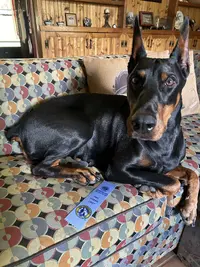
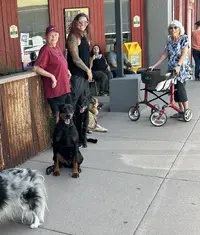



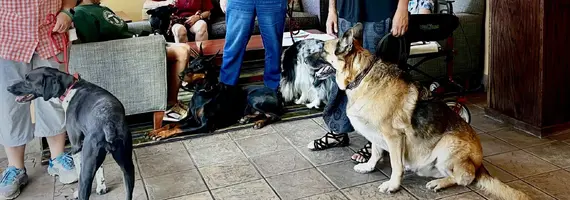

 But the nice gal behind the counter took the picture of all of us.


