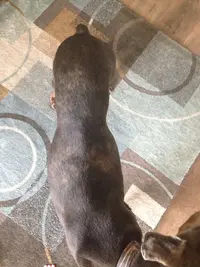

I saw this in the UDC Focus magazine and got the authors permission to cross post. While, I do not agree with everything she says, I do think it is worth sharing...
So you want a Fawn or Blue Doberman...
Written by Michelle Shelby Frye
And the “breeder” is telling you that they are rare, so
you better act fast…
Wrong.
The “breeder” trying to sell you this cute, beautiful, soft
coated bundle of joy is wrong. And you should run. Not
necessarily from the fawn or blue Doberman, but from the
“breeder.” Fawn and Blue Dobermans are not rare. They
are an acceptable color in the United States and can be
shown in all events. But if that is the case, why do you not
see as many Fawns and Blues as you do Blacks and Reds?
Because in order to get a Fawn or Blue Doberman both
parents must carry the Dilute Gene.
Let’s back up a step and explain what a fawn and a blue
Doberman are. They are a “dilute” or color dilution in
the hair shaft of the black or red dominate colors of
Dobermans.
Blue Dobermans are a dilute form of the color black, blue
Dobermans colors can range from light grayish blue to
almost black.
Fawns or Isabella as they are sometimes called, are the
dilute form of Red Dobermans. They are, as the name suggest,
fawn in color.
Fawns and blues keep their Rust markings like on their
black and red counterparts.
Now that you know the difference between the two, how
do you tell them apart? Well Blues being a dilute of black
will have a blackish/blue nose and Fawns, being from Reds
will have a pinkish/brown nose. So if you encounter one
and are not certain, look at the noses, and you should be
able to tell.
As asked earlier, why do you not see as many fawns and
blues? Well its genetics. In order for a Doberman dam to
produce “dilutes” she must carry the Dilute Gene AND the
sire she is bred to must also carry the Dilute Gene. And as
with most genetics it doesn’t always happen every time.
Now reputable breeders will know their Dam and Sires
genetic history, normally to include which color genes they
carry, and they may or may not avoid breeding two dilute
gene carrying Dobermans together. For reputable breeders
other factors like conformation, temperament and health of
the parents weigh into the decision and they will choose to
breed two dilute carrying dogs together and they may end
up with a dilute in the litter. Since the dogs they have breed
together are excellent examples of Dobermans, you have
no harm no foul, as in the United States they deem them
acceptable colors. Reputable breeders rarely breed Fawn or
Blue Dobermans but again it falls back on the conformation,
temperament and health of the dogs being bred. IF
the dam or sire is fawn or blue make sure you check for all
health testing and titling of the dogs to make sure you are
purchasing from a reputable breeder.
On the other end of the scale, you have the BYB’s and
“greeders” who do no genetic workup on the dogs they
breed, no health testing and certainly don’t care what the
dogs produce so long as they can sell the puppies. If a
dilute or two comes along from the litter even better, they
can sell it for more, claiming it is rare, when in fact; it’s just
a matter of parent’s genetics.
So why are reputable breeders not breeding for dilutes?
Well, they tend to have lots of hair and skin issues. 93%
of Blue Dobermans and 75% of Fawn Dobermans develop
CDA or Color Dilution Alopecia (source Wikipedia).
Like the name implies, they start losing their hair and get
bald(ing) patches of their blue or fawn hair. And there is
not a lot you can do about it, after all it is genetic. So all
those people who paid lots of money for their beautiful,
soft fawn or blue Doberman puppy, will end up with a
rough coated and probably patchy (or bald) adult Doberman.
Dilutes have less hair on their bodies per square
inch than a Black or Red, so even the “best” dilute coat
as an adult is lacking the luster of their counterparts. CDA
does not happen overnight. Its normal onset is between
6 months of age and when the dog reaches maturity at
around 2 years old.
So is owning a dilute Doberman really a problem?
chance of balding. If you’re ok with that, than think of the
health issues that come along with CDA
Because of the clumping of the pigment in the hair shaft it
makes the hair shaft is softer, or rather not as strong as the
Black or Red, it tends to break easily or is unable to push
through the follicle and cause the dog to have ingrown hairs
or staph infections. These issues will result in more vet visits
and antibiotics or other remedies you and your vet discuss.
If you live in colder climates you will probably have to
purchase sweaters or jackets to help keep their thin furred
bodies warm.
In the warmer climates you will probably have to purchase
dog safe sun block or cooling coats to protect their sensitive
skin from the harmful rays of the sun.
Let’s talk treatment.
There is no effect treatment for this disorder. It’s progressive
and incurable. But there are some things you can do to help
prevent infections and promote the health of the hair left.
Do not over or excessively brush or bathe. Since the hair
shaft is not as strong as black or red, it breaks easily during
excessive brushing or even shampooing. Some suggestions
that have been made to me are shampoos with keratin in
them, but I find its better not to bathe at all unless she’s
gotten into something absolutely disgusting. Then I use an
antimicrobial shampoo with very little scrubbing.
Some people suggest moisturizers on the coat to make the
hair less brittle, but I’m of the mind of less chemicals and
more natural. Plus won’t they just end up licking it off? I
prefer a scoop or two of coconut oil in her dinner.
Speaking of dinner, the absolute best thing I have found
for her is a high quality diet filled with fatty acids. She
started on a kibble as a puppy and even though it was a
“high quality” kibble she still was getting patchy and her
hair was very course and broke easily. I switched her over
to completely raw diet and cannot believe the difference it
has made. Weekly she gets an array of raw meat; Sardines,
ground pork, green tripe, turkey tails, duck necks, chicken
livers, ground beef organ and bones. I know that CDA is
curable, but given her the best possible food has made her
the healthiest dog she can be, therefore helps her have the
healthiest coat she can have. My number one “treatment”
suggestion: feed raw. It’s worth it.
What is the most important part of this lecture? If you are
still interested in a dilute, make sure that you look to a
reputable breeder, who will be there for the life of your Doberman
to help you with any issues associated with Dilutes
and Dobermans in general.
Michelle (Shelby) Frye, owner of Shelby’s Crowning Gem
BN RA CGC, is a member of VTDC – Vermont Total Doberman
Club and the UDC. Information obtained in this
article has been gathered through research and should
cite the following list of resources: DCPA and Wikipedia,
along with firsthand knowledge of owning a dilute and
speaking with reputable breeders and owners from the
UDC about their practices.

 ) His coat is in rough shape but he was also underfed and flea infested. It will be interesting to see what happens after a couple months on good food and flea-free. I'm hoping it improves, but I doubt he's a well-bred Dobe.