Good post and one that strikes a common chord with me. Hence I've taken the liberty to add other pertinent info to the concurrent post regarding bikework and contingent on guidelines being recommended/enforced by AD requirements governing sustained speed over distance and age of dog in physical development stages. I hope that makes sense. We all are aware of when growth plates are fulled closed and the recommended age to engage in endurance bikejouring.
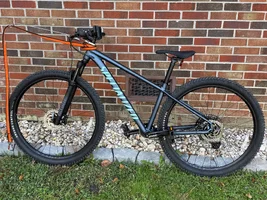
The equipment links provided are valuable yet there are some caveats that need be recognized. The forward projecting wand with length of bungee leaves the rider in near zero control should distraction from either side influence the straight line course that is hopefully being adhered to. Needless to state OB at times falters and even fails when most needed therefore OB control is vital as is need of functional fail-proof calliper or hydraulic brakes . Sudden stops are not an anomaly. It happens. The urge to answer Nature's Call gives little if any warning of an upcoming dead halt. Speaking from experience and currently utilize bike-work as an adjunct to personal mobility related issues and mobility SD tasks.
The side mount antenna restraint IMHO is not where a Doberman during any endurance activity is not strategically in place to be observed because lagging behind leaves the rider at disadvantage of not being observant as to fatigue and dehydration evidencing.
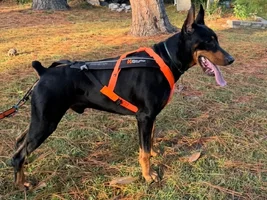
The extended front antenna and bungee attachment is functional in environment where there is no oncoming pedestrian and dog traffic. I often encounter both in my bikework regimen and need to navigate through the distraction without interference. I use a utility harness that transfers load directly to shoulders. A double strand of 4 ft. heavy duty bungee one end carbiner clipped to harness and other end to hand loop looped over the left handgrip. Strategically the Dobe is on my left and leading in 10 o’clock position. In overtaking slower pedestrian and dog traffic the bike is strategically a barrier separating the pedestrian/dog traffic on my right. Much like walking with Dobe on left side. If there is incident from the overtaking the distraction it defuses within a few bike lengths of passing the distraction. Forward momentum is requisite.
Oncoming traffic requires another strategy. I vocally and visually signal my intended pass lane keeping the bike between my Dobe and the oncoming pedestrian traffic. Etiquette not perfect, nevertheless required as stated. The middle finger salute I am certain is in the rear view if I were too look, however eyes are glued to the terrain ahead.
Turning to the left requires a slow speed with left leg extended to act as safety bumper when crowding the Doberman to the left accompanied by vocal direction “this way”. A right turn will be instinctual in following the flow of momentum and verbal direction “follow me”. Stop and starts are governed by braking and releasing. A vocal “Ready” incites enthusiasm and a push off and mounting the seat is indication it’s ’game on'. Stopping is preceded by the verbal negative reinforcer a guttural sounding “uh” the first sounding syllables of the common “uh uh” used in correcting a toddler or defiant Doberman. The negative reinforcer verbal correction messages the running behaviour is to be terminated.
How much and how soon to engage in bikejouring. The question of age as to when has been addressed — closure of growth plates 15 months +- i.e. reliable orthopaedic advise short of visual x-Ray.
How much and how far to extend the endurance capabilities of the said dog is vital lest lameness in an unconditioned dog will prevail. As a side note Ray Carlisle utilized 5 mile daily stints with his foundation bitch Alida throughout her life as found on page 16 of the document second from last paragraph and consequently motivated me decades ago to follow Ray's conditioning regimen. If it worked for Ray and if endorsed by one of the founding fathers of the UDC then his conditioning regimen can't be all that bad. Sounded like it had benefits which proved true in my experience.
A reliable source that provides a progressive conditioning regimen from 'A to Z' can be reviewed per the attached link
Conditioning for the Ausdauerprüfung (AD) | SIRIUS DOG and worth reading and adhering to the suggested measures.
Conditioning progress can statistically be mapped via an odometer recording average speed, max speed , distance and time. Current condition can readily be determined as progressing or regressing by comparing previous results to current results — hence logging the average times per mile will reveal at a glance progress or regress. Why all the trouble in detailing conditioning??? If bikework is an alternate day activity then if regress is being evidenced then something out of the ordinary is occurring. On a personal note a regressing of performance was evidencing leading to my suspicion of hypothyroidism in my Doberman and confirmed via TH blood panel. Thyroid meds have restored the endurance levels back to performance preceding her Hypothyroidism. All good. Nitpicking?? Only if on a stringent bikework regimen. Bikework comes with another caveat — unsurprisingly is the development of a monster …..albeit a welcoming athletic demeanour for rider and companion Dobe yet for some a not so welcoming demanding lifestyle.
The silver lining is that 6 mph/10 kph is a comfortable gait of an effortless undemanding trot and with intermittent bursts of sprint speeds nearing breakneck on-board 30 kph with rider in tow on favourable terrain then makes a 4 or 5 mile outing an attainable 1/2 hour 'work-out' for rider and Dobe. Dehydration is to be guarded against. A cupped extended tongue signals the onset. Needless to write high temps and humidity are to avoided and if signs of dehydration are appearing then rest, a squirt or two of water administered to thirsty tongue — avoid copious intake of water lest the danger of bloat could evidence — and slowing pace are a given.
The endurance title in IGP/Schutzhund is the AD (Ausdauerprüfung) details do's and don’t as did the siriusdog link above.
---

Details of the AD Title
• Name: AD (Ausdauerprüfung, meaning “Endurance Test”)
• Purpose: Demonstrates the dog’s physical stamina, structural soundness, and conditioning.
• Test Requirements:• The dog must trot beside a bicycle for 12.5 miles (20 km) at a steady pace of about 6 mph.
• A 10-minute rest is given at the halfway point.
• After completing the distance, the dog performs a short obedience exam (heeling, sit, down, recall).
• Eligibility: Dogs must be at least 16 months old and have passed the BH (Begleithund) temperament/obedience test before attempting the AD.
• Recognition: The AD is often a prerequisite for breed surveys (Körung) in German Shepherds and other working breeds, proving the dog’s fitness for work and breeding.

Why It Matters
• For Breeding: Confirms the dog’s joints, heart, and stamina are sound enough for working life.
• For Training Progression: Serves as a foundation before advancing to higher IGP titles (IGP1–3).
• For Working Dogs: Ensures the dog can sustain long periods of controlled activity, critical in police, sport, and service work.
In the common bond of Dobermans …..Mikel




 Typical Distances in Dog Bikejoring
 Source
 Typical Speeds and Times in 2 km Bikejoring Runs

 Love reading about the gear and training!


