• Disclaimer: Hello Guest, Doberman Chat Forums presents the opinions and material on these pages as a service to its membership and to the general public but does not endorse those materials, nor does it guarantee the accuracy of any opinions or information contained therein. The opinions expressed in the materials are strictly the opinion of the writer and do not represent the opinion of, nor are they endorsed by, Doberman Chat Forums. Health and medical articles are intended as an aid to those seeking health information and are not intended to replace the informed opinion of a qualified Veterinarian.”

If I was a breeder...looking for working lines

Every single carrier to carrier breeding is lowering the number of clears. Every. Single. One.
Fortunately, not every single breeder does this or even close to half. I'd safely say a fair majority try to breed to clears when we can. If you can't? You then breed that carrier or even affected back to a clear on the next generation. Problem solved. I'm just saying, vWD vs DCM... when one is a death sentence and the other is not? Breeders will choose the lesser of two evils. And you're right, you still get clears on carrier x carrier so often breeders will do everything they can to keep the clear puppy. I've known of breeders (rarely) using an affected x carrier and getting....zero affected. Odds say they should be 50% in a litter but that doesn't mean it'll always happen.

Anyways, this is usually why stud dogs are clears because people want to use them. But then everyone is going to those same dogs. We still need carrier stud dogs to be used with clear and even carrier bitches to produce more clears.

Here is a devil's advocate question for you... what if that affected has a BFL-1 or 2? Or hopefully the obvious decision, the clear has DCM?
 
I thought I recalled reading that some long effort in breeding out vWD has resulted in an improvement.
I asked Grok to look at AI and other similar data and confirmed the trend.

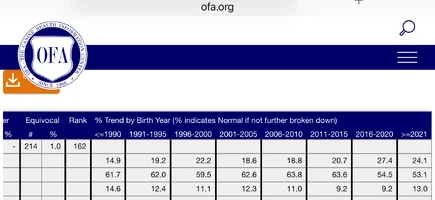
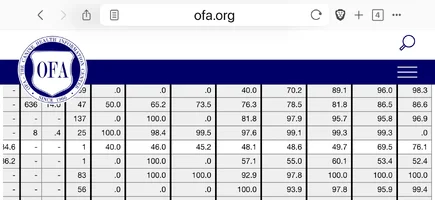
I'm not a breeder or geneticist so just tossing this quick look out for discussuon. Screenshots from OFA (which is not mobile friendly, so dig into them if interested)


Last edited:
I'm just saying, vWD vs DCM... when one is a death sentence and the other is not? Breeders will choose the lesser of two evils.
Without a test for DCM you don't know if you are breeding to one or not. So yes,
what if that affected has a BFL-1 or 2
I did mention that in a previous comment here:
Obviously it didn't hurt this dog who lived to be 14 while affected, but some are not so lucky.

So to answer your question if choice is only two dogs that died and has frozen semen, perfect in every way for my vWD carrier bitch but one lived to 14 as vWD affected and one died of DCM at age 8 what to do? I'd feel sorry for myself and cry. 😅🥲 I couldn't bring myself to breed a carrier to an affected. And frozen from a dog that died before 10 with DCM? Nope, can't consider it. If it were the last of the breed, I'd rather take my chance on the affected dog, so yes, with only those two choices I'd choose vWD. Then I'd DNA test the pups and any affected pups would be sold with that knowledge passed on to the new owner along with the fact that any surgeries, planned or emergency can cost 2 to 3 x as much with some vet clinics. Who wants to buy into that?
But if I didn't like the head on my girl and wanted a prettier head, the best looking head on the handsomest most perfect dog could not sway me if he had a known repetitive history of heritable disease in himself or his pedigree. I cannot choose striving for perfect looks over better health, I just can't.

You have to take your chances somewhere in preserving the breed. You're a breeder, you hold the bag on the future! That's where we stand today. As a buyer I would consider all health tests in parents of a litter and it can still turn to sh!t. I know that. We are both between a rock and a hard place and it's a crying shame it's not easier.
 
Oops too slow on the edit, timed out:

I asked GrokAI to look at OFA and other sources for proof of improvement- it also cited DobeQuest but only on individual dogs not listed in summary year by year.

If DPCA could open that database and make customer friendly, plus mandate yearly reporting on all pups as a condition of membership- then the free market could decide...people could select pups tgat are long lived or more to a partivular look, or to sports working proofs.

Education brings more awareness and better data gives MORE choices, and that means good business, right?

Sample iphone screenshots attached,
IMG_1650.webpIMG_1649.webp
go to PC to see OFA data better.

And here is another good discussion:
 
I thought I recalled reading that some long effort in breeding out vWD has resulted in an improvement.
It was more serious years ago, true. Careful breeding to avoid affected dogs has resulted in much lower cases, and as @Jan and @Rits mentioned, many affected never bleed out or have problems in surgery. And as was mentioned in one of the spay discussions here, if you alert your veterinary clinic of the fact that you have an affected dog, they are better prepared to deal with it if they see things going wrong in surgery. But also, one person was told that their routine spay would be several thousand dollars due to having to prep for a bleed-out whether it happened or not. And what about insurance, they are born affected, do you disclose that to the insurance? Can the deny you?

And like I mentioned the first time, not so many deaths any more from it, mostly due to knowledge ahead of time, but my very first Dobe - an adopted homeless/dumped bitch from the early '80's - had it but I knew nothing about it and in po-dunk Arkansas neither did the vets. She bled during her spay, every cut bled and bled - I assisted in the spay so I can assure you none of us in the room had seen anything like it. Clamps everywhere. I'm sure the vet gave something to help clotting and it finally got under control, then she didn't come out of the anesthesia. It took hours instead of minutes. She lived for another year or so, I'd moved to Oklahoma, long story, but over night she was crying and I looked at her gums and she was white as a sheet, rushed her to the vet but she died in the front seat of my truck. The vet examined her and said she bled out internally, probably from a minor injury. It was a long time later I learned of vWD, and realized that's what I was looking at. So maybe I'm more sensitive on this subject, since my one & only first dog died of it. I saw and assisted in 100 spays and only mine bled relentlessly, I can't unsee that. So, no. I don't want an affected dog.
 
I'm just saying, vWD vs DCM... when one is a death sentence and the other is not?
My thoughts exactly. I'm by no means a breeder but vWD is the least of worries when it comes to health testing since it alone isn't going to affect the longevity or health of the dog where many of the other things that are tested for will, if they have a problem. If you happen to wind up with that small percentage of a clinically affected dog, your vet needs to be aware if they need surgery or get hurt so they can take precautions.
One of our members (I won't mention names) had a clinically affected Doberman who recently passed at 13 years.
 
^^^ That's a very good article that explains a lot. I've been told that affected dogs just aren't dying like they use to and I only knew from my personal experience that "but they CAN". I do accept that severity is trending down and I embrace that. But for my own reasons I will forever be wary of it.
I would be too, after a first experience like that especially.
I remember that vWD screening/proof FIRST was explained as a MUST DO by the person who helped me find my first dobe 30+ years ago.
I note the DNA test is now accepted as one that IS accepted proof of clear vs the old blood test.

But of course- how many new owners of byb pet dogs or rescues actually take a DNA test, or know to get a blood test before surgery?

I'm assuming more GP vets are aware or have the resources to understand a specialty breed, and I did not know vWD affects other breeds too:

 
Then I'd DNA test the pups and any affected pups would be sold with that knowledge passed on to the new owner
Yup! Thats what responsible breeders do!

And what about insurance, they are born affected, do you disclose that to the insurance? Can the deny you?
We had insurance on Stavros, who is affected, with no issues from insurance. He had a minor surgery and was fine then too. I understand the trauma from your personal experience and I cannot imagine going through that. Thankfully that doesn't seem to be the case much more these days. Breeders still try to breed to clears as much as possible. I personally returned Stavros back to my breeder because he is affected and my Ripley son could only be a carrier or a clear. I knew in my heart it was the right decision for my program.
 
I knew in my heart it was the right decision for my program.
I know that as a breeder your choices must weigh much heavier than my own. I only have to make decisions about what I want and go search for it. You have to work on actually creating and maintaining what you want since it's ever-evolving.

I am supportive and grateful for breeders who are truly dedicated, even if we don't align 100%, I know it's never easy!
 
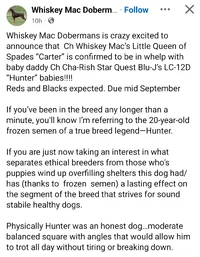
@Nordika ….. I've been following your thread and consequently including a useful link to assist in determining the COI of Hunter relative to longevity in your pup. COI calculator. Perhaps better said , the COI of your pup relative to Hunter and consequently a 'look into the crystal ball' in projecting genetics that could/would promote longevity. If Hunter appears in both sides of your pup's pedigree then the exercise in determining COI might provide a reliable indicator regarding longevity and inherited genetic probability representative of “physically Hunter was an honest dog… moderate balanced square with angles that would allow him to trot all day without him breaking down”.

Then again if Hunter appears on only one side of the pedigree then this discussion becomes moot and apologies for taking up your time.

In the common bond of Dobermans/Dobermanns …..Mikel
 
@Nordika ….. I've been following your thread and consequently including a useful link to assist in determining the COI of Hunter relative to longevity in your pup. COI calculator. Perhaps better said , the COI of your pup relative to Hunter and consequently a 'look into the crystal ball' in projecting genetics that could/would promote longevity. If Hunter appears in both sides of your pup's pedigree then the exercise in determining COI might provide a reliable indicator regarding longevity and inherited genetic probability representative of “physically Hunter was an honest dog… moderate balanced square with angles that would allow him to trot all day without him breaking down”.

Then again if Hunter appears on only one side of the pedigree then this discussion becomes moot and apologies for taking up your time.

In the common bond of Dobermans/Dobermanns …..Mikel
Thank you for the link! That dog is only on the dam's side, no apologies necessary though. Thank you for contributing to the conversation and including a very useful COI tool.
 
I think you are exactly right. I think the suggested 4 changes are spot on. I hate things being required, but it's probably the only way to make it happen. Right now I would say it would never pass the board of the DPCA to even be written up as a suggestion. In fact, I'd say each 1 - 4 wouldn't fly even as a stand-alone suggestion. I could be wrong, I don't belong to the club, but I think the pearl-clutching would be real.

I had to laugh when the outcross program was presented on several different Doberman based pages on FB the outcry could be heard through a brick building. Not one understood what an outcross/breeed-back even meant. They thought the idea was to create new breeds of these 50/50 outcrosses. CLUE.LESS. And I guess no desire to read the article, do some research, ask questions instead of screaming "NOooooo!!!" Any way, I pretty much feel like most of the breeding world is happy to go along with the current state of affairs, and never mind that the chances of your dog living to 10 are less than 50/50.
This was an interesting read if you have the time, and note that the last option to save the breed is outcrossing.
 

Back
Top