Mercy Dog’s during WWI WWII

Ddski5

Hot Topics Subscriber
$ Forum Donor $
I knew Dobermans were used during the Wars but not at this capacity. Always good and makes me proud.
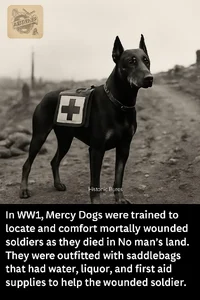
IMG_3980.webp


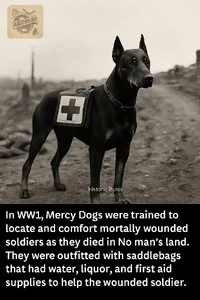
Were Dobermans used as Mercy Dogs during WWI WWII?

Yes, Dobermans served as mercy dogs during World War I and World War II
, finding and providing aid to wounded soldiers in the chaos of battle. These dogs carried medical supplies, stayed with soldiers until help arrived, and sometimes brought back items to signal a location. They were used by multiple armies, including Germany, Britain, and France, and were praised for their courage and loyalty in difficult conditions.
  • Role of a mercy dog: Mercy dogs were trained to locate wounded soldiers who were unable to call for help. They would carry medical supplies like bandages and morphine, sometimes staying with a soldier to offer warmth and companionship.
  • Signaling for help: If a soldier was too severely injured to receive aid, the dog would often return to the base with an item of the soldier's gear to signal their location.
  • Other roles: While serving as mercy dogs, Dobermans were also used for other duties like guard and messenger roles, searching for mines, and acting as sentries.
  • Courage and training: These dogs were trained to ignore the sounds and smells of battle, relying on their instincts and loyalty to complete their missions. Their intelligence, resilience, and stamina made them ideal for the job.
 
I knew Dobermans were used during the Wars but not at this capacity. Always good and makes me proud.

View attachment 157338


Were Dobermans used as Mercy Dogs during WWI WWII?

Yes, Dobermans served as mercy dogs during World War I and World War II
, finding and providing aid to wounded soldiers in the chaos of battle. These dogs carried medical supplies, stayed with soldiers until help arrived, and sometimes brought back items to signal a location. They were used by multiple armies, including Germany, Britain, and France, and were praised for their courage and loyalty in difficult conditions.
  • Role of a mercy dog: Mercy dogs were trained to locate wounded soldiers who were unable to call for help. They would carry medical supplies like bandages and morphine, sometimes staying with a soldier to offer warmth and companionship.
  • Signaling for help: If a soldier was too severely injured to receive aid, the dog would often return to the base with an item of the soldier's gear to signal their location.
  • Other roles: While serving as mercy dogs, Dobermans were also used for other duties like guard and messenger roles, searching for mines, and acting as sentries.
  • Courage and training: These dogs were trained to ignore the sounds and smells of battle, relying on their instincts and loyalty to complete their missions. Their intelligence, resilience, and stamina made them ideal for the job.
Thats a good looking dog!
Wonder how it would fare in confo?
 
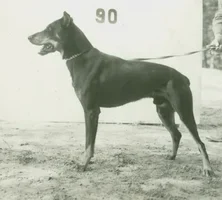
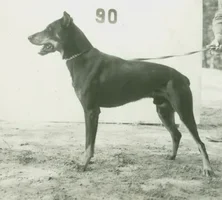
The Doberman of old doesn’t not look like our modern Doberman.

Perceptions and expectations have changed.
Yes, and interestingly enough, today's dogs from German working lines still look much like this. And the critiques are usually referring to a plain or incorrect head, lack of chest, imperfect back.... but I'd take the dog in this picture in a heartbeat. Pretty is as pretty does.
 
The image is AI so it wouldn't do well at all as "a doberman of old" or "as a doberman in the ring today" since it doesn't exist :D The dog actually doesn't look half bad. The only thing I can accurately judge from this picture is his eyes aren't almond shaped (round eyes change the intimidation look factor, and reflects too much light) and not enough fill under the eye (which affects jaw strength/shape).

Perceptions and expectations have changed.
I wouldn't say perceptions have changed. The written standard is still the standard! It takes time to develop and breed to the standard. No dog is perfect. A breeder can make one step forward in one area and two steps back in another. They can get there, then lose it all to an accident, health (...the breed was founded with heart issues from the start), the dog doesn't reproduce itself well, etc. Now multiply those steps for every breeder so that we have the population as a whole more closely fitting the standard. Plus, toss in breeding for health and temperament. My point is of course the doberman of old doesn't look like the doberman of today because a doberman in WW1 was not far off from its conception as a breed, which used mutts and dogs from the pound to create. ;)

It is disappointing seeing all the confo hate on here. I think conformation has just as much importance as health and temperament does. All parts matter to enjoy this wonderful breed. Who wouldn't want to promote breeding a dog with a strong back, strong hocks, well angled chest to better cover ground, a well defined muzzle with the correct depth of jaw and an appropriate amount of teeth to bite and hold onto the bad guy with, strong pasterns that won't break down, all so the dog will be more comfortable when working and performing its job? Because this "dog of old" looks uncomfortable, especially in the topline (hunched, not strong and powerful) and rear (cowhocked). Jumping and landing on his straight front will be so incredibly jarring on this dog's body. The lack of angulation in the front will prevent him from being able to reach out and cover ground. I see ACL issues down the road with his hocks turned in and foot turned out, his knee is also rotated out, all making it much more susceptible to being torn.

1763834909834.webp

Have expectations changed? Oh, I definitely agree there. The modern family doesn't have the appropriate resources, dedication, or care to own a doberman with the temperament of a doberman of old. Daily mental and physical stimulation, a job, obedience to keep the sharpness under control. People of today solely want the look of a doberman that can lay on the couch day in and out.
 
Funny, I was going to add that it looked like an AI image....almost cartoon. Glad you mentioned it and posted the photo of an actual 'older' version of the Doberman.
I had never heard of Mercy Dogs @Ddski5 so thanks for the info!
 
The image is AI so it wouldn't do well at all as "a doberman of old" or "as a doberman in the ring today" since it doesn't exist :D The dog actually doesn't look half bad. The only thing I can accurately judge from this picture is his eyes aren't almond shaped (round eyes change the intimidation look factor, and reflects too much light) and not enough fill under the eye (which affects jaw strength/shape).


I wouldn't say perceptions have changed. The written standard is still the standard! It takes time to develop and breed to the standard. No dog is perfect. A breeder can make one step forward in one area and two steps back in another. They can get there, then lose it all to an accident, health (...the breed was founded with heart issues from the start), the dog doesn't reproduce itself well, etc. Now multiply those steps for every breeder so that we have the population as a whole more closely fitting the standard. Plus, toss in breeding for health and temperament. My point is of course the doberman of old doesn't look like the doberman of today because a doberman in WW1 was not far off from its conception as a breed, which used mutts and dogs from the pound to create. ;)

It is disappointing seeing all the confo hate on here. I think conformation has just as much importance as health and temperament does. All parts matter to enjoy this wonderful breed. Who wouldn't want to promote breeding a dog with a strong back, strong hocks, well angled chest to better cover ground, a well defined muzzle with the correct depth of jaw and an appropriate amount of teeth to bite and hold onto the bad guy with, strong pasterns that won't break down, all so the dog will be more comfortable when working and performing its job? Because this "dog of old" looks uncomfortable, especially in the topline (hunched, not strong and powerful) and rear (cowhocked). Jumping and landing on his straight front will be so incredibly jarring on this dog's body. The lack of angulation in the front will prevent him from being able to reach out and cover ground. I see ACL issues down the road with his hocks turned in and foot turned out, his knee is also rotated out, all making it much more susceptible to being torn.

View attachment 157373

Have expectations changed? Oh, I definitely agree there. The modern family doesn't have the appropriate resources, dedication, or care to own a doberman with the temperament of a doberman of old. Daily mental and physical stimulation, a job, obedience to keep the sharpness under control. People of today solely want the look of a doberman that can lay on the couch day in and out.
Great explanation @Rits
I agree confo is necessary to proof a strong efficient and functional to tasks muscles and skeleton. If the dog cant move well, the health and temperament suffer.
So its almost like an art form, to create and refine a line, amiright?
 
Interesting and grateful to hear your take on the history, too, @Ritz

Doing some digging on this using my research assistant, found some useful references. A poster here mrntioned Pfaffenberger on another forum, and his thinking and work on temperament.

Joanna Walkers book on Dobies, Greunigs book, are there others that speak to this evolution in a softer side away from working lines? I read about UDC formed as a split from DPCA to focus on working purposes, and using Schutzhund health and temerament testing as the standard, as requirement to breed in Germany.
Whats interesting to me is as you say; American breeders decided to shift the standard (sometime between WW1 and WW2?)
To a more docile, soft temperament, so judges wouldnt get bit in the ring.

As someone else here noted; American show line buyers wanted this and breeders delivered.
If there is a need, the free market will fill it.

Now the focus is shifting to how do we deal with effects of inbreeding. Its a delicate but necessary conversation for a new generation more familiar with ordering a meal to be delivered to doorstep...buying dogs as fashion statements or accessories to be an influencer with "scary black dog privilege" as they say on TikTok, IG...

Not judging breeders or confo per se here, just noting that customer preferences have always moved the needle, going back to the county fairs in Thuringia, when farmers showed their prize bulls and bartered or bought dogs to do a job; hunting dogs, ratters, and home guardians.

Sort of interesting to me how much some of those different drives show up in dobes, each an individual if course, but as a breed; originally built as a functional dog to a purpose.

Really fascinating- history.
 
To a more docile, soft temperament, so judges wouldnt get bit in the ring.

As someone else here noted; American show line buyers wanted this and breeders delivered.
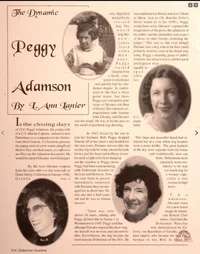
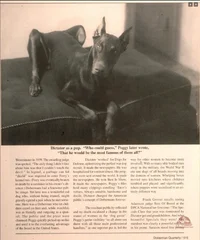
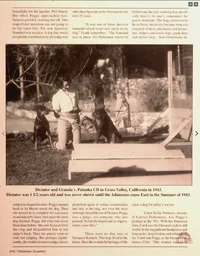
Men were at war and women were left home to take care of the breeding while also raising their own babies, so whelping boxes moved inside the kitchen and home with the family and children. America now needed a doberman that was incredibly stable in temperament. You also have Peggy Adamson and Dictator to thank, who changed the public's perception of dobermans and their temperaments, after the first doberman Ferry von Raufelsen of Giralda to win Best in Show at Westminster in 1939 could not be touched. Dictator was used in Dept. of Defense war dog advertisements. He was seen allowing children to crawl on him. Winning Best in Shows and judges able to touch him. Peggy also excused a doberman from the ring at the DPCA National for growling at her after repeated attempts to give the dog time. The American public's perception of the doberman was forever changed. No longer was a doberman housed in kennels outside the home.

I am for one happy about this adaptation for society at that time. What good is a doberman as a protector if kept in cages out of the home because they are too sharp and can hardly be handled because they are too aggressive? I do feel we need to dial it back though and bring back in dobermans that won't fold so easily under pressure.


Screenshot 2025-11-23 131154.webp
Screenshot 2025-11-23 131219.webp
Screenshot 2025-11-23 131253.webp
 
Men were at war and women were left home to take care of the breeding while also raising their own babies, so whelping boxes moved inside the kitchen and home with the family and children. America now needed a doberman that was incredibly stable in temperament. You also have Peggy Adamson and Dictator to thank, who changed the public's perception of dobermans and their temperaments, after the first doberman Ferry von Raufelsen of Giralda to win Best in Show at Westminster in 1939 could not be touched. Dictator was used in Dept. of Defense war dog advertisements. He was seen allowing children to crawl on him. Winning Best in Shows and judges able to touch him. Peggy also excused a doberman from the ring at the DPCA National for growling at her after repeated attempts to give the dog time. The American public's perception of the doberman was forever changed. No longer was a doberman housed in kennels outside the home.

I am for one happy about this adaptation for society at that time. What good is a doberman as a protector if kept in cages out of the home because they are too sharp and can hardly be handled because they are too aggressive? I do feel we need to dial it back though and bring back in dobermans that won't fold so easily under pressure.


View attachment 157390
View attachment 157391
View attachment 157392
This is great history @Rits and I defer to your long breeder experience on how things work.
Its a fascinating debate, and I "have no dog in the fight" nor an agenda.

Its very interesting to me how things unfolded and this is invaluable context for history of the breed. I agree, moving dobes indoors seems obvious today but things were different then.

I read somewhere the Army "gave" the kenneling and training of dobes to the Marines as the dogs were too tough to handle, anong other dogs donated to the war effort in WW2.
 
The image is AI so it wouldn't do well at all as "a doberman of old" or "as a doberman in the ring today" since it doesn't exist :D
AI picture or not, it’s pretty close to the original product and contrastingly different than today’s DPCA standard. That standard would not be too nice at all to the old school Doberman. One can definitely tell they were originally made specifically to do the job and not to meet a standard.


It is disappointing seeing all the confo hate on here. I think conformation has just as much importance as health and temperament does.
Confo hate on here?? I hope that not what you are seeing. No hate posted that I see…just a conversation topic.

Because this "dog of old" looks uncomfortable, especially in the topline (hunched, not strong and powerful) and rear (cowhocked). Jumping and landing on his straight front will be so incredibly jarring on this dog's body. The lack of angulation in the front will prevent him from being able to reach out and cover ground. I see ACL issues down the road with his hocks turned in and foot turned out, his knee is also rotated out, all making it much more susceptible to being torn.
But the dog of old prob had no DCM, VWD, Wobblers?
Be it on BYB or reputable breeders, there was a cost to achieve today’s perception of the “standard”?
 
Last edited:
AI picture or not, it’s pretty close to the original product and contrastingly different than today’s DPCA standard.
We can't fairly judge a whole lot at the angle of the AI pic other than the face and crop length. Because honestly, at this angle it could easily be a dog of today to me besides the short cropped ears and too round eyes lol.

But the dog of old prob had no DCM, VWD, Wobblers?
No it definitely did. Three of the original seven sires had died of "heart issues." vWD was worse in the past than it is today because we had no test. Wobblers, I imagine has been with the breed for equally as long. We didn't have health testing back then like we do today, nor an online database to track pedigrees, nor longevity programs awarded by the DPCA to track longevity in pedigrees, all which has helped the health of our breed. Unfortunately, the breed has started with heart issues and we still haven't found all of the markers there are to start weeding that out too but annual heart testing such as holter and echo has really only caught on recently.

long breeder experience on how things work.
Not long breeder experience but a huge passion in the breed. I apologize if I seemed defensive but some of the (funny enough) criticism about showing, show breeders, conformation, the standard, etc. has been building up in some posts here and its important to remember that all parts that make the doberman a doberman are important. We can't have a doberman without breeding to the standard which describes conformation AND temperament, not just conformation. You wouldn't build a house without a blueprint, why would we breed dobermans without one? The pieces written in the standard have purpose. To preserve our breed and give them an ideal body to perform their job well.
 
Defensive? I think all of your hard work, energy and time has made you a mama bear of conformation 🤣?
We can't fairly judge a whole lot at the angle of the AI pic other than the face and crop length. Because honestly, at this angle it could easily be a dog of today to me besides the short cropped ears and too round eyes lol.
Huge appearance differences of the Dobermans down below.


Not long breeder experience but a huge passion in the breed. I apologize if I seemed defensive but some of the (funny enough) criticism about showing, show breeders, conformation, the standard, etc. has been building up in some posts here and its important to remember that all parts that make the doberman a doberman are important.
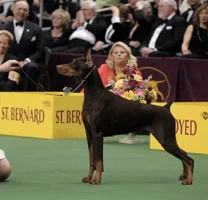
My thoughts in that was not criticizing or questioning breeders, the standard, nor the parts that make the Doberman a Doberman. It was a simple statement saying that the the old Doberman would not fair too well in conformation of today. I think it would be interesting to hear the thoughts of a confo judge who critiqued these Dobermans:

IMG_3980.webpIMG_3986.webp

Vs

This modern to “the standard” Doberman
IMG_3987.webp

Not questioning if the modern standard made the Doberman better or not. Just saying, I don’t think today’s judge would be too complimentary to the older Dobermans with today’s standard. Wonder what they would think if one ran in the ring (and them not knowing and then another different scenario of them knowing it was an old gen). I think it would have different outcomes.
 
I just wrote about 500 words on what I think, but I deleted it and will save it for a post of its own and I don't want this topic about one of the best things the Doberman breed ever did in public service to turn into how they needed to look better doing it.

Let's just agree that every Doberman is a Mercy Dog for each and every person that has one.
 
I remembered the comment about AI rendered image, so I went ahead and screen shotted and copy paste to Grok to "find image"...it didnt, which is not proof as fake, just that it could not finf it in the databases it has access to...

Grok did compile some related links- to the OPs point- dogs did amazing stuff in WW1.


I don't want this topic about one of the best things the Doberman breed ever did in public service to turn into how they needed to look better doing it.
I don't either so I'm not sure why it was even brought up. But it did make for interesting conversation on the development and evolvement of the breed to adjust to society.
 
Last edited:

Back
Top