Importance of Temperament in Breeding

Ravenbird

Moderator
$ Forum Donor $
At the request of @BG1 I have put this post in its own thread for mored input specifically on the temperament issue.

I stumbled over this post on FB and the author says everything I've tried to put into words myself and failed to get across what I'm seeing and feeling. I've said a hundred times that this breed is not what they use to be, and swear there were never all these problems that we see in today's Dobermans. Finally someone has said it for me. When she describes the "use to be" Doberman, that's the one I call my perfect dog who was whelped in 1991. She was all those things. She wasn't a unicorn, that was the norm back then.

OPEN LETTER TO THE DOBERMAN COMMUNITY
For the love of the Doberman….
I am writing this now because after 25 years of living with, working with, titling, and loving Dobermans, I am seeing something in the breed that I have never seen before. A steady decline in stability, confidence, and resilience that should concern every single one of us who claims to care about this dog.
I have stood beside Dobermans from multiple eras. Dogs who earned championships, obedience titles, temperament certifications, and working titles. Dobermans who lived into double digits with sound minds and bodies. Dogs who could walk into a room, assess it clearly, and settle with quiet dignity. They could be left alone without panic, crated without hysteria, and worked in true drive without spiraling into arousal. These were Dobermans who were present, confident, and sane.
Today, I am seeing far too many Dobermans who cannot tolerate simple confinement. Dogs who cannot be separated from their owners by even a few feet without emotional collapse. Dogs who tremble, spin, self-soothe through compulsive behaviors, scream in crates, and pace endlessly. Not because they are high drive, but because they are overwhelmed by their own nervous system.
You do not get to call anxiety loyalty. Clinginess is not devotion. A Doberman that cannot stand on its own four feet without unraveling is not a guardian. It is a prisoner to its weak nerves.
The Dobermans I came up in the breed with were aloof, discerning, confident, and athletic. They were watchful without hysteria, protective without panic, powerful without over compensation. They could take pressure without folding. They could be asked for work without falling apart. They thrived under structure and clear leadership.
Today, many Dobermans swing between frantic golden-retriever-style neediness and sharp overcompensation. They make defensive displays not from courage but from fear. Worse still, many cannot be fulfilled through healthy drive outlets because their food drive is flat, their toy drive is non-existent, and their genetic confidence is fractured. This is not the Doberman described in our breed standard.
To the breeders reading this. You are the gatekeepers of the Doberman’s future, not its marketers. Please stop romanticizing fragility. A dog that cannot cope with life is not “sensitive” in a charming way. It is unfit for the very role the breed was created for. Stop placing puppies into homes you know are not prepared. That is not kindness. Be brutally honest with your buyers. Tell them that a Doberman without structure becomes neurotic. Tell them that affection alone is not leadership. Tell them that these dogs will run their households if allowed, and once they do, anxiety will follow. Health matters deeply, but a long-lived Doberman with a broken mind is not a win.
To the owners. If you have chosen this breed, you have chosen responsibility. Your Doberman does not need more affection. It needs structure. It needs follow-through. It needs you to show it how to live in this world without falling apart. Crate training is not optional. Independence is not cruel. Obedience is not oppressive. And a walk around the block and a lick mat is not enrichment for a working dog.
Stop confusing hyperactivity with drive. Stop over-socializing your Doberman into insecurity. Stop excusing reactivity as “just how Dobermans are.” They do not need more freedom. They need better leadership. If you do not meet their mental and physical needs, they will not simply grow out of it. They will grow into it.
The Doberman is already under pressure from serious health concerns. To layer compromised temperament on top of that is to walk this breed toward a future where it becomes nothing more than an anxious silhouette in a striking outline.
We can do better. For the love of the Doberman, we must do better. Breeders must choose stability over trend. Owners must choose structure over comfort. As a community, we must choose honesty over righteousness.
Because clarity is kindness, and this letter is written not in judgment but in devotion to a breed that deserves more than what we are currently giving it.
Tamara Champagne


and from @BG1 - ideas for discussion:

what can breeders do to slow/stop the decline
And
Two, what can we owners or new puppy buyers do in terms of structure, etc.

@Ravenbird since you are passionate about this- would you repost as its own topic, for more comments?

I especially appreciate the grounded perspective of those in working sport, on training etc.
 
I'm sure this is the basis for WAE and ATT. I know with ATT it is geared toward the breeds temperament and it most likely is with WAE too.
 
Love this and am saving it to share....Thanks for posting; I am not on FB.
So many powerful statements, the one's that stand out:
"Tell owners a Doberman without structure becomes neurotic"
"Work with true drive without spiraling into arousal"
"Become prisoners to weak nerves"

The WAE is failed by many now on that last "Protective response" exercise. They either get so amped up, and unable to turn it off when the evaluator comes over to touch them after the threat has passed, or they hide behind their handler at the sight of the danger.
 
I'm sure this is the basis for WAE and ATT. I know with ATT it is geared toward the breeds temperament and it most likely is with WAE too.
Thanks @JanS very interesting supposition...

I wonder...when did WAE begin to be widely adopted for dobes on working side and
The same for ATT on the AKC show dog side?

I'm a total noob on show dog or working dog trials but its interesting to see how titling, shows, etc evolved in the US as more proof of free market customer demand- the breed splitting into show or working, as is evident in other breeds- GSD mot obviously.

As the OP on the letter opines, we the customers of the breed have a voice and a responsibilty... both for what we chose in best breeders, and what we do as best owners in things like providing "structure"...training, what we ask the "ethical-preservation-responsible" breeders to actually DO vs just use marketing buzz words.

I can think if some things I want as a "maybe one more big dog buyer" if I could find it in one dog: health and longevity screening and proof, to start...now lets talk temperament...I'm thinking of the working border collie breeders and buyers who ignore pretty, refuse color coding as the standard, and breed for intelligence and drive to purpose...seems to me we have a good definition in the past...how do we turn the supertanker of showdog pretty world around to get back to that?

So this topic can go down several interesting paths but all under one goal: saving or even restoring the original breed standard as a "total doberman" or "functional dog" more to its original purpose.

I know there are some breeders out there doing it...how can we as owners and future buyers support that?
 
Last edited:
Love this and am saving it to share....Thanks for posting; I am not on FB.
So many powerful statements, the one's that stand out:
"Tell owners a Doberman without structure becomes neurotic"
"Work with true drive without spiraling into arousal"
"Become prisoners to weak nerves"

The WAE is failed by many now on that last "Protective response" exercise. They either get so amped up, and unable to turn it off when the evaluator comes over to touch them after the threat has passed, or they hide behind their handler at the sight of the danger.
TY. So thats another dobe owner/informed observer validation and proof statement to the OPs point- an example of over neuroticism, shyness, lack of courage, confidence, resilience in temperament...over time.
 
I wonder...when did WAE begin to be widely adopted for dobes on working side and
The same for ATT on the AKC show dog side?
I'm not sure of that but I think WAE was around before ATT.
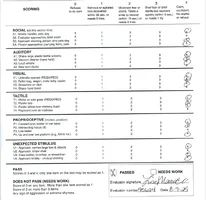
I'm sure you've seen it but this was one of Olive's ATT sheets and what wasn't checked in the first one was done in the second test. She passed all of them in both tests.
ATT score sheet August 2025.webp
 
I'm not sure of that but I think WAE was around before ATT.
I'm sure you've seen it but this was one of Olive's ATT sheets and what wasn't checked in the first one was done in the second test. She passed all of them in both tests.
View attachment 156563
Nice work Olive!
And to use this as an example of what to do, as an owner or buyer- is look for proof of temperament on ATT or WAE, on both sire and dam. And how about up the line?

Has anyone here on DCF selected for that temperament as a primary factor? How far back in generations for proof? Where do you find it? Dobequest? Other?

As I recall, there are differences in the WAE and ATT, but both are the same in concept- that you dont TRAIN for this...you just test to see what you got...

So having proof in the lines of high passing is a very good first step in selecting a dobe from a breeder with proof in lines to one of the key desired factors- calm, confident, resilient and discriminating guardian temperament.

Who is Olives breeder, btw?
PS: TY @Ravenbird for platforming this...I'm gonna try to defer to you as the OP but everyone forgive me for my enthusiasm...i'll try NOT to thread hog here...
And admit whats in it for me- if I were to commit to one more big dog here as family companion to BYB Bonnie now in ESA/SD role but of unknown longevity...
Then for family guardian backup I am thinking a calm confident traditional male Dobe, with proven health and longevity. Thats a lot of work but worth the Return on Investment
if you put in the time, with good help, and my learning curve on that is shortened and leveraged by having begun to understand the breed, on BYB Bonnie.
 
Last edited:
I'll have to chime in more later, but I want to point out that the "Letter" is not about WAE or other temperament tests. Go back and re-read. I'm seeing referrals to extreme behaviors AT HOME, that we have to live with, manage and constantly address that did not use to exist. . Now they exist to the point that they are "normal" for the breed, and have even become endearing to the owners (blanket sucking) or at the worst, cause them to be surrendered to shelters, sent back to breeders and be the reason that they are "not for first time puppy shoppers".
Today, I am seeing far too many Dobermans who cannot tolerate simple confinement. Dogs who cannot be separated from their owners by even a few feet without emotional collapse. Dogs who tremble, spin, self-soothe through compulsive behaviors, scream in crates, and pace endlessly. Not because they are high drive, but because they are overwhelmed by their own nervous system.
^^^ This is not seen at a WAE, or at a show. In hand, they are working machines, doing their self stack or their obedience trial like the champions they are, pass their health tests, then they get bred with nobody mentioning these "little things".
To the owners. If you have chosen this breed, you have chosen responsibility. Your Doberman does not need more affection. It needs structure. It needs follow-through. It needs you to show it how to live in this world without falling apart. Crate training is not optional. Independence is not cruel. Obedience is not oppressive. And a walk around the block and a lick mat is not enrichment for a working dog.
Stop confusing hyperactivity with drive. Stop over-socializing your Doberman into insecurity. Stop excusing reactivity as “just how Dobermans are.” They do not need more freedom. They need better leadership. If you do not meet their mental and physical needs, they will not simply grow out of it. They will grow into it.
^^^ Here she is suggesting how to deal with these issues, but I can assure you that many of these dogs coming home from a breeder at 10 - 12 weeks are difficult from day one, not because of a newbie not knowing how to crate train. All we have to do is read the training and behavior threads or the puppy threads. Anxiety runs deep in this breed whereas they use to be totally chill, confident dogs that couldn't be rattled. We joke about not going to the bathroom alone, but really, what does this say about our dogs?

Temperament & behaviors are genetic. Any little thing snowballs/stacks up with inbreeding, whether it's a pretty head, cat feet, heart disease, blanket sucking, separation anxiety or explosive barking & excessive suspicion or being so shy they wet themselves. You can help any dog with management and good training and exposure to life, but it will still pass their genetic tendencies to the next generation. This is why it's about breeding, not training. It's how we got here in the first place.
 
Thanks for sharing a well written article.

Yes, Oji (working line Dobe) was in some ways, a mess. He definitely helped me step away from the breed.

Dax, his predecessor, (working line Dobe) also had serious problems.

Magnum (hobby bred in 1996) was the best of them all, but he was nervous enough, would clack his jaws when stressed in some situations, lick excessively, could only nip – not bite, and would probably back down if pushed by an aggressor.

Excessive whining in them all, especially the working Dobes
 
As with any breed, breeders have their own name and self-interest in mind. They won't collaborate for betterment.

I believe the breed, overall, will not improve. It's my prediction that the noble Dobe of yesteryear that Ravenbird describes, and that I recall @Tropicalbri's talked about, and that my girlfriend's mom back in 1988 had, is not coming back.
 
Hmmmm. I hear you @Ravenbird that its about breeding. I'm agreeing from my experience, limited as it is (only one dobe 30 years ago, and another age 3 now) plus reading a fair bit about the history in books and archives here and other dobe forums...


That this is a consensus view, among mamy very experienced...the lamentable decline from old standards, in stable temperament.
I'm recalling trading that American dobes went through a popularity surge in 50's, and that show breeders in US show workd purposely selected for looks and also softer temperament, as compared to in Germany where it was bred for fierceness in temperament and for example it was not disqualifying for the judge to get bit while laying hands in.

I'm also wondering about the authors training experience in the breed- have to infer it from "her 25 years" mention the letter, but also her own history...see the links to her trainer business, that podcast, anyone know anyone she worked with?
And what sort of dogs was she working with- personal pets of customers in the home, confo Handling in the ring? Training for trials, confo and sport, working and PPD...?
To understand what someone feels it helps to know where they come from...

My go forward focus is, assuming its true for her from her own 25 year perspective, and that assuming its true from other folks long in the breed, and assuming it matches a deliberate choice as in history books,
and as expressed in forums like this going back 20-30 years, then...

What can we do about it?
I'm reading there are people breeding to at least try to hold onto the original intent, and to the ideal -calm, confident, resilient etc...

So, how do we customers influence the return to that? Talk about it, as in here and other places, thats one small contribution.

Make choices in future purchases from those kinds of breeders..."ethical, preservation" is the buzzword...

And is that enough?
Or is the breed irretrievably narrowing out, down an evolutionary path to the decline and loss of that old standard, doomed to mediocrity by puppy mills and flashy marketing for big blocky hypertrope ghetto dogs?

One thing I noticed from the authors current background, from podcast link, thst she is moving to a focus on hunting dogs, inc the GSP...for drive.

Reminds me some of how other commenters here and at other places, shift in preference to other breeds. Same in showdog world- I'm thinking of one vet I know who was into dobes, rotties, then pugs, then cavaliers.

Is it a sign of how dogs are increasingly viewed by general public in US and elsewhere as fashion accessories, and chosen by whats hot on IG, YT, and tiktok? See also how an emerging newly affluent class for example in China, childless or late parents, are gaga about dogs, dressing them up, etc.

I'm wondering about the changes in glamouzing ones life on social media, and how that influences dog purchases - the rise in designer breeds to suit the popular whim of the moment...

Just spitballing here...
 
Last edited:
Hmmmm. I hear you @Ravenbird that its about breeding. I'm agreeing from my experience, limited as it is (only one dobe 30 years ago, and another age 3 now) plus reading a fair bit about the history in books and archives here and other dobe forums...


That this is a consensus view, among mamy very experienced...the lamentable decline from old standards, in stable temperament.
I'm recalling trading that American dobes went through a popularity surge in 50's, and that show breeders in US show workd purposely selected for looks and also softer temperament, as compared to in Germany where it was bred for fierceness in temperament and for example it was not disqualifying for the judge to get bit while laying hands in.

I'm also wondering about the authors training experience in the breed- have to infer it from "her 25 years" mention the letter, but also her own history...see the links to her trainer business, that podcast, anyone know anyone she worked with?
And what sort of dogs was she working with- personal pets of customers in the home, confo Handling in the ring? Training for trials, confo and sport, working and PPD...?
To understand what someone feels it helps to know where they come from...

My go forward focus is, assuming its true for her from her own 25 year perspective, and that assuming its true from other folks long in the breed, and assuming it matches a deliberate choice as in history books,
and as expressed in forums like this going back 20-30 years, then...

What can we do about it?
I'm reading there are people breeding to at least try to hold onto the original intent, and to the ideal -calm, confident, resilient etc...

So, how do we customers influence the return to that? Talk about it, as in here and other places, thats one small contribution.

Make choices in future purchases from those kinds of breeders..."ethical, preservation" is the buzzword...

And is that enough?
Or is the breed irretrievably narrowing out, down an evolutionary path to the decline and loss of that old standard, doomed to mediocrity by puppy mills and flashy marketing for big blocky hypertrope ghetto dogs?

One thing I noticed from the authors current background, from podcast link, thst she is moving to a focus on hunting dogs, inc the GSP...for drive.

Reminds me some of how other commenters here and at other places, shift in preference to other breeds. Same in showdog world- I'm thinking of one vet I know who was into dobes, rotties, then pugs, then cavaliers.

Is it a sign of how dogs are increasingly viewed by general public in US and elsewhere as fashion accessories, and chosen by whats hot on IG, YT, and tiktok? See also how an emerging newly affluent class for example in China, childless or late parents, are gaga about dogs, dressing them up, etc.

I'm wondering about the changes in glamouzing ones life on social media, and how that influences dog purchases - the rise in designer breeds to suit the popular whim of the moment...

Just spitballing here...
And I was edting to acknowledge your observation, @Oh Little Oji but I hit the 30min limit on exits in my longwindedness...sorry!
 
As with any breed, breeders have their own name and self-interest in mind. They won't collaborate for betterment.

I believe the breed, overall, will not improve. It's my prediction that the noble Dobe of yesteryear that Ravenbird describes, and that I recall @Tropicalbri's talked about, and that my girlfriend's mom back in 1988 had, is not coming back.
TY @Oh Little Oji for @Tropicalbri's posts to read suggestion- so much good stuff there
 
As with any breed, breeders have their own name and self-interest in mind. They won't collaborate for betterment.

I believe the breed, overall, will not improve. It's my prediction that the noble Dobe of yesteryear that Ravenbird describes, and that I recall @Tropicalbri's talked about, and that my girlfriend's mom back in 1988 had, is not coming back.
I tend to agree mostly because the gene pool is just not big enough. And then there is the reason we got here in the first place, not enough demand to the correct temperament. People want the sweet, cuddly lap dog including show breeders. A watered down dobe with the right look is the demand so that's what we get.
 
I believe the breed, overall, will not improve. It's my prediction that the noble Dobe of yesteryear that Ravenbird describes, and that I recall @Tropicalbri's talked about, and that my girlfriend's mom back in 1988 had, is not coming back.
I pretty much agree. Just as with health problems, traits that become fixed are difficult to reverse.

Yes, Oji (working line Dobe) was in some ways, a mess. He definitely helped me step away from the breed.

Dax, his predecessor, (working line Dobe) also had serious problems.

Magnum (hobby bred in 1996) was the best of them all, but he was nervous enough, would clack his jaws when stressed in some situations, lick excessively, could only nip – not bite, and would probably back down if pushed by an aggressor.

Excessive whining in them all, especially the working Dobes
An article on Benchmarks website about nerve explains a lot about this. It's a bit complicated, but if you know dog behavior it makes a lot of sense. They say they concentrate on solid nerve in their working and sport dogs and I have seen litters that they don't push for bite sports, but other active sports, and some litters for "serious working homes only". I'd be curious about the in-home behavior differences of those litters.


Also, as you yourself stated several times, maybe Oji would have been different had you been able to provide different outlets for him. I recall several times you commenting on my acreage that Asha was able to run full out compared to your home and on-leash walks in town supplemented by bike rides and some outings.

But that's the difference I'm referring to here about yesteryears Dobes. The dog "designed" by Mr. Dobermann himself, was a companion dog, to walk the neighborhoods with him to collect taxes. I'm pretty sure he didn't get dragged by an over-enthusiastic dog. This personal companion and protector didn't need explosive runs or pace the house (or kennel) all day and bark incessantly, I feel certain... nor did they by WWI or WWII or they would not have been able to do their jobs. The changes came when their purpose changed: to be a stunning house pet.

When the working sports type realized they needed improvement they probably used sharper dogs with thinner nerve (easy to set off and show defense) rather than steady nerve. If you study the link I provided, it makes sense. I see dogs off balance in both directions - sometimes in the same dog under different circumstances! And just like you can't breed a Jack Russel to a Poodle and get 50/50, same with these things that you can't see.
 
I tend to agree mostly because the gene pool is just not big enough.
Exactly. It's why we can't reverse the health problems, the gene pool is too small to find a consistent line without it.

But breeders are the only ones who can work hard to lessen the chances of health problems and honestly access their dogs "personal problems" that is invisible when in the show or trial rings.

As buyers, we can demand health tests, look at pedigrees for longevity and ask breeders about anxiety behaviors at home, but this last one is totally dependent on honesty and what's viewed as a problem to the breeder. I think many, if not most, just view this as Dobermans being "normal".
 
  • Empathetic
Reactions: BG1
Love this and am saving it to share....Thanks for posting; I am not on FB.
So many powerful statements, the one's that stand out:
"Tell owners a Doberman without structure becomes neurotic"
"Work with true drive without spiraling into arousal"
"Become prisoners to weak nerves"

The WAE is failed by many now on that last "Protective response" exercise. They either get so amped up, and unable to turn it off when the evaluator comes over to touch them after the threat has passed, or they hide behind their handler at the sight of the danger.
I've only been to one WAE in person, and I'd say all the ones that didn't pass were due to shyness at the gunshot and/or the boogie man advancing. I saw zero dogs that stayed amped up after the boogie man retreated. There were about 20 - 25 dogs entered if I remember right. I'd have to go look up how many passed.

Curious if you've been to several yourself and seen the lack of off switch often? If I had any close enough I'd go to watch just because I find it fascinating to watch the behaviors.

And "work with true drive w/o spiraling into arousal" - this was the trigger-happy thing I referred to. Harmless such as when I tried to go from food reward to ball reward, Asha got so amped up for the ball she could not do the thing asked to get the ball. Just nuts, and I literally called it spiraling out of control". With some help, I did get that fixed, and she could work for food or toy when I learned more about training her. Or not-so-harmless arousal such as no off-switch when in defense.
 
I have only been to 2 WAE - 2018 was where I saw one dobe not turn off after the threat...and this dog wanted to kill the umbrella too...but that is what the evaluator had told me there....it's one of those 2 things usually.....you are correct; most were too shy at the gun shot and again at the boogy man. In 2018 I don't remember many dogs passing....maybe less than 1/2? It was a huge deal when someone's dog passed :thumbsup: and fortunately my Clarke did :). It was great to hoot and hollar when someone's dobe did a job well done! I know many who participate are breeders, working to showcase their temperaments, but I enjoyed doing it with my dogs for fun....and also find all of it facinating!
 
I don't have much useful input but I'm watching this. I would also like to know how to help, even beyond talking about it. Flint doesn't love gunshots, but I've taken him shooting with my husband and I. I can tell he's stressed out by it, but when I tell him to "down" he listens despite it. It might have more to do with him trusting me than his nerve being solid, I don't know. I almost never use a leash now, just an ecollar, and that includes when we shoot.

He definitely always pees a little at the vet when the veterinarian themselves come out and touch him, but he welcomes the touch of everyone else.
 
I have only been to 2 WAE - 2018 was where I saw one dobe not turn off after the threat...and this dog wanted to kill the umbrella too...but that is what the evaluator had told me there....it's one of those 2 things usually.....you are correct; most were too shy at the gun shot and again at the boogy man. In 2018 I don't remember many dogs passing....maybe less than 1/2? It was a huge deal when someone's dog passed :thumbsup: and fortunately my Clarke did :). It was great to hoot and hollar when someone's dobe did a job well done! I know many who participate are breeders, working to showcase their temperaments, but I enjoyed doing it with my dogs for fun....and also find all of it facinating!
Thanks for that info! I agree, that it is a huge deal when passed, and fun to do, and informative about your dogs. Especially breeders learn about what they are breeding - I'm not saying throw the baby out with the bath water, you have a great dog with some manageable faults, no reason to exclude them. I'm not looking for unicorns, they don't exist. I'm looking for breeders who are conscious of improving the breed as a whole, and to me a dog with solid nerve is more important than perfect looks.
 
  • Agree
Reactions: BG1

Back
Top