What is it with the misinformation these days?

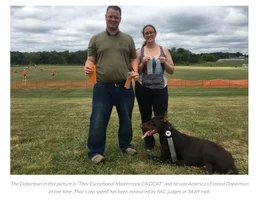
The AKC results for lifetime speed of Thor https://www.apps.akc.org/apps/fastcat_ranking/index.cfm?display are based on his 3 fastest speeds — 2018 at 26.63 mph, 2019 at 26.63. Toss in the 34.89 mph shown in the screenshot and the average hits 30 +- as shown in the lifetime ranking. AKC does not show an entry for that 34.89 mph from any sanctioned AKC events from 2016 to 2026.

Bottom line is — a Doberman was clocked at 35 mph give or take a millisecond and the Doberman Planet guy had it right.🤔 although 28 - 30 mph appears to be the most common high number for Dobes.
 
Last edited:
I have no connection whatsoever to John at DobermanPlanet but some small admiration for anyone trying to excel at an endeavor, building his youtube channel etc, its obvious he cares, even if he is a little dorky...

He's braver than me...!
And lets be fair- he is getting the word out on what a great breed, with cautions about be prepared for extra effort, cost, training etc.

He appears to be getting better at accuracy of info so while I can appreciate the best breeders and owners might quibble and moan over a misstatement or inaccuracy...

If he gets people doing their homework better, thats fewer dobes chosen on impulse, and fewer abandoned at the rescue at age two in the terrible dobeteens...

Just my $0.02 and ymmv.
PS: if you watch youtube a lot you'll notice other same related topics will show up like EMBs The Doberman Way...which is jam packed with highly useful stuff from someone with a LOT of experience...

Heres an oldie but goodie, for you new lurkers...
 
The AKC results for lifetime speed of Thor https://www.apps.akc.org/apps/fastcat_ranking/index.cfm?display are based on his 3 fastest speeds — 2018 at 26.63 mph, 2019 at 26.63. Toss in the 34.89 mph shown in the screenshot and the average hits 30 +- as shown in the lifetime ranking. AKC does not show an entry for that 34.89 mph from any sanctioned AKC events from 2016 to 2026.

Bottom line is — a Doberman was clocked at 35 mph give or take a millisecond and the Doberman Planet guy had it right.🤔 although 28 - 30 mph appears to be the most common high number for Dobes.
Preamble is warranted therefore in reference to the Freedom video a heads up is offered.

If someone wants to play with speed estimates without entering a Fast CAT event — and without climbing onto an ATV on a gravel‑strewn county road while trying to trigger prey drive to chase — there is a far safer method. A simple recall over a known distance (100 yards, or whatever distance you choose) on flat, safe terrain that meets AKC‑style footing guidelines gives you all the data you need. A favourite prey inciting tug or launched toy animated to attract the dog's attention is the catalyst to incite drive and hence enthusiasm. Use a stopwatch for accuracy, or the old “one Miss‑is‑sip‑ee” count, where each syllable is roughly one‑fifth of a second and the full phrase approximates one second. Then plug the known distance and time into any basic speed calculator. Determine the 100 yard distance via a know number paces within a measurable 10 ft segment or GPS the distance via the satellite bird's eye view HERE

For those who dislike math or distrust AI, the calculator does the work for you: enter distance and time, and it returns the speed. HERE

You may ask, “Why all the nerdy, overly detailed explanation?” Because it’s the only rational alternative to the DIY method — and avoiding need — of riding an ATV, keeping one eye on the road, one eye on the speedometer, and — if you have a spare — a third eye on the rear‑view mirror to see where the dog is.

If you’re still with me, here comes the nerdier part. If not, feel free to bail out now.

For the nerdy-minded 'kin' who enjoy the nerdy explanation : think force, load, foot‑pounds, and biomechanics. What does that actually mean?

In the referenced Freedom video, the Doberman weighs 100 pounds pre-determined by poster's admission. At normal speed, you can’t see the forelimb impact clearly, but slow‑motion shows the lead forelimb taking the initial load every stride. Only one front leading forelimb absorbs that force at a time. A 100‑pound dog running 30 mph doesn’t simply load that limb with 100 pounds — the peak load becomes several times body weight. Three hundred pounds is a conservative estimate. Picture the 300–400 lb barbell on the bench‑press rack at your local Gold’s Gym. That’s the kind of load being transmitted into the pastern, tendons, ligaments, and pads when being in contact by loose gravel in a steady stream when viewed at stop/start intervals.

Now shift to the world of Thoroughbred racing. This is not comparing apples to oranges — both are four‑legged animals with the same gaits: pace, trot, gallop, and full sprint. And both face similar biomechanical vulnerabilities especially at peak speeds. Modern racetracks are engineered to absorb impact because hard, unforgiving surfaces were contributing to catastrophic breakdowns. Entire tracks were torn up and rebuilt to reduce limb‑loading shock.

With that in mind, it should be obvious why a rigid, non‑absorbing in places sharp gravel surface is a terrible choice for a dog being pushed beyond its natural comfort zone for a two‑minute endurance run. Gravel is quarried stone — sharp, angular, abrasive. Think about what that means for exposed pads, digits, and pasterns.

Some may argue that the dog in the video “was fine” because it walked away without visible injury. But the cupped, hanging tongue showed dehydration and over‑extension. Absence of immediate injury does not equal responsible handling.

The point is not to be PETA‑esque, “Karen‑ish,” or bubble‑wrapping. The point is simple: it is irresponsible to subject a dog to a hazardous, high‑speed run on a gravel shoulder. There are safer, smarter, and far more controlled ways to evaluate speed.
 
I'm a bit nerdy on stuff like this, so I totally enjoyed the information and totally agree on methods to test speed. Fast Cats are pretty popular and would be the very safest and they use electronic timers that ((work most of the time)) and are recorded in stone once done. For a fun day and a reasonable entry it's much worth it.

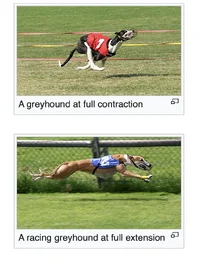
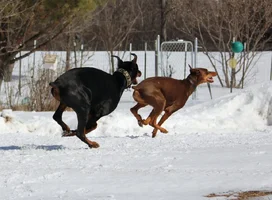
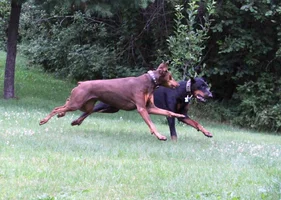
I came from a horse racing background and saw all those PSI load studies on horses, and with horses the hoof angles made a big difference too. Hooves being able to be trimmed and shaped by knowledgable farriers could make or break a sound horse. The other thing I learned from a Whippet guy at a fast track who helped me try taking my insane Doberman to the start of the Fast Cat was about Double Suspension as opposed to a single suspension gallop. Almost all sight hounds have it, and a sprinkling of other breeds do too. Some Dobermans have it and some don't. He watched Asha run and said she had double suspension, I had to ask what he meant and he pointed it out. When full out, the legs will all be off the ground gathered together, hit the ground 1-2-3-4, then suspend again stretched completely out. Most dogs are suspended only once with all four off the ground.

From Wikipedia: The double suspension gallop is also a four-time gait. The dog's weight, however, is not supported by the feet in the sequence of the single suspension gallop. Just after taking off from the LF and just after taking off from the RF suspension occurs. This is the only gait in which a dog is in full extension.

Screenshot 2026-05-09 at 5.40.54 PM.webp


Asha:

DSC00314.webpDSC00318.webp


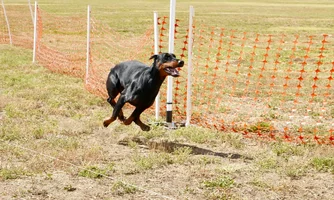
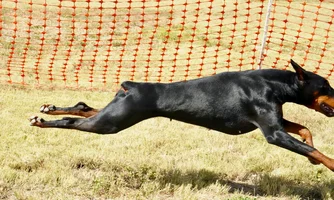
Obviously Asha doesn't have the elasticity and extension of a greyhound, but she definitely has double suspension. To note, this is efficient only for a very short burst - to catch the prey - and will exhaust a dog quickly. I don't think she ever reached 26 mph, she's number 236 on the lifetime list at 25.14 mph.

Your statement regarding the recall made me laugh as I had to ask for help because years ago she would not be able to stop she was coming at me so fast and just plow into me. The answer was from @DobermanGang who did IGP and he said start yelling Sitz!!! about 15 feet out, and it worked, she'd put the breaks on and slide into a sit in front of me. Still her best exercise to this day is a recall to front.

 
The answer was from @DobermanGang who did IGP and he said start yelling Sitz!!! about 15 feet out, and it worked, she'd put the breaks on and slide into a sit in front of me. Still her best exercise to this day is a recall to front.
That's interesting but it does make good sense. That's kind of like the braking time a train needs with all of that force and it can't be instant.
 
it does make good sense.
He taught me a whole lot about training, he understood that the dog I got was way more than I knew what to do with and it was more of directing the energy rather than shutting it down.

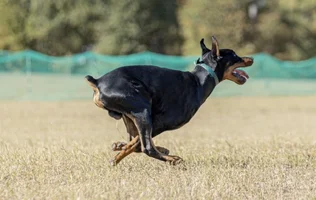
hard getting pic of running Doberman lol
It is hard! I lucked out at that Fast Cat, a gal had just bought a new fancy camera and asked ME if she could practice with it on my dog. She did miss her head in that extension photo, but I was so happy to get photos I paid her over her protests. There was no official photographer at that trial.
Those are great photos of yours!
 
Yes just like shooting shoot where their going to be not where their at oh have plenty that would be excellent pics but nose head cut off
 
I'm a bit nerdy on stuff like this, so I totally enjoyed the information and totally agree on methods to test speed. Fast Cats are pretty popular and would be the very safest and they use electronic timers that ((work most of the time)) and are recorded in stone once done. For a fun day and a reasonable entry it's much worth it.

I came from a horse racing background and saw all those PSI load studies on horses, and with horses the hoof angles made a big difference too. Hooves being able to be trimmed and shaped by knowledgable farriers could make or break a sound horse. The other thing I learned from a Whippet guy at a fast track who helped me try taking my insane Doberman to the start of the Fast Cat was about Double Suspension as opposed to a single suspension gallop. Almost all sight hounds have it, and a sprinkling of other breeds do too. Some Dobermans have it and some don't. He watched Asha run and said she had double suspension, I had to ask what he meant and he pointed it out. When full out, the legs will all be off the ground gathered together, hit the ground 1-2-3-4, then suspend again stretched completely out. Most dogs are suspended only once with all four off the ground.

From Wikipedia: The double suspension gallop is also a four-time gait. The dog's weight, however, is not supported by the feet in the sequence of the single suspension gallop. Just after taking off from the LF and just after taking off from the RF suspension occurs. This is the only gait in which a dog is in full extension.

View attachment 160580


Asha:

View attachment 160578View attachment 160579


Obviously Asha doesn't have the elasticity and extension of a greyhound, but she definitely has double suspension. To note, this is efficient only for a very short burst - to catch the prey - and will exhaust a dog quickly. I don't think she ever reached 26 mph, she's number 236 on the lifetime list at 25.14 mph.

Your statement regarding the recall made me laugh as I had to ask for help because years ago she would not be able to stop she was coming at me so fast and just plow into me. The answer was from @DobermanGang who did IGP and he said start yelling Sitz!!! about 15 feet out, and it worked, she'd put the breaks on and slide into a sit in front of me. Still her best exercise to this day is a recall to front.
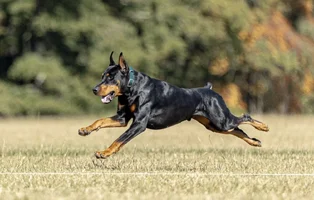
When full out, the legs will all be off the ground gathered together, hit the ground 1-2-3-4, then suspend again stretched completely out. Most dogs are suspended only once with all four off the ground.
Thanks for the additional input @Ravenbird and keeping the conversation alive. The last quote and the last picture of Asha with extended leading right forelimb sets up the ground contact sequence of 1-2-3-4 clearly indicating the when for the 1.

As an aside — you’ve got a leg up on me on the saddle horses (pun intended) in reality and metaphorically. My hands-on equine experience was solely with a pair of Belgians back in the day atop and alongside the hay wagon armed with pitch fork at harvest time and also relegated to cleaning their stalls and hauling their bales of feed hay and bucket of oats. The only thing I know about hooves was to stay clear of the fryin' pan size on a Belgian stallion and mare. I wonder what the static load of 2000 lbs plus divided by 4 would be on a 10 year old's foot. Front heavy in excess of 500 pounds my best guess — no bio mechanical formula needed…..anyway it’s been enjoyable conversation here …..I unwittingly revealed a well kept secret IYKWIM ( “back in the day” “draught horses” oh I forgot to mention an International Farmall and nary a reference to an ATV — we used our legs they got us and the collies to and from the back 40 without issue

In the common bond of Dobermans and long ago equines ….Mikel
 
Last edited:

Back
Top