I learned I can't use ok as a release. I was handling somebody else's dog that used OK. OMG! What an epic fail! I had no idea how many times I say OK.Right then she was waiting for the 'release ' (OK) command from me.


I learned I can't use ok as a release. I was handling somebody else's dog that used OK. OMG! What an epic fail! I had no idea how many times I say OK.Right then she was waiting for the 'release ' (OK) command from me.

I use OK as release, fortunately over the years I have learned to use alright for everything else that would be (okay). We do use okay too much in everyday languageI learned I can't use ok as a release. I was handling somebody else's dog that used OK. OMG! What an epic fail! I had no idea how many times I say OK.
 so it's not a good release word!
I use free as my release word. I rarely use it for anything because there ain't nothing free.I use OK as release, fortunately over the years I have learned to use alright for everything else that would be (okay). We do use okay too much in everyday language


Yes, I've made that mistake too. Oskar will be on a sit, or down stay, and I'm talking to someone and say, "Okay" in the conversation, and he's up and gone. What an idiot I am.I learned I can't use ok as a release. I was handling somebody else's dog that used OK. OMG! What an epic fail! I had no idea how many times I say OK.

One trainer I worked with a long time ago told us to not choose that as a release word. She cited an experience where a person had her dog in a down stay while chatting w/ a friend. The woman said "Okay, then I'll talk with you later" and the dog, thus released, promptly ran in front of a car and was hit and killed.I learned I can't use ok as a release. I was handling somebody else's dog that used OK. OMG! What an epic fail! I had no idea how many times I say OK.

How horrible.the dog, thus released, promptly ran in front of a car and was hit and killed.


I do like this idea. I use German for my obedience commands and I like the idea that I'm saying thank you. I do say that on occasion, when Asha does something I've asked like Go lay down, and she does I just say thank you. But it's more like a confirmation of "thanks, you did the right thing", not OK, you're free to go. If there's ever a new dog in my future I'll incorporate Danke in the vocabulary!Since I am German, I use the word "Danke" (thank you) as a release word. It's not a word I use in typical conversation.
I use German (mostly) for formal obedience--sitz, platz, hier, steh, etc. English is informal--"come" means "come over by me so I can touch you", while "hier!" is "come and sit in front". Per schutzhund, I don't use a "stay" command, since it's redundant--when you ask the dog to sit, then they should sit until you tell them otherwise. Plus it gets mixed up easily w/ "steh" soundwise.It's interesting, my dog seems to just know when I'm talking in conversation to people and when I say OK to her. She also hears words in context for what's happening. We'll be sitting on the porch in the afternoon near 5 o'clock and I can ask J "is it time ?" and Asha jumps up and runs to the door to go get fed. I can say "what's the time?" at 4 o'clock and she doesn't even lift her head. She definitely knows about 5 words for getting ready to eat dinner at 5 pm, but she only reacts to them at that time of day.
I use OK for a release word around the house but it must be the way I say it to her because she just ignores it if I use it in conversation. Also I've never seen react to a command word said by another person. They could say OK 3 times and she wouldn't pay any attention. Unless we were in a training situation and she knew somehow she was being addressed.
I do like this idea. I use German for my obedience commands and I like the idea that I'm saying thank you. I do say that on occasion, when Asha does something I've asked like Go lay down, and she does I just say thank you. But it's more like a confirmation of "thanks, you did the right thing", not OK, you're free to go. If there's ever a new dog in my future I'll incorporate Danke in the vocabulary!

I was handling someboby elses dog in conformation that knew ok as a release. The judge kept talking to me and I would respond ok. The dog would release from her beautiful stack and zoom around the ring. No one other than me thought it was funny.Yes, I've made that mistake too. Oskar will be on a sit, or down stay, and I'm talking to someone and say, "Okay" in the conversation, and he's up and gone. What an idiot I am.
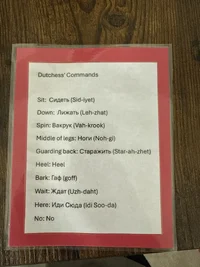
Another person w/ a GSD in our old schutzhund club had a dog trained in Czech (so our trainer had to learn it when he did a B&T w/ the dog) and a Beauce owner trained her dog in French. Always interesting to see how people do it.Zastava's littermate sister can only be commanded in Russian. Since I have her in my home sometimes, I have a whole sheet printed out, stuck to my fridge with a magnet. I probably wouldn't need it anymore, but I guess I still sometimes reference it for study when she isn't here. I do appreciate her training, as there are no cases where the Russian commands sound anywhere close to English. And when I use it, she does mind! I still don't know why, but her owner wanted two commands in English. The "no!" i get, but "heel", I don't. Maybe there isn't a translation for it that fits nicely?View attachment 162761
Those commands have damn near as many syllables as the Finnish language, which is why I never tried to learn it or use it with the dogs.Zastava's littermate sister can only be commanded in Russian.
From my limited experience with Dutchess, the extra syllables have been worth the effort.Those commands have damn near as many syllables as the Finnish language, which is why I never tried to learn it or use it with the dogs.

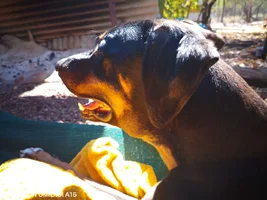
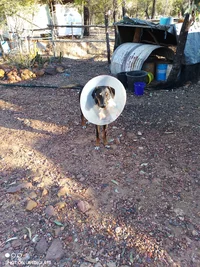
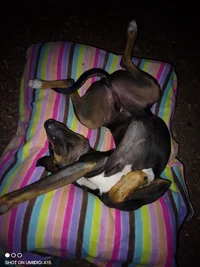

Awww, who's a good dog?!Clancy has had an abscess. He was treated with antibiotics but needed to have it drained and removed a week later. I removed the drain yesterday but there's still 9 days until I can remove the stitches. He has been really good with the vets, the cone of shame and all his meds. I'm really proud of his progress!View attachment 162762View attachment 162763
The cone is to stop him scratching the stitches but only wears it if I'm not able to watch him.View attachment 162764
And in full relax mode. He's not bothering about the wound much now.

The vet and I both think it was a stab wound to the inner cheek. He is a chewer of sticks and old bones when he can sneak one. The wound is large because the abscess capsule was tough and in an awkward place because of all those important facial nerves. No nerve damage thankfully.Awww, who's a good dog?!
He's fair dinkum that one.
That looks like a lot of stitches.
Kudos to you for great wound after care!
Did the vet have any idea what caused it? Some kind of weird OzzieBugs or thorns DownUnder or just random?

On this thought, I wonder if formal training like IGP or Obedience for trials and teaching dogs that a command is different that "around the house" talk. Most people here don't trial in obedience, so everything they hear is "around the house" talk. I use Platz in obedience but around the house I say "down" or more often "Go lay down" when she's milling around and generally in the way. I don't expect her to stay until I release her, it's just a phrase that means I'm busy, go somewhere else. For the longest time I thought "yes" was just as good as a clicker for marking behavior in training, but after using a clicker for a few things, specifically a shaped dumbbell retrieve, I realized my variation on saying Yes made more complications that I was aware of. If I want something super clear and precise, a clicker is much better for my dog than my voice.Per schutzhund, I don't use a "stay" command, since it's redundant--when you ask the dog to sit, then they should sit until you tell them otherwise.
Russian command for heel is рядом (ryadom), which translates to "side" or "next to." It's an easy word to say, so idk, maybe preference for single syllable.Zastava's littermate sister can only be commanded in Russian. Since I have her in my home sometimes, I have a whole sheet printed out, stuck to my fridge with a magnet. I probably wouldn't need it anymore, but I guess I still sometimes reference it for study when she isn't here. I do appreciate her training, as there are no cases where the Russian commands sound anywhere close to English. And when I use it, she does mind! I still don't know why, but her owner wanted two commands in English. The "no!" i get, but "heel", I don't. Maybe there isn't a translation for it that fits nicely?View attachment 162761
A trainer friend also says the clicker is much better, even moreso than a vocal click. She says it affects the brain in a different way, and you end up w/ a much better response. I've also found that the clicker gives a better response than "yes!", although it can be a PIA to use when your hands are full w/ other things. Our old schutzhund club taught to use a clicker rather than "yes!'On this thought, I wonder if formal training like IGP or Obedience for trials and teaching dogs that a command is different that "around the house" talk. Most people here don't trial in obedience, so everything they hear is "around the house" talk. I use Platz in obedience but around the house I say "down" or more often "Go lay down" when she's milling around and generally in the way. I don't expect her to stay until I release her, it's just a phrase that means I'm busy, go somewhere else. For the longest time I thought "yes" was just as good as a clicker for marking behavior in training, but after using a clicker for a few things, specifically a shaped dumbbell retrieve, I realized my variation on saying Yes made more complications that I was aware of. If I want something super clear and precise, a clicker is much better for my dog than my voice.