
F
FredC

Well lookie what came in the mail yesterday and had an extra special New Years Day Surprize!!! lol is it a sign that 2015 is gonna rock?

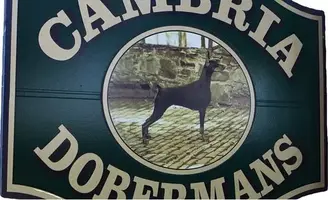
Anyways pretty cool article featuring Cambria..
Cambria Dobermans' Long Stretch
Published December 2014
Published December 2014
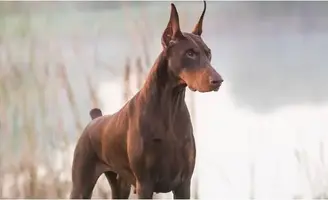
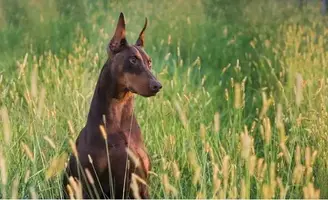
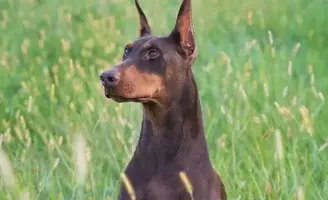
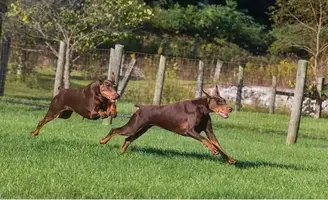
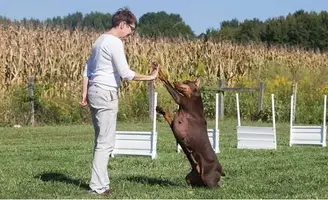
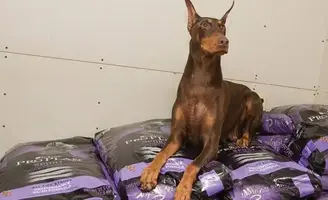

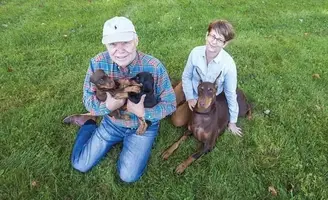
Autumn sunlight highlights the elegance of the female Doberman Pinscher, radiating power from her chiseled silhouette and deepening the richness of her stunning red coat. Poised and alert, she proudly conveys the nobility of the loyal German breed.
Moments later, “Zsa Zsa” drops the stacked pose and gracefully bounces off to affectionately nudge Ann Ramsbottom White, with whom she has intimately shared the past two years traveling in an RV while being campaigned. This year, she is the No. 1 Doberman Pinscher in the country. Weekend after weekend, crisscrossing the Midwest to attend an impressive 155 dog shows, the handler is road-weary yet satisfied.
Back home in Holton, Indiana, husband Jim White has worked doubly hard to keep things going. Justification for their mutual sacrifices is pumped by their bragging rights as the breeders of Zsa Zsa (Multi-BIS/Multi-BISS GCH Cambria’s Vraiment Parfait), a 3-year-old who represents the 10th generation of Cambria show champions.
“The time had come for a more moderate Doberman,” Ann says, running her hands on Zsa Zsa’s head and down her back. “It worked in her favor. Sometimes you can have the right dog at the wrong time.”
Cambria’s celebratory mood is also boosted by this year’s 23 finished show champions sired by their “Nick” (CH Cambria’s Out For Justice), a 5-year-old black Doberman. His sire was CH Cambria’s Cactus Cash (“Eddie”), the top-producing sire in breed and Working Group history with 167 champions. With 34 champion offspring of his own, which includes Zsa Zsa, Nick has proved that he, too, is a producer. Another prominent male in Nick’s pedigree is his paternal grandsire, CH Brunswig’s Cryptonite, the top-winning Doberman of all time with 124 Bests in Show.
“In the past 10 years, every No. 1 Doberman goes back to Eddie,” reflects Jim. “He is the sire of 14 Best in Show winners.”
Smiling, Jim says, “Producers produce producers.”
Jim and Ann’s 100-plus years’ cumulative experience in Doberman Pinschers belies those words of wisdom. The couple’s sometimes contrary views fuel the fire between them. Jim is undoubtedly the equalizer when the stakes are high.
“Jim keeps me humble,” Ann says.
Driven to make every effort count, Ann finished 14 champions this year besides managing Zsa Zsa’s high-profile campaign. “You have precious little time to make an impact,” she says. “You learn from the mistakes and successes of proven breeders before you, from your breed, from other breeds, and even from other species.”
Jim found his niche as a breeder since retiring. The first litter he bred was in 1989. The sire was CH Agape Lion of Judah, and the dam was CH Florowill Bit of Magic (“Betta”), a red bitch who would produce 21 champion in four litters and become the top-producing dam in Doberman history.
Betta appears three times in the pedigree of CH Cambria’s Victoria Secret (“Reigny”), the No. 1 Doberman in 2008 and winner of 14 Bests in Show. Reigny won the breed at the Westminster Kennel Club Dog Show in 2007, 2008 and 2009 and took a Working Group Second in 2007.
Ann credits Jim’s photographic memory and knowledge of pedigree depth in their breeding success. “Jim remembers dogs of the past,” she says. “He’s actually seen many of these dogs and understands the effect they’ve had on the breed through what they have produced.”
“I have been really lucky,” he says.
Luck aside, Jim and Ann are the breeders of two recent DPCA (Doberman Pinscher Club of America) Grand Prize Futurity winners, both sired by Nick out of dams that are sisters. In 2012, the winner was Zsa Zsa, and in 2013, it was “Argus” (CH Cambria’s Above And Beyond).
“For breeders, the Futurity is like winning the jackpot,” Ann explains.
“Futurity winners don’t always turn out,” adds Jim.
Not so for Argus and Zsa Zsa. Argus returned to the DPCA National this fall after a year at home with owners Lora and Dan Van Epp to take an Award of Merit. Zsa Zsa, owned by Karen Thompson, Glen Lajeski and Ann Wulbrecht, took back-to-back Select Bitch honors at the 2013 and 2014 Nationals.
“We try to stay the course,” Ann says. “It’s easy to fall and hard to stay up there.”
Jim agrees. “We are always trying to breed the perfect Doberman by the breed standard. It will never happen. We just keep at it. That’s what we’re good at.”
A Twist of Fate
A shared passion for Doberman Pinschers, with a twist of fate, brought Jim and Ann together more than 20 years ago. In truth, they might have never connected.
“I thought she was stuck up when I met her,” Jim recalls of the cute, young handler ignoring his small talk while grooming a Lhasa Apso at a show in Texas.
“I am painfully shy,” explains Ann, who was working full time and handling dogs on weekends.
When they were married in 1995, Jim asked Ann, “What do you want to do?”
“You know!” she told him. “I have wanted to be a handler since I was 11 years old.”
Jim agreed to finance her handling career for five years. “I didn’t think she would be successful,” he laughs.
Besides finishing several show champions, Ann had noteworthy wins. Her
finesse handling a red female sired by Eddie, CH Nova’s Zolara v Kelview, led to Best of Breed at the 2001 DPCA National Specialty, making “Zolara” the youngest winner in history at 16 months of age.
Zolara also won Best of Breed and took a Working Group Second in 2002 at Westminster. “I remember stacking her at the Garden,” Ann says. “Wow! She looked so beautiful. She loved the camera flashes and the lights.”
Ann’s success in the ring helped shape the future for her and Jim. In 2002, they moved to southeastern Indiana, a location strategically chosen because of its proximity to dog shows. In reality, they had spent a lifetime preparing for their joint venture.
Jim fell in love with a red female Doberman when working at the Jerome Hotel in Aspen, Colorado, in the late 1950s. He was impressed with the dog’s beauty and nimbleness like a deer. While attending Denver College, he bought his first Doberman, a red male pet named “Damien,” who he trained and titled in obedience.
Nearly 20 years later, early mentors, including Mary Rodgers of Marienburg Kennels in Missoula, Montana, and the late James T. “Jim” Bennett, a professional handler, breeder of Gladiator Dobermans and show judge, helped him form an image of the ideal Doberman Pinscher.
Rodgers, Moe Miyagawa and Jim were co-owners of CH Marienburg’s Sun Hawk. The red male was the No. 1 Doberman in 1976 and 1977, and the DPCA National Specialty Best of Breed winner in 1976 and 1979, the latter won from the Veterans class.
Likewise, Ann benefited from early influencers. She was 11 when the late Irene Bivin helped her buy a show-quality Doberman from Mildred Bryant of Milbryan Kennels.
“That probably made the difference whether I stayed with it or not,” Ann says.
Ann was a devout student of the breed, living vicariously through Doberman Quarterly and studying the photos in every issue. When she was 14 years old, Ann was named the DPCA’s top junior handler. Two years later, she was thrilled when Bryant accompanied her to New York so she could compete in Junior Showmanship at Westminster.
Another similarity Ann and Jim share is their respective expertise in livestock and horses, and the impact this knowledge had on their understanding of Dobermans. Ann, an ag journalism alumna of Texas A&M University, learned to defend her rating of livestock quality based on the hoof to rail value. Jim dabbled in Arabian horses, later realizing the likeness of the standards, except for the dog’s slightly rounded croup and the 30-degree angle of the hipbone.
For many years, Jim practiced the horse breeding philosophy of concentrating all efforts on a few outstanding mares and paying a fee to breed to the most appropriate stallion. “It wasn’t until several generations into breeding Dobermans that keeping a male was even considered,” Jim says.
Cambria’s foundation bitch, Betta, “interestingly did not produce herself,” Jim says. “She always gave in to the sire to whom she was bred.”
“Fortunately, Jim sought out and made the effort to breed her to some impressive sires,” Ann says.
One thing Jim and Ann know for certain is that success can be fleeting. “The more you know, the more you realize you don’t know,” Ann says. “As fast as dogs rise, they can go down.”
The Cambria Doberman breeders make it look easy to produce impactful sires and dams. Through old-fashioned persistence, hard work and love of the breed, they have earned success. It is their commitment that distinguishes them and gives Cambria its well-deserved prosperity and good fortune.
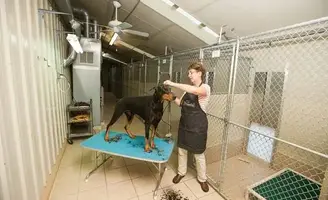
The Cambria Kennel
At the Cambria Doberman kennel, “we believe in creating a kennel environment that is good for our dogs,” Ann says.
Each dog kennel is 5-by-6 feet inside and 5-by-14 feet outside. They are made of 12-gauge, 1 ½-inch chain link. Guillotine doors are closed to keep dogs safe at night, and secure latches on the inside kennel doors cannot be flipped by dogs. Propane and heat lamps help maintain a comfortable 65 to 76 degrees in winter, and air conditioning and ceiling fans keep temperatures 72 to 74 degrees in summer.
Breeding for Best Results
Cambria Doberman Pinscher breeders Jim and Ann White share breeding practices that have helped them to be successful.
- Linebreed quality dogs to solidify desirable traits in your bloodline. Linebreeding is mating dogs with common ancestors.
- Never breed for convenience. You should breed to the most appropriate stud dog for your female.
- Remove all emotion when selecting breeding partners. Breed to the dog, not the owner, the kennel prefix or popular sire.
- Try to see a potential sire to assess the dog’s movement and temperament. Photos cannot convey these attributes.
- Study the health histories of many generations of the pedigree of potential mates to learn genetic diseases and health conditions and ages in which relatives died.
- Learn to live with the results of your breeding decisions. Embrace your good fortune and learn from your misfortune, and then move on. Breeding is a constant learning process.
- Remember that good health and temperament should never take a back seat to good conformation.
You can download the PDF in its entirety HERE.
Last edited by a moderator:


