• Disclaimer: Hello Guest, Doberman Chat Forums presents the opinions and material on these pages as a service to its membership and to the general public but does not endorse those materials, nor does it guarantee the accuracy of any opinions or information contained therein. The opinions expressed in the materials are strictly the opinion of the writer and do not represent the opinion of, nor are they endorsed by, Doberman Chat Forums. Health and medical articles are intended as an aid to those seeking health information and are not intended to replace the informed opinion of a qualified Veterinarian.”

Pulling on leash

HakuTheDoberman

Notable member
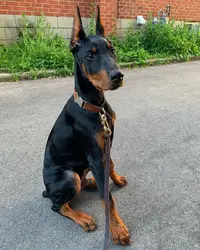
hey guys just wondering if anyone had any tips on training a 4 month old not to pull on the leash.

He gets excited and tends to pull and it’s not to chase things like squirrels etc.

It hasn’t been to bad but now that he’s bigger I’m starting to struggle (being 5”4 and 120 I’m gonna eventually be getting dragged soon if it keeps up aha)

Collar or harness he pulls, but I’d rather harness since he ends up making himself gag from pulling so much if he’s using the collar.

I’ll be watching some videos and looking into training for it but wanted to see if you guys have any tips that helped you.

I will be using a prong collar down the road for training although I read you shouldn’t had it earlier then 6 months old? So I think it’s too young for that ?

Thanks !
 

Attachments

  • 0838C2DD-C8B8-4037-B474-8F4A6F01758A.webp
    0838C2DD-C8B8-4037-B474-8F4A6F01758A.webp
    629.7 KB · Views: 30
  • 51BEC60D-E86E-469C-8A51-5FF0C06E2573.webp
    51BEC60D-E86E-469C-8A51-5FF0C06E2573.webp
    324.2 KB · Views: 27
We are struggling with the same thing except our guy just turned 1 and is a handful:facepalm:

I'm honestly here for the advice as well Haha. We do group classes and it's a constant work in progress. Our trainer recommends starting slow. She recommends to start by leashing them inside and rewarding for a lose leash. Then start taking a couple steps forward and rewarding for a lose leash, etc. Once they get it down inside then try to transition to the yard and repeat until you can do it on say a sidewalk. Now in theory this sounds great Haha inside and in our yard our guy is a pro, the second he gets on the street he could care less about praise and treats. His real excitement and rewards come from the smells:facepalm: I swear some days I could dangle a steak in the air and he could care less. Bring him into a space with other dogs, say group training class with a flat collar or harness on and you are asking for rope born in the first couple minutes.

Since our guy is older we rely on a prong collar. I am the first to admit that we are still reliant on it when he gets so consumed with excitement. We dont abuse the collar, but the second we put it on he knows that he shouldn't pull. The first couple of minutes at last weeks class we had to use it because he was losing his mind. I want to say about 10 minutes in we were actually able to switch to a flat collar but it was a struggle in the beginning. We are finally at the point where we can use a martengale for our morning walks since there isn't a lot going on in the neighborhood yet but it's still not a slack loose leash.

For a puppy maybe try bringing along a toy? Something that you can use to show that you are fun, but also use as a reward. Oh and a key piece is to try to get some of their energy out first! I would do a good little play session first and get the initial energy out that way he might be a little calmer.

I think with our guy this has been the hardest thing we have dealt with training wise. I think it's a good thing that you are starting young. I would just keep in mind his age and to not overdue exercise.

If your find the answers please don't hesitate to share, we will take all the help we can get here too!
He is very handsome too :love:
 
What we did was annoying but it got results. On a flat collar, anytime Jasper would pull or be too far out front we would grab the leash and turn into him and walk the opposite direction. Most times that dogs mean pushing them with your knee (not kicking them). Do this every single time he walks too far up front. At some point they realize that they don’t like getting whacked by your knee and remember to fall in line.

Takes a bit of practice and time but you get results. I still use a prong just incase something happens and I need extra control. But for the most part he walks loose leash. Not perfect by any means and I still need to correct him a couple times a walk but hes pretty good.
 
You have to teach leash pressure so that he understands it. I teach all leash pressure stationary first. With your dog standing next to you, slowly put pressure straight back on the leash and hold. Do not pull your dog back just pressure. As soon as your dog moves the slightest backwards (even just one foot) say yes, release the pressure and reward with food or a game of tug. I teach pressure in all directions, backwards, forwards, sideways ect.
This will teach your dog that giving to pressure is rewarding so if they start to pull they immediately realize they need to back up to release the pressure. Using a yes reward marking over and over will eventually make the word yes be a reward through associative learning (Pavlovian learning).
 
What commands does your pup know? Can he heel? If so can he do it well?

I had this problem with my guy.... he was 1.5 years when I got him and the problem was pretty bad for almost 4 months. I've tried almost everything. Even the pressure training @dobermangang recommended. The problem was it all worked well inside and outside on my property but as soon as we stepped into the unknown neighborhood, he immediately wanted to lead on leash in an alerted state.....

My process was long and still is a work in progress in new places, but what I did was leash him inside and walk the house. In the house he stays by my side. If he tries to lead I change direction and he goes right back by my side. I dont treat or praise at this point as he gets it.

After a good 5 - 10 min of good progress, we move to the backyard and do the same thing. The exception is when outside, I give praise and firm commands. Before we get out the door he gets a wait command, then break to go out the door.

Once outside hes put in the heel position and we walk the backyard. I give him the "check it out command" to sniff random things in the backyard... the back to the heel. Praise, treat, and play towards are given for on point commands.

I also incorporate "take a break" commands which let's hin free sniff and walk on leash. This gives him a break and allows him to feel independent to a point. This allows him his own time so to speak on a leashed walk. After that he gets a heel and off to the neighborhood.

When we get to the front yard, we continue the same commands and process we just did in the backyard. The only difference is I put him in the heel and go as far as he can make it until he starts to get distracted. I then put him in a sit, down, and speak commands... i do this as i know he'll get them right... then i praise, treat and go back to the house.

This happened and progress was made as he kept going farther and farther each time.

Now hes good to go on leash and walks good mannered for as long as I like. He stays in the heel unless I release him or give him the take a break... when I release him he stays within the leash distance meaning, he'll go out as far as the leash will allow before he feels pressure.

Sorry for the novel but I hope it helps!!!!
 
@Atingles10 my guy was the same way... great on property... different dog off property.

The only way I could break this was to sit in the driveway for hours.... he would be so amp'd up out front... where the unknowns are... after consistently sitting for hours in the driveway, he naturally became bored and calm out there... when he was calm I'd interact with him and play ball or do training... this naturally led to walking off property....
 
You have to teach leash pressure so that he understands it. I teach all leash pressure stationary first. With your dog standing next to you, slowly put pressure straight back on the leash and hold. Do not pull your dog back just pressure. As soon as your dog moves the slightest backwards (even just one foot) say yes, release the pressure and reward with food or a game of tug. I teach pressure in all directions, backwards, forwards, sideways ect.
This will teach your dog that giving to pressure is rewarding so if they start to pull they immediately realize they need to back up to release the pressure. Using a yes reward marking over and over will eventually make the word yes be a reward through associative learning (Pavlovian learning).


Thank you I’ll start trying that today! :)
 
What commands does your pup know? Can he heel? If so can he do it well?

I had this problem with my guy.... he was 1.5 years when I got him and the problem was pretty bad for almost 4 months. I've tried almost everything. Even the pressure training @dobermangang recommended. The problem was it all worked well inside and outside on my property but as soon as we stepped into the unknown neighborhood, he immediately wanted to lead on leash in an alerted state.....

My process was long and still is a work in progress in new places, but what I did was leash him inside and walk the house. In the house he stays by my side. If he tries to lead I change direction and he goes right back by my side. I dont treat or praise at this point as he gets it.

After a good 5 - 10 min of good progress, we move to the backyard and do the same thing. The exception is when outside, I give praise and firm commands. Before we get out the door he gets a wait command, then break to go out the door.

Once outside hes put in the heel position and we walk the backyard. I give him the "check it out command" to sniff random things in the backyard... the back to the heel. Praise, treat, and play towards are given for on point commands.

I also incorporate "take a break" commands which let's hin free sniff and walk on leash. This gives him a break and allows him to feel independent to a point. This allows him his own time so to speak on a leashed walk. After that he gets a heel and off to the neighborhood.

When we get to the front yard, we continue the same commands and process we just did in the backyard. The only difference is I put him in the heel and go as far as he can make it until he starts to get distracted. I then put him in a sit, down, and speak commands... i do this as i know he'll get them right... then i praise, treat and go back to the house.

This happened and progress was made as he kept going farther and farther each time.

Now hes good to go on leash and walks good mannered for as long as I like. He stays in the heel unless I release him or give him the take a break... when I release him he stays within the leash distance meaning, he'll go out as far as the leash will allow before he feels pressure.

Sorry for the novel but I hope it helps!!!!


No that’s ok the more information the better! Helpful as well thanks.

He knows sit, down, stay, wait, come, speak, leave it, paw and shake. He knows heel but not perfectly and hasn’t had too much training with it outside the backyard so that ones still a work in progress that learning better will definitely aid in him not pulling.
 
@Atingles10 my guy was the same way... great on property... different dog off property.

The only way I could break this was to sit in the driveway for hours.... he would be so amp'd up out front... where the unknowns are... after consistently sitting for hours in the driveway, he naturally became bored and calm out there... when he was calm I'd interact with him and play ball or do training... this naturally led to walking off property....
This sounds familiar Haha the other day my husband asked why our walk took so long.....well its because we stood in one spot for over 10 minutes with him on a listed
Pressured leash with him refusing to acknowledge me..... multiple times :rofl:

I always thought I was stubborn, but I've met a great contender with our guy:rofl:

@Doberman Gang I will definitely try the pressure piece. He will let off on the pulling if you say easy or wait but only for a brief period. Same with changing directions so he has to focus, short lived results. Hopefully the pressure piece will help, thank you!

@HakuTheDoberman you will have to let me know if you have better results with one method versus another!

I will! I’ll keep everyone posted :D
 
You are experiencing one of the trademark problems in Dobermans (and a lot of dogs!)

Was it Lizbell above who described turning left into your dobe and bringing your knee into contact with them if they don't remain back in heel position? That is part of the approach I used, but there is a step that is used prior to advancing to that.

The step is actually turning 180 degrees right, not left. You do an about-face to the right WHILE KEEPING YOUR MOUTH SHUT and your Dobe, who is out in front of you, paying no attention to you, gets a jerk and finds that – surprise! – my person is heading the opposite direction!

Keep it gentle at first, as your Dobe is small and immature, and they are not to be expected to understand and be able to obey the heel command yet.

Also, give your chosen heel command and hand signal and repeat it calmly while they are successfully in heel position, and praise them. Don't, however, confuse this with nagging repeating of commands when they are breaking the command!! When they break the command, they get the above surprise.

The result tends to be that they are encouraged via the consequences of their own actions to stay in position. They are encouraged to stay by your side where they can see you and be ready for your actions, rather than out in front of you where they cannot see when you are about to make your abrupt turns.

Don't be surprised when you experience them trying to have their cake and eat it too by forging forward where they cannot see you, yet crowding you so they can gauge your position by feeling your legs with their side.

The foregoing describes training the heel. Now, simply training them to walk as they choose, but not putting tension on the leash is a different matter and not as cut-and-dry and is in my opinion a more advanced behavior.

My technique has always been to make the heel command absolute and as precise as possible, and to let them know when they are free from that command. I let my Dobe pull for the majority of the walk, but demand that he heel when commanded.
 
The step is actually turning 180 degrees right, not left. You do an about-face to the right WHILE KEEPING YOUR MOUTH SHUT and your Dobe, who is out in front of you, paying no attention to you, gets a jerk and finds that – surprise! – my person is heading the opposite direction!
Not a good method to teach to a 4 month old puppy though. Should still be building trust and engagement meant with us. Everything with us is good not a surprise.
 

Back
Top