Here is an article that you might like to read, the first thing i myself would do is rule out any health problems especially if it started suddenly.
Forms of Aggression
A dog may exhibit more than one form of aggression in varying degrees of severity.
The very first course of action when your dog shows aggression is to visit the Veterinarian for blood work to rule out a medical problem. This is especially true if your dog's aggression appeared suddenly and is escalating in intensity.
Brain Chemistry It is possible for dogs to have a chemical imbalance just as it is with people. In humans, this manifests itself as anxiety, depression, or obsessive compulsive disorder. The treatment is also the same as it is for people - a combination of medication and behavior modification. Yes, you and your dog could both be on Prozac and undergoing therapy at the same time!
Lyme Disease Lyme disease is caused by a bacteria transmitted by ticks. It can cause sudden aggression in both dogs and humans. This culprit is often overlooked by Veterinarians, so be sure to ask for this test specifically if you think this could be your problem. Some laboratories have better tests for Lyme Disease, so be sure to ask about the accuracy as well. more...
Thyroid Dysfunction Another medical problem that can cause aggression is thyroid disfunction, an abnormality in the secretion of thyroid hormone. more...
Encephalitis Distemper and Rabies fall under this category.
Hypoglycemia, brain tumors, epilepsy, seizures, head trauma, and hydrocephalus in brachycephalics (water on the brain) are other potential medical causes of aggression. To summarize, anything that affects the brain or central nervous system can show aggression as a symptom.
An animal in pain may bite to stop someone from hurting them. This is usually a reflexive reaction, so even a normally mild-mannered canine could bite if you hurt him. Humans have the same reflex. If you've got a broken arm and someone tries to grab it, the reflex is to strike their hand away. For this reason, always muzzle a dog who has injuries when administering aid.
There are three possible responses to a perceived threat - fight, flight, or freeze. The dog who chooses to fight feels that the best defense is a good offense. Once again, this is true in humans as well. To protect yourself from the fear aggression of a strange dog, make yourself as unthreatening as possible. If the dog is your own, don't put him in situations where he feels the need to defend himself while you work on building his confidence. Remember, what is important is what the dog perceives to be a threat, not whether or not it actually is a threat. If you standing on one leg is perceived as threatening by a fear aggressive dog, for your safety, don't stand on one leg!
Dogs are predators. Some have a very high prey drive, some have a seemingly nonexistent prey drive, but all dogs have predatory instincts. A dog who chases and kills small animals is not abnormal. It is a dog being a dog. When predatory aggression becomes a problem is when one does not have control of the dog. A high prey drive cannot be extinguished - not without resorting to inhumane methods. However, it can be managed. more...
In the wild, dogs survive primarily by scavenging. Predation is secondary. They will frequent areas where they are most likely to find food. This becomes their territory, and they will protect that territory in order to ensure that the food supply is not depleted. This is necessary in the wild for survival. Resources are not unlimited. However, it is not necessary or appropriate in the domestic environment. more...
Dogs with protection aggression fancy themselves a canine bodyguard. They will protect other family members, human, canine, or other, regardless of whether or not those family members wish to be protected. If your dog won't let your date touch you or the UPS driver deliver your package, there is a protection aggression problem. Unless you want to remain single for life and forget about online shopping, teach your dog that you don't need to be protected. more...
Dogs with possession aggression are overly sensitive about others coming near their things. In severe cases, people are in danger around this dog because one never knows what he will consider his and protect at all costs! In milder cases, you still need to be able to take things from him without a struggle. It could save his life. more...
If a dog is highly agitated and cannot take it out on the object of his frustration, he may turn his focus to the nearest available outlet. He's mad at somebody else, but since he can't get to them, he will take it out on someone nearby. more...
One of the most mystifying types of aggression is related to dominance. This dog wants to be master of his own destiny. He resents any attempts to control him, touch him, or otherwise direct his behavior in any way. In some cases, he may even attempt to control YOU instead! more...
Moms can relate to this one. A mother dog will protect her puppies from threats, real or perceived. A normally docile animal can turn into a ferocious beast when it comes to protecting her young. Tread lightly with a mom and her pups. Dogs sometimes have false pregnancies and will protect objects as if they were puppies. This is driven by hormones, so the best course of action is a trip to the Vet. Spaying greatly reduces the risk of maternal aggression.
Play
When dogs wrestle together in play, they often vocalize. They may growl and bark, or they may sound like Chewbacca from Star Wars. This is normal, healthy dog behavior and not an indication of an aggression problem. When dogs are play-fighting, it is more deliberate and controlled than the frenzy of a real fight. The growls are less ominous sounding and the barks less gruff, and the dogs are relaxed - not stiff. If one dog accidentally gets hurt, she will yelp and the other will stop immediately. There's no reason to prevent dogs from play fighting with one another, unless they are getting too rough to the point where they could accidentally get hurt. Play fighting will not lead to real aggression and is healthy for well-adjusted dogs. It actually helps them to learn bite inhibition and to control themselves to be more gentle when necessary. In other words, dogs who play with other dogs are less likely to become aggressive than dogs who are never allowed to play with other dogs.
the full article
http://www.caretoadopt.org/info/display?PageID=2243



 I'm sure someone like Dale (Pitts), Katja, Jess (marinegeekswife), Jan (JanS), or Rits would have better advice.

 .


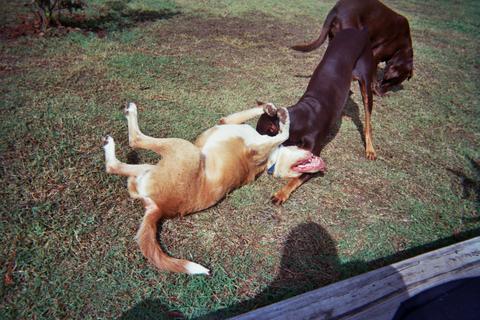

 He has not bitten her but it is about as close as it gets........Idk

 Idk,Idk,Idk?:shakinghead:


