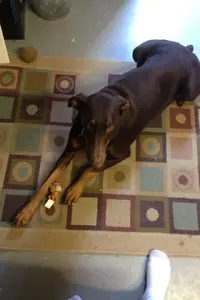
I vaguely remember a conversation I had a few years back when Liberty came home to Justice and I for the first time. I remember stating that I expressed concern of Justice showing signs of jealously. Not to pick on Katja but she mentioned to me that dogs " Do not get jealous " which I thought odd since all the signs pointed to my jealously theory. Came across this experiment tonight in our local news. Read it and see what you think....
http://www.kare11.com/story/news/nation/2014/07/23/jealousy-dogs-emotion/12936191/
Possessive puppies: Yes, dogs get jealous
Traci Watson, Special for USA TODAY2:03 p.m. EDT July 23, 2014
All dog lovers know their pets can feel loyalty and love. Now a study has found that dogs also show signs of a feeling that, for humans, goes hand-in-hand with love: jealousy.
In newly published experiments, pet dogs became aggressive and pushy when their owners showered affection on a plush toy dog, which so captivated the real dogs that almost all of them sniffed the area under the fake animal's tail. When their owners read a book, the pets were relatively indifferent, suggesting that something other than a lack of attention prompted the animals' efforts to divide their beloved people from the "other" dog.
"These data support the idea that (dogs) have this state that motivates them to regain their loved one's attention," says study co-author Christine Harris of the University of California, San Diego. "I do think they have a form of jealousy."
Harris was researching jealousy in humans when an encounter with her parents' three young border collies prompted her curiosity about jealousy in creatures other than humans.
When she tried to pet two of them at the same time, "they weren't happy," she says. "One would take its head and literally push the other's head out of the way so both my hands were on him and the other one would do the same thing. And I thought, 'This really does look like jealousy.' "
To test the idea that dogs can be driven by jealousy, Harris and her collaborator Caroline Prouvost recruited 36 university students with small dogs. "We didn't want to have some German shepherd go ballistic on us," Harris says. She asked the pet owners to focus on three different objects in turn. One was a children's book, one was a plastic jack-o'-lantern pail and the third was a toy dog that briefly barked and wagged its tail when a button on its head was pushed.
When the human subjects read the book out loud, few of the dogs showed any interest. But when the humans cooed and stroked the fake dog, the real dogs went on the warpath. They snapped at the toy and even bit it. They pushed their owners or the toy dog. They whined and barked. They showed the same behaviors, though to a lesser degree, when their humans petted and lavished endearments on the plastic pail, Harris and Prouvost report in this week's PLOS ONE.
Many researchers have argued that unlike sadness and anger, jealousy requires complex cognitive abilities and consists of a blend of feelings, rather than being a fundamental "core" emotion. But these results imply that you don't need sophisticated thinking to fuel jealous actions, Harris says.
The study is "carefully and meticulously constructed," says Texas Tech University's Sybil Hart, who is not connected to the new study. The new findings dovetail with her own research on human babies to suggest "jealousy is part of human nature. It's not a pathology that is only found in individuals who are flawed."
But Indiana University's Jonathon Crystal, who studies memory and cognition, wonders whether the dogs may have learned these behaviors to get attention without the motivation of jealousy. Harris responds that if the dogs only wanted attention, they would've tried the same tricks when their owners were fussing over the jack-o-lantern or reading the book. Instead, the dogs were most likely to snap and try to thrust the interloper away when confronted with their toy "rival."
That's not to say that the dogs' internal experience is the same as that of humans confronted by a romantic rival, Harris says.
"We perseverate on these things. We ruminate on them, we imagine things, we ask questions about ourselves," she says, whereas "once the love triangle is over, the dog is probably over it."
http://www.kare11.com/story/news/nation/2014/07/23/jealousy-dogs-emotion/12936191/


 .
 ). Although very similar, it is still is not the same jealousy as humans ie: my husband glanced at my ex friend so I'm going to despise her from here on, lol.
 And that was simply my point that dogs feelings of "jealousy" are much simpler than we humans make it out to be.