

You are using an out of date browser. It may not display this or other websites correctly.
You should upgrade or use an alternative browser.
You should upgrade or use an alternative browser.
"Moose" sighting!
- Thread starter LifeofRubie
- Start date

Kaiser2016
Well-Known Member
I know the term because it's used to describe Euros as they tend to have more blocky heads compared to Americans. @WiglWerm has a Euro. Is Grace a Euro?@WiglWerm ...you agreed with my block head post above, one might assume you know the term...I wonder if My Buddy & L of R understand the term...they thought I was making a joke,
....
GOD'S GRACE
Notable member
Is Grace a Euro?
Grace, you remember is a rescue from a BYB...she's all Dobe
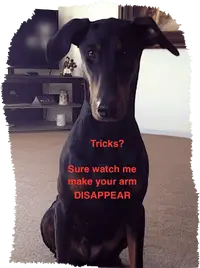 from the melting pot of the USA....but you know what, She's loyal, protective, funny, caring, playful, good with kids, and happy to be here in her forever home & I just love her to high Heaven


WiglWerm
Hot Topics Subscriber
Nope I know the block heads...My grandparents owned yellow labs since I was a baby, now my uncle owns them....great dogs and GREAT with kids. English labs are the block heads...love them.
English Labs are calmer, sturdier, more levelheaded, and much, much easier to train. They tend to be a bit shorter in stature, meeting the AKC regulations; have a heavier build; thicker tail; and a block head.
English Labs are calmer, sturdier, more levelheaded, and much, much easier to train. They tend to be a bit shorter in stature, meeting the AKC regulations; have a heavier build; thicker tail; and a block head.
WiglWerm
Hot Topics Subscriber
Huh, I have never heard the term used with dobies though, @Kaiser2016...I guess I'm not hip to the new lingo, lol

LifeofRubie
Moderator
Nope I know the block heads...My grandparents owned yellow labs since I was a baby, now my uncle owns them....great dogs and GREAT with kids. English labs are the block heads...love them.
English Labs are calmer, sturdier, more levelheaded, and much, much easier to train. They tend to be a bit shorter in stature, meeting the AKC regulations; have a heavier build; thicker tail; and a block head.
Those are all the reasons Norris wanted an English. I'm SO EXCITED to train a pup that I think will be the exact opposite of Rubie in demeanor and attitude and I think it will be great for her to have a calm, laid-back side kick
 but she'll also be a great resource for him to learn from.
Kaiser2016
Well-Known Member
I wish rescue orgs would collect more information about a dogs background.Grace, you remember is a rescue from a BYB
Kaiser2016
Well-Known Member
It will be interesting to see how they compare.Those are all the reasons Norris wanted an English. I'm SO EXCITED to train a pup that I think will be the exact opposite of Rubie in demeanor and attitude and I think it will be great for her to have a calm, laid-back side kick

Rits
Hot Topics Subscriber
Yeah, don't get a field lab if you don't want crazy for 10+ years. Just ask me how I found out. 
I'm jealous you are getting a much calmer Lab, haha. But I can't wait to hear all about it! Maybe after our Doberman we will go the breeder route for another Lab vs random chance through rescue.
I'm jealous you are getting a much calmer Lab, haha. But I can't wait to hear all about it! Maybe after our Doberman we will go the breeder route for another Lab vs random chance through rescue.
LifeofRubie
Moderator
Ready for some puppy pictures! They have breakfast themed names.
Gravy

Scone

Bacon

Sleeping Babies!!


Gravy
Scone
Bacon
Sleeping Babies!!

Breakfast themed names? Now, I like that idea 
Look how chilled they look!! They are absolutely gorgeous
Look how chilled they look!! They are absolutely gorgeous
LifeofRubie
Moderator
*gasp* Bacon!!!!! Squuuueeeeee.
I just told the breeder I'm glad they pick your puppy because I wouldn't be able to choose just ONE!!!

English style Labs are relatively new around here in Washington County Maine (almost in Canada). When I moved to Maine, there were only field style American Labs that were actually used to retrieve ducks by the owners I knew. They were very good dogs with plenty of drive. The English style started gaining popularity, and although the Labs started to look more stocky, block headed, and shorter, I have not seen a real change in drive. They are just as crazy as ever for retrieving and swimming from what I can see, but the owners don't actually take them out hunting like they used to.
GOD'S GRACE
Notable member
Gravy looks like a BRUTE! .... He's made my team, first round pick!
Kaiser2016
Well-Known Member
I like Bacon too! He looks calm and sleepy
Your next Dobe needs to be a Euro
Your next Dobe needs to be a Euro

Scone has the look for me. Love the face!
Where is Grits?
Where is Grits?
LifeofRubie
Moderator
I'll just post the group!
Grits

Gravy

Hash

Scone
Scramble

Strudel

Waffle

And of course... Bacon

the two gals are really sweet looking, too
Biscuit

Muffin

Grits
Gravy
Hash
Scone
Scramble
Strudel
Waffle
And of course... Bacon
the two gals are really sweet looking, too
Biscuit
Muffin
LifeofRubie
Moderator
English style Labs are relatively new around here in Washington County Maine (almost in Canada). When I moved to Maine, there were only field style American Labs that were actually used to retrieve ducks by the owners I knew. They were very good dogs with plenty of drive. The English style started gaining popularity, and although the Labs started to look more stocky, block headed, and shorter, I have not seen a real change in drive. They are just as crazy as ever for retrieving and swimming from what I can see, but the owners don't actually take them out hunting like they used to.
Our breeder has told me that a lot of her pups go on to be field dogs so they definitely have the instinct and ability to do that type of work. Not clue what we'll do with Moose. Barn hunt?
They are precious!!
Similar threads
- Replies
- 3
- Views
- 724


