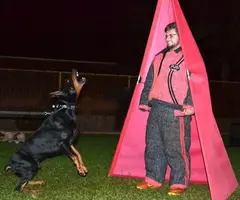
I always go back to John Soares article he wrote about Why Dobermans are Different. Most of the article has to do with training but some of the things mentioned here the article relates to.
Why the Doberman is Different | John Soares K9 Training
Why the Doberman is Different
by
John Soares K9 Training | Jul 10, 2014 |
Dobermans |
By John Soares
An important consideration in training the Doberman for IPO/Schutzhund is understanding their aggression/defense. In my opinion, our limited success in the sport has a lot to do with methods of training which do not take these qualities into consideration. References to the herding group (German Shepherds, Malinois) will be made throughout this article. It is with the utmost respect for these breeds and their trainers that they will be mentioned. Due to the success of these trainers in IPO/Schutzhund, their principles and philosophies of training have been accepted as the standard for all to follow. As a consequence, training methods used in our sport are dependent on the instinctive qualities of the herding dog. Our breed does not possess these same qualities. The way a dog chooses to work, socialize and relate to its environment is due to the qualities and attributes specific to a breed’s purpose. Unless a trainer has had the opportunity to own and train herding dogs as well as Dobermans, there is a limited ability in understanding the differences. We need to thoroughly research what provided the Doberman with its legacy as a working dog and cultivate those strengths. This article’s purpose is to explain why the Doberman is different. The findings are based on personal research and practical experience.
The way a dog perceives life is determined, to a great degree, by levels of prey, aggression and defense. Although all dogs need to possess each of these innate qualities in order to sustain good mental health, it is in the varying levels of combinations of these drives that sets one group of dogs apart from another. Before talking about breed differences, we need to first understand aggression/defense. Why is it needed? What purpose does it serve? And where is it derived from?
Instinctively, in nature, it is the amount of resources within an area which determines the amount of space an animal will need for survival. Aggression is a survival instinct which establishes the boundaries to this area. Marking, spraying, scenting, etc., designate the boundaries of territory. This is deeply rooted in the natural order of wild animals. It is important that these annunciations are respected. Nature has provided animals with these forms of communication to limit contact. This order in nature provides a respect to resources of another animal. This common ritualistic language all stems from the aggression/defense qualities of an animal. When these boundaries are disrespected, it is often due to a lack of available resources. In such cases, the decision of entering another’s territory is based on survival (lack of food, etc.) and injury or fight are seen as risks worth taking.
Though our domesticated dogs do not rely on a need for nature’s resources for survival, they often possess the same instinctive needs or reactions to space/distance. We have to always keep in mind that our dogs are caught up living in two different worlds. The first being that of man due to domestication; the second being that of their wild ancestors, which is where dogs have stemmed from.
The basis of understanding the Doberman lies in studying those groups of dogs responsible for its creation. Our breed is largely attributed to the selective breeding of the mastiff, hunting and terrier groups. By understanding the genetic qualities and attributes of each, we begin to see why the Doberman’s perception of stimulus is different. What makes our breed aggression/defense based? What concerns should be addressed in training? And why are traditional training methods not conducive to an aggression/defense-based breed? Before analyzing these groups we need to acknowledge the Thuringian Shepherd and the Old German Shepherd, which are unlike the German Shepherds seen today. These old breeds may have also been sued to produce our Doberman. However, the information available does not clearly support if or what they contributed to our breed.
An important quality of the mastiff and hunting groups is they do not possess the need to “pounce”. By not possessing this need there is a refraining from making contact or of closing in space to a rival or stimulus. Instinctively, these two groups were provided with ways of communicating ritualistically to influence a rival to go away or to stay away from prey. “Pounce” is the third step in patterned behavior of hunting referred to as “predatory sequence”. This is the sequence by which a carnivore hunts. Predatory sequence consists of stalk, chase, pounce, bite, kill and dissect. Dogs’ working capabilities are greatly based on the manipulation of this pattern. Most of our contemporary breeders do not utilize this sequence as a reference for breeding true to a breed. However, historical breeding was based on these natural qualities which provided man with consistency in the dog’s performance. By not having the ability to “pounce” there is a break in the predatory sequence. This break is substituted by aggression/defense. The substitution creates an opportunity to ritualistically communicate. By not having “pounce” in its genetic makeup, the mastiff was provided with the ability to often influence a potential intruder (to go away) without contact. This ability is made possible by substituting “pounce” with aggressive/defensive qualities. Likewise, the hunting groups were able to provide man with the needed behaviors of pointing or indicating prey. This group also did not possess “pounce” and instinctively resorted ways of pointing or indicating prey (staying away). The similarity in both groups is that “pounce” is not part of their predatory sequence. Again, we see how the substitution provided these groups with their functional purposes.
Let us look at these two groups.
For a mastiff to be efficient in its purpose, it needed to have a genetic predisposition to guard, work independently of man, be highly territorial, have limited socializing capability and not to have the tendency to wander from its source of reference; be it a home, farm, livestock, etc.
Genetically, a mastiff needed to be able to influence another by ritualistic behavior stemming from aggression/defense with limited prey needs. When intrusion of space happens to a mastiff, it is a serious violation. An aggressive reaction is warranted and the encounter is stressful. Due to the mastiff’s strong aggressive tendencies, “bite” is short-lived, explosive and meant to injure. The sole purpose of engagement is to induce flight, subdue or, at times, injure or kill. The mastiff’s predatory sequence was to “stalk” and give limited “chase”. If the rival did not respond to this ritualistic behavior and advanced, then the “bite” would follow. The mastiff’s response of “bite” is no longer a response of predatory sequence but one of aggression.
This instinctive refrain from making contact or closing in space is also seen in most of the hunting breeds. The hunting group was to “stalk”, “chase” and to “stalk” again to maintain distance from the prey. This group purposely did not possess “pounce”. Unlike the mastiff breeds, they were to work with man; not independently, and have a greater “chase” ability in order to pursue prey and work in different locations. Some enthusiasts of hunting breeds believe that their retrieving tendency is due to “pounce”. This unique ability to retrieve and handle prey in a soft mouth is not characteristic of a strong “pounce” tendency. But the general expression of this tendency in the hunting group seems to be much more pack and play oriented with limited prey drive.
The terrier is a complete contradiction to the mastiff and hunting group’s response to stimuli. Instinctively, the terrier possesses strong “pounce” responses. Terriers do not refrain from closing in of space to make contact with prey. Their strong prey drive is very aggression based. This unique combination provides them with its innate fighting ability. The terriers’ response to a stimulus is to chase, pounce, bite, kill and dissect. Remember, the terrier was purposely bred to have killing-dissecting needs because of their specialization to rid areas of vermin. They needed to possess a fearlessness required to fight for long periods without great regard for self preservation. The terriers’ unique quality is that it does not honor nature’s reason for providing animals with aggression. Remember, aggression is a survival instinct for self preservation. Duration in fighting is not a way to sustain life. When two rivals fight, a purely defensive state will shortly develop in one, which will bring about a flight response and the fight quickly ends. However, in the terrier, their unnatural response of longevity to fight is due to an exaggeration in levels of prey and aggression/defense. The terrier has historically been praised for its disregard for self preservation. No other group possesses this ability. The tenacity of this group is legendary. Like the mastiff, they were to work without the influence of man.
The herding dog, in order to be efficient in its work, needed to have a high degree of social tendencies; to its herd as well as to its handler. It needed to induce movement with great care not to panic a herd and, when required, to stalk, chase, pounce and bite to control a member of the herd. Genetically, a herding dog needed to be able to influence another by ritualistic means stemming primarily from prey. Their biting response came from a strong independent prey drive used to control a herd member; not to kill. Therefore, the herding dog’s aggression needed to be controlled. This unique quality provided a high degree of social responsiveness to the handler while working. The herding dog was purposely bred to possess obedient traits to facilitate strong social tendencies toward man.
We know that our sport is based on this instinctive ability to socialize through prey. Helmut Raiser’s book bases itself on this quality of the herding dog. Raiser, and other great trainers, believed that pronounced prey is the extension to pronounced fight drive. The herding dog’s resilience to the intrusion of its space, as well as to space of another, is due to its instinctive socialization capabilities stemming from prey. Although the terrier also possesses these same qualities, it does not do so with the intention of gathering or maintaining order in a herd. The terrier’s goal is to eliminate! It does not possess the same consideration to prey as is seen in the herding dog. The herding dog was to bite, contain or control with no impulses of killing/dissecting. Full mouth biting in the herding dog was desired. Full mouth biting comes from strong independent prey! The difference regarding the terrier and herding groups, when it comes to prey, is that the terrier was to finish the stalk, chase, pounce, bite responses with aggressive tendencies to kill and, at times, dissect. The herding breeds were to stalk, chase, pounce and bite without the killing/dissecting responses.
When we think of our Doberman, full mouth biting was never a consideration when originally bred. Our earlier Dobermans had strong terrier tendencies. Remember, terriers were needed to rid areas of vermin. Killing was an important aspect of this purpose. In order to accomplish this, the terrier was to possess strong prey drive that was aggression based. Our earlier Dobermans possessed these qualities. Ironically, the terriers’ tenacity to prey is what provides pit bull terriers with the reputation they have today. Dobermans had that same quality not so long ago. Strong terrier-type drives are what made the Doberman, at that time, in wrong or incapable hands, a liability.
With changes due to breeding, we have gone from terrier to more mastiff- and hunting-type mentalities in our Dobermans. This change has brought about advantages as well as disadvantages. One advantage of going away from the terrier-based bloodlines has been a nervous system better adapted to human interaction. The reactivity level to stimuli was decreased providing an increased social ability toward human influence. The main disadvantages of increasing mastiff and hunting responses in the breed has been an increase in sensitivity to space/distance of another and a diminished ability to “pounce” and socialize through prey. Fortunately, we are still able to find enough terrier-type responses that, when properly channeled, can make Dobermans successful in our sport.
Anyone who has had the benefit of watching or working with great Doberman trainers would notice the importance of promoting and increasing focus on prey. These great trainers were successful because of their consideration for our breed. Our greatest misfortune is that, for one reason or another, we have lost these references. Doberman trainers and handlers of the past had the dedication needed to learn about the strengths and weaknesses of the breed and trained accordingly. It was clear to them that the Doberman’s strong aggression/defense-based impulses warranted a different method of training. They understood that when these drives are inappropriately cultivated, very hectic mannerisms result. Defensive mannerisms were countered by promoting strong prey in training. Even with our breeding changes today, this type of training still holds true. As Doberman trainers, we need to be aware that neutralization training techniques are required because of the aggression/defense qualities of the terrier, mastiff and hunting breeds. Classical training methods used to train dogs in the sport do not address these concerns.
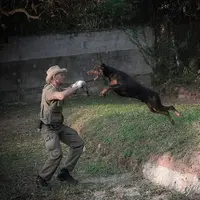
None of the groups which were used to breed the Doberman possessed the strong, independent prey drive that is found in the herding dog. All of the groups that contributed to producing the Doberman were strongly influenced by aggression/defense. It is an aspect of the Doberman that needs to be addressed in training tracking, obedience and protection. The protection phase requires helper work that is able to induce strong social behaviors stemming from prey. Prey presentation must be provided in such a way to induce “pounce”. This balance is a concern very specific to the Doberman. In training tracking and obedience, prey is important to neutralize the Doberman’s willingness to accept a decrease of space relative to the handler and then maintaining reliability while increasing that distance.
Unfortunately, in training circles today, the training required to provide our breed with success is not always appreciated. The breed continues to be misunderstood through lack of consideration or knowledge. Changes in training are needed to make our breed successful. The differences in our breed are not a handicap. The handicap comes from a refusal to acknowledge that there is a difference between breeds. It should be made clear that this article is not meant to excuse dogs which do not possess the qualities for our sport. If a dog is weak, insecure, etc., it has no place in the sport or in a breeding program. There are also non-herding dogs which, perhaps, are able to comprehend and are successful using the same training methods used for herding dogs. But that is not the norm. A successful training method gains acceptance when it works for the average good dog; not the exceptional dog. It becomes heart-breaking to continually see a Doberman fail or be limited in the working arena due to training methods. It is not a lack of quality. We need to realize the differences of our breed and make changes accordingly.



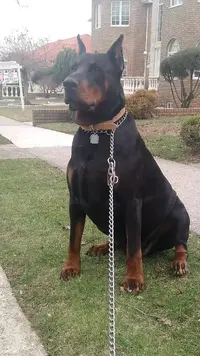
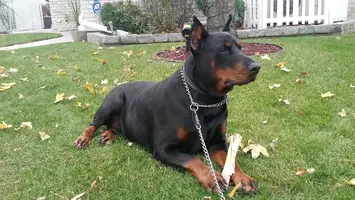


 But your handsome boy is simply overweight. Looking for a 'bigger' Doberman doesn't mean adding on weight. The Doberman breed is meant to be sleek and athletic like a racehorse. Even Euros. With all the heart problems within our breed, adding so much weight just makes the heart work harder.