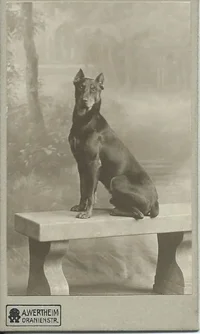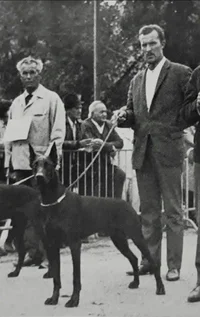

remy
Active Member
One of the recent threads inspired me to share some Doberman history from the old books I have. This particular book is called “The Doberman Pinscher in America” by Willis Sidney Schmidt. It is from 1940! 
This book has a little bit of everything in it. Let me know if there are any particular chapters/pages you’d like me to share! For now I’ll post a few sections that I find interesting.
The First Standard of the Breed (Issued by the National Doberman Pinscher Club in 1899):
“General Appearance:
The Doberman Pinscher should be built muscular and powerful, but not clumsy and massy, neither should he be greyhound-like. His appearance must indicate swiftness, power and endurance. Temperament should be lively and ardent. He must be courageous and not be scared of anything. When protecting his master he is showing the courage of a lion. He is not fighting other dogs; he is not vicious and not unloyalw. His eyes show intelligence and resolution.
Height at the shoulder:
Males 55-65 cm (21.6 to 25.6 inches).
Females 48 to 55 cm (18.9 to 21.6 inches).
Color:
Ground color velvet black, red or blue with rust brown markings. White spot on chest permissible. Gray undercoat permissible on neck, behind the ears and on top of the head, also black spots on toes permissible.
Head:
Top of head must be flat or may be slightly arched, but the forehead must be broad; stretched long, the head must go over into a not too pointy muzzle. Cheeks must be flat but very muscular. A dog of about 50 cm (19.7 inches), height at the shoulder should measure about 41 cm (16 inches), around the forehead. The length of the head, from the occiput to the tip of the nose should be 25-26 cm (9.9 - 10 inches). Bite must be very powerful, well developed and closing tight. Lips lying close to jaw, not drooping. The eye must be dark brown, medium sized, with an intelligent, gentle but energetic expression.
Ears:
Well cropped, not too short and not to pointy.
Neck:
Powerful and straight.
Legs:
Straight, with well closed and arched toes. Elbows must stand horizontal under the rump and should not turn out. Hindquarters powerful and muscular.
Back:
Straight and not too long. Length from occiput to first joint of tail about 70 cm (27.5 inches), so that the entire length, without tail, should measure about 95 cm (37.4 inches). Back should not be weak. Kidneys powerfully developed and well filled out. Briskest well arches, not flat and reaching deep to the elbow.
Tail:
Cropped, not longer than about 15 cm (5.9 inches).
Coat:
Hard, short and close lying.
Qualities:
Watchful, loyal and obedient, intelligent and not vicious; however he must be sharp, equally well working in the water and on land. Most excellent killer of all animals of prey.”
“The Latest American Standard:
In the following is a reprint of “The Present Official American Standard and Scale of Points,” proposed and approved by the Executive Committee of the Doberman Pinscher Club of America, issued in January, 1935.

1 General Appearance
The APPEARANCE is that of a dog of good middle size, with a body that is square; the height, measured vertically from the ground up to the withers, equalling the length, measured horizontally from the forechest to the rear part of the upper thigh. Height at shoulder, males 24 to 27 inches, bitches 23 to 25 inches. Compactly built, muscular and powerful, for great endurance and speed. Elegant in appearance, of proud carriage, reflecting great nobility and temperament. Energetic, watchful, determined and alert. Loyal and obedient. Fearless and aggressive.
Faults: Coarseness. Fine greyhound build. Undersized or oversized. Commonness, sluggishness, lack of nobility and temperament. SHYNESS, viciousness.
2 Head: Shape, Eyes, Teeth, Ears
Shape: long and dry, resembling a blunt wedge. Top of the head flat, slightly depressed to ridge of nose, with nose line extending as nearly parallel as possible to the forehead. Cheeks flat. Jaws full and powerful. Well filled under the eyes. Lips lying close to jaw.
Faults: RAMSHEAD, prominent frontal arch, too prominent occipital bone, rounded skull or apple head, dishfaced. Hollowness under eyes, too short or snippy muzzle. Heavy cheeks. Lippiness.
Eyes: Dark and of medium size, almond-shaped, with vigorous, energetic expression. In reds, eye should blend with color of coat.
Faults: LIGHT EYES (SULPHUR COLOR), eyes too small or too large. Sinister.
Teeth: Strongly developed and snow-white. Lower incisors as nearly upright as possible and touching inside of upper incisors.
Faults: MISSING TEETH, poor or black-brown teeth; UNDERSHOT OR OVERSHOT EXCEEDING ONE-QUATER INCH.
Ears: Well trimmed and carried erect.
Faults: Ears badly carried or placed too low.
3 Neck
Sufficiently long and “dry”, well muscled and slightly arched.
Faults: Short or thick neck. Throatiness.
4 Body
Backline firm, at least level, sloping to croup desirable. Withers clearly defined. Back short, firm and muscular. Chest, well developed with noticeable spring of ribs, reaching deep to the elbow. Brisket full but not too broad. Stomach well tucked up extending curved line with chest. Loins well muscled, hips sufficiently broad. Tail clipped short.
Faults: Long back, roaches or swayed. BACK-LINE DEFINITELY HIGHER AT HIND-QUARTERS. Diagonally slanting or low rounding croup. Stuck-on tail placement. Narrow, shallow, barrel-shaped chest. Gothic arch. Waspiness, lack of muscular development, too narrow hips.
5 Forequarters
Shoulders well muscled, lying close to body. Upper arms forming, as nearly as may be, a right angle with the shoulder blades. Legs straight to the pasterns. Pasterns firm. Paws compact.
Faults: Loose or stiff shoulders. FRENCH OR “FIDDLE” FRONT. Feet turning in or out. Narrow front. Weakness in pasterns. Steepness (too short an upper arm). Insufficient forechest. Paws long, flat or splayed.
6 Hindquaters
Broad, with upper thigh forming right angle with hip bone. Well muscled, with clearly defined stifle. Lower thigh of good length. Legs, when viewed from behind, straight, turning neither in nor out. Paws compact.
Faults: Fine or slightly-muscled hindlegs. Steepness, insufficient angulation. Excessive angulation. COW-HOCKS. Slanting or excessive rounded croup, with low tail placement. Lack of balance with forequarters. Feet turning in or out. Flat feet.
7 Gait
Free, balanced, vigorous and true. Back firm, reflecting good “working dog” qualities.
Faults: Lack of drive, stiffness, looseness, excessive back motion. Paddling. Throwing front or rear legs.
8 Coat, Color and Markings
Short, hard and close-lying. Black, brown or blue, with rust-red, sharply defined markings. Some white hairs on chest permissible, but not desirable.
Faults: Long hair, wavy hair, gray undercoat showing through. White on chest exceeding half-inch square. LIGHT FAWN (OR ISABELLA) PROHIBITED. Straw-colored, mixed, missing or too large markings.
Note: Faults in capital letters are MAJOR FAULTS evidencing degeneration of the breed.”
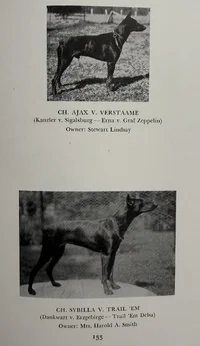
A few photos of dogs in the book:


There were some breeder ads too:


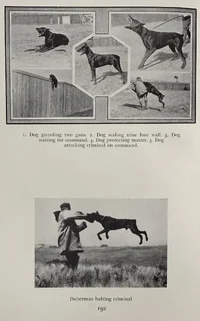
Doberman Pinscher and the Police
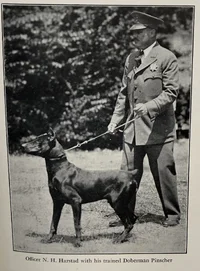
“The following are excepts from an article which appeared in the September, 1932, issue of the “Western Kennel World” and which was written by Sergeant N. H. Harstad, Berkeley Police Department, now Chief of Police of Palm Springs California.”
“Thirty-five years ago the Germans produced a breed of dog, after sixty years of secret breeding, that today is recognized throughout the world as ‘the dog with the human brain.’ Not only are the police departments and patrol officers in all branches finding them invaluable in their work, but they are used in guarding homes, hunting and as pets for children.
They are the famed Doberman Pinschers, a breed which saw active service with the German Army during the World War because they stood up under heavy fire. They were used to carry medical supplies to wounded men in the field and to transport messages. They are the only dogs as a breed which will not retreat when fired upon.
Since the war, however, their ability to react to proper training has made a niche for them in everyday police work. A little over a year ago, C. A. Roy, former member of the Provincial Police of Canada, famous trainer of police dogs and the owner of the Palanka Kennels, Richmond, California, introduced the dogs into the Berkeley Police Department.
Roy has had twelve years’s experience as a trainer of dogs, including two years in Europe, nine years in Canada and one year in California. He not only trains them for police work, but has been called upon to train them in obedience for private owners.
During the past twelve months, nine dogs have been purchased by members of the police department. At the time they were purchased they were puppies and have been put through an intensive course of training. Today, they are almost ready to take their posts with the officers.
They are used to inspect dark alleys, areaways, vacant buildings, by the members of the two night patrols. Their effectiveness might be illustrated by the fact that the officer in charge of the dog can stay in the open while the dog prowls through the darkened street or through the vacant buildings.
Because of their type of training, the dogs can race up a fire escape as fast as the ordinary man. Here again, the officer can protect himself, while the dog routs out the criminal.
Only recently members of the department found another, and very important, use for the dogs. Students of the University of California staged a semi-annual ‘rush’ on two Berkeley theatres, forcing their way past the doorman and usually creating a mild ‘riot’ inside.
Officer Ormes, with Artus and Diogenes, two Doberman Pinschers, was sent to the Fox California Theatre, where the students were believed to be headed. Artus took his post on one side of the box office, while Diogenes stood guard on the other side. Ormes stood off to the side.
Down the street came a mob of 250 or 300 students ready to rush the doors. The two Doberma Pinschers stood pat. As the students reached the front of the theatre, the front of the mob slowed down. Those in the rear started to push forward.
They were literally shoved forward until they stood only a few feet from the two dogs. They didn’t care to get any closer, although Artus and Diogenes had not made a move or a sound.
Then those in the front, probably inspired by the fear of facing those two immobile animals, succeeded in moving backwards. At first the movement was slow, then it began to pick up speed as those in the rear learned that they were not facing a policeman, but would have to battle with two highly trained Doberman Pinschers.
In less time, much less in fact, than it takes to tell the story, that mob of students had quietly moved on without making their semi-annual ‘rush’ of the theatre.
There is no doubt in my mind or in the mind of Officer Ormes that nothing kept those students from rushing the doors except the presence of Artus and Diogenes.
This is only one incident in the life of a Berkeley police dog, and only one type of case in which they can and will be of invaluable aid.
Citizens in Berkeley have been startled to see, on more than one occasion, the figure of a man, thoroughly padded, make his way into a darkened alley. A few minutes later an officer climbs out of his car, followed by the dog.
The dog is sent into the alley, while the officer stands outside. Within a few seconds the officer hears a deep-throated growl. It is not sight which tells the dog that someone is in the alley, but his keen sense of smell.
‘Search’ the officer orders.
Without waiting a moment, the dog continues his prowling of the alley to rout out the origin of the smell which has told him that someone is there. When the dog has found the man, he raises a disturbance and the officer advances into the alley.
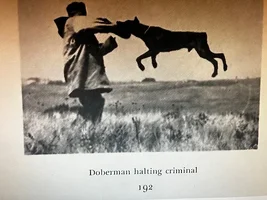
The dogs never attack a person until they are ordered to by their masters. If the criminal keeps his hands above his head and does not move, the dog merely barks until he has attracted the attention of the officers.
However, if the man refused to put up his hands or tires to escape, the dog seizes him by the worst, knocks him down and holds him until the officer arrives. Kicking or clubbing the dog faults to make him release his hold.
Many other similar instances, demonstrating the almost unlimited usefulness of our dog, could be related.”


This book has a little bit of everything in it. Let me know if there are any particular chapters/pages you’d like me to share! For now I’ll post a few sections that I find interesting.
The First Standard of the Breed (Issued by the National Doberman Pinscher Club in 1899):
“General Appearance:
The Doberman Pinscher should be built muscular and powerful, but not clumsy and massy, neither should he be greyhound-like. His appearance must indicate swiftness, power and endurance. Temperament should be lively and ardent. He must be courageous and not be scared of anything. When protecting his master he is showing the courage of a lion. He is not fighting other dogs; he is not vicious and not unloyalw. His eyes show intelligence and resolution.
Height at the shoulder:
Males 55-65 cm (21.6 to 25.6 inches).
Females 48 to 55 cm (18.9 to 21.6 inches).
Color:
Ground color velvet black, red or blue with rust brown markings. White spot on chest permissible. Gray undercoat permissible on neck, behind the ears and on top of the head, also black spots on toes permissible.
Head:
Top of head must be flat or may be slightly arched, but the forehead must be broad; stretched long, the head must go over into a not too pointy muzzle. Cheeks must be flat but very muscular. A dog of about 50 cm (19.7 inches), height at the shoulder should measure about 41 cm (16 inches), around the forehead. The length of the head, from the occiput to the tip of the nose should be 25-26 cm (9.9 - 10 inches). Bite must be very powerful, well developed and closing tight. Lips lying close to jaw, not drooping. The eye must be dark brown, medium sized, with an intelligent, gentle but energetic expression.
Ears:
Well cropped, not too short and not to pointy.
Neck:
Powerful and straight.
Legs:
Straight, with well closed and arched toes. Elbows must stand horizontal under the rump and should not turn out. Hindquarters powerful and muscular.
Back:
Straight and not too long. Length from occiput to first joint of tail about 70 cm (27.5 inches), so that the entire length, without tail, should measure about 95 cm (37.4 inches). Back should not be weak. Kidneys powerfully developed and well filled out. Briskest well arches, not flat and reaching deep to the elbow.
Tail:
Cropped, not longer than about 15 cm (5.9 inches).
Coat:
Hard, short and close lying.
Qualities:
Watchful, loyal and obedient, intelligent and not vicious; however he must be sharp, equally well working in the water and on land. Most excellent killer of all animals of prey.”
“The Latest American Standard:
In the following is a reprint of “The Present Official American Standard and Scale of Points,” proposed and approved by the Executive Committee of the Doberman Pinscher Club of America, issued in January, 1935.
1 General Appearance
The APPEARANCE is that of a dog of good middle size, with a body that is square; the height, measured vertically from the ground up to the withers, equalling the length, measured horizontally from the forechest to the rear part of the upper thigh. Height at shoulder, males 24 to 27 inches, bitches 23 to 25 inches. Compactly built, muscular and powerful, for great endurance and speed. Elegant in appearance, of proud carriage, reflecting great nobility and temperament. Energetic, watchful, determined and alert. Loyal and obedient. Fearless and aggressive.
Faults: Coarseness. Fine greyhound build. Undersized or oversized. Commonness, sluggishness, lack of nobility and temperament. SHYNESS, viciousness.
2 Head: Shape, Eyes, Teeth, Ears
Shape: long and dry, resembling a blunt wedge. Top of the head flat, slightly depressed to ridge of nose, with nose line extending as nearly parallel as possible to the forehead. Cheeks flat. Jaws full and powerful. Well filled under the eyes. Lips lying close to jaw.
Faults: RAMSHEAD, prominent frontal arch, too prominent occipital bone, rounded skull or apple head, dishfaced. Hollowness under eyes, too short or snippy muzzle. Heavy cheeks. Lippiness.
Eyes: Dark and of medium size, almond-shaped, with vigorous, energetic expression. In reds, eye should blend with color of coat.
Faults: LIGHT EYES (SULPHUR COLOR), eyes too small or too large. Sinister.
Teeth: Strongly developed and snow-white. Lower incisors as nearly upright as possible and touching inside of upper incisors.
Faults: MISSING TEETH, poor or black-brown teeth; UNDERSHOT OR OVERSHOT EXCEEDING ONE-QUATER INCH.
Ears: Well trimmed and carried erect.
Faults: Ears badly carried or placed too low.
3 Neck
Sufficiently long and “dry”, well muscled and slightly arched.
Faults: Short or thick neck. Throatiness.
4 Body
Backline firm, at least level, sloping to croup desirable. Withers clearly defined. Back short, firm and muscular. Chest, well developed with noticeable spring of ribs, reaching deep to the elbow. Brisket full but not too broad. Stomach well tucked up extending curved line with chest. Loins well muscled, hips sufficiently broad. Tail clipped short.
Faults: Long back, roaches or swayed. BACK-LINE DEFINITELY HIGHER AT HIND-QUARTERS. Diagonally slanting or low rounding croup. Stuck-on tail placement. Narrow, shallow, barrel-shaped chest. Gothic arch. Waspiness, lack of muscular development, too narrow hips.
5 Forequarters
Shoulders well muscled, lying close to body. Upper arms forming, as nearly as may be, a right angle with the shoulder blades. Legs straight to the pasterns. Pasterns firm. Paws compact.
Faults: Loose or stiff shoulders. FRENCH OR “FIDDLE” FRONT. Feet turning in or out. Narrow front. Weakness in pasterns. Steepness (too short an upper arm). Insufficient forechest. Paws long, flat or splayed.
6 Hindquaters
Broad, with upper thigh forming right angle with hip bone. Well muscled, with clearly defined stifle. Lower thigh of good length. Legs, when viewed from behind, straight, turning neither in nor out. Paws compact.
Faults: Fine or slightly-muscled hindlegs. Steepness, insufficient angulation. Excessive angulation. COW-HOCKS. Slanting or excessive rounded croup, with low tail placement. Lack of balance with forequarters. Feet turning in or out. Flat feet.
7 Gait
Free, balanced, vigorous and true. Back firm, reflecting good “working dog” qualities.
Faults: Lack of drive, stiffness, looseness, excessive back motion. Paddling. Throwing front or rear legs.
8 Coat, Color and Markings
Short, hard and close-lying. Black, brown or blue, with rust-red, sharply defined markings. Some white hairs on chest permissible, but not desirable.
Faults: Long hair, wavy hair, gray undercoat showing through. White on chest exceeding half-inch square. LIGHT FAWN (OR ISABELLA) PROHIBITED. Straw-colored, mixed, missing or too large markings.
Note: Faults in capital letters are MAJOR FAULTS evidencing degeneration of the breed.”
A few photos of dogs in the book:
There were some breeder ads too:
Doberman Pinscher and the Police
“The following are excepts from an article which appeared in the September, 1932, issue of the “Western Kennel World” and which was written by Sergeant N. H. Harstad, Berkeley Police Department, now Chief of Police of Palm Springs California.”
“Thirty-five years ago the Germans produced a breed of dog, after sixty years of secret breeding, that today is recognized throughout the world as ‘the dog with the human brain.’ Not only are the police departments and patrol officers in all branches finding them invaluable in their work, but they are used in guarding homes, hunting and as pets for children.
They are the famed Doberman Pinschers, a breed which saw active service with the German Army during the World War because they stood up under heavy fire. They were used to carry medical supplies to wounded men in the field and to transport messages. They are the only dogs as a breed which will not retreat when fired upon.
Since the war, however, their ability to react to proper training has made a niche for them in everyday police work. A little over a year ago, C. A. Roy, former member of the Provincial Police of Canada, famous trainer of police dogs and the owner of the Palanka Kennels, Richmond, California, introduced the dogs into the Berkeley Police Department.
Roy has had twelve years’s experience as a trainer of dogs, including two years in Europe, nine years in Canada and one year in California. He not only trains them for police work, but has been called upon to train them in obedience for private owners.
During the past twelve months, nine dogs have been purchased by members of the police department. At the time they were purchased they were puppies and have been put through an intensive course of training. Today, they are almost ready to take their posts with the officers.
They are used to inspect dark alleys, areaways, vacant buildings, by the members of the two night patrols. Their effectiveness might be illustrated by the fact that the officer in charge of the dog can stay in the open while the dog prowls through the darkened street or through the vacant buildings.
Because of their type of training, the dogs can race up a fire escape as fast as the ordinary man. Here again, the officer can protect himself, while the dog routs out the criminal.
Only recently members of the department found another, and very important, use for the dogs. Students of the University of California staged a semi-annual ‘rush’ on two Berkeley theatres, forcing their way past the doorman and usually creating a mild ‘riot’ inside.
Officer Ormes, with Artus and Diogenes, two Doberman Pinschers, was sent to the Fox California Theatre, where the students were believed to be headed. Artus took his post on one side of the box office, while Diogenes stood guard on the other side. Ormes stood off to the side.
Down the street came a mob of 250 or 300 students ready to rush the doors. The two Doberma Pinschers stood pat. As the students reached the front of the theatre, the front of the mob slowed down. Those in the rear started to push forward.
They were literally shoved forward until they stood only a few feet from the two dogs. They didn’t care to get any closer, although Artus and Diogenes had not made a move or a sound.
Then those in the front, probably inspired by the fear of facing those two immobile animals, succeeded in moving backwards. At first the movement was slow, then it began to pick up speed as those in the rear learned that they were not facing a policeman, but would have to battle with two highly trained Doberman Pinschers.
In less time, much less in fact, than it takes to tell the story, that mob of students had quietly moved on without making their semi-annual ‘rush’ of the theatre.
There is no doubt in my mind or in the mind of Officer Ormes that nothing kept those students from rushing the doors except the presence of Artus and Diogenes.
This is only one incident in the life of a Berkeley police dog, and only one type of case in which they can and will be of invaluable aid.
Citizens in Berkeley have been startled to see, on more than one occasion, the figure of a man, thoroughly padded, make his way into a darkened alley. A few minutes later an officer climbs out of his car, followed by the dog.
The dog is sent into the alley, while the officer stands outside. Within a few seconds the officer hears a deep-throated growl. It is not sight which tells the dog that someone is in the alley, but his keen sense of smell.
‘Search’ the officer orders.
Without waiting a moment, the dog continues his prowling of the alley to rout out the origin of the smell which has told him that someone is there. When the dog has found the man, he raises a disturbance and the officer advances into the alley.
The dogs never attack a person until they are ordered to by their masters. If the criminal keeps his hands above his head and does not move, the dog merely barks until he has attracted the attention of the officers.
However, if the man refused to put up his hands or tires to escape, the dog seizes him by the worst, knocks him down and holds him until the officer arrives. Kicking or clubbing the dog faults to make him release his hold.
Many other similar instances, demonstrating the almost unlimited usefulness of our dog, could be related.”





 I had a great feeling all day she would win!