• Disclaimer: Hello Guest, Doberman Chat Forums presents the opinions and material on these pages as a service to its membership and to the general public but does not endorse those materials, nor does it guarantee the accuracy of any opinions or information contained therein. The opinions expressed in the materials are strictly the opinion of the writer and do not represent the opinion of, nor are they endorsed by, Doberman Chat Forums. Health and medical articles are intended as an aid to those seeking health information and are not intended to replace the informed opinion of a qualified Veterinarian.”

Leadership

Ravenbird

Moderator
$ Forum Donor $
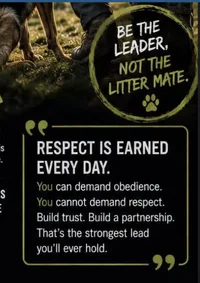
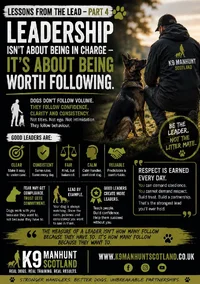
I saw this outline on being a leader and it says so much I thought it worthy of sharing here. Such turmoil in the training biz now with whatever set the pure positive thing against corrections or even saying "no", and wanting to be equals and best friends with your dog rather than "Pack Leader" - that sounds so bossy, I guess.
I did use to use that phase, but just being a Leader is all it's really about. No different than raising children. If you are a good leader in your household, the kids (or dogs) will look up to you in admiration and want to follow in your footsteps. They aren't afraid of you and they don't cower when they see you coming. They try to please you by doing the right things and gain your approval. We've all slept better at night knowing someone was pleased with what we did that day. Even if we did something like make a great dinner or get the lawn mowed, you are pleased with yourself and the satisfaction makes life good. How could being a good leader to your dog be any different?
Leadership.png.webp
 
In 2024 I did a multi day, point to point, bike trip in Scotland. I was SUPER impressed by the people and their dogs. On trails that were for bikes and pedestrians, not one dog was out of order, even the dogs that were off leash. When the bikers came upon people, the people had their dogs sit by their side as the bikers went by.
 
I saw this outline on being a leader and it says so much I thought it worthy of sharing here. Such turmoil in the training biz now with whatever set the pure positive thing against corrections or even saying "no", and wanting to be equals and best friends with your dog rather than "Pack Leader" - that sounds so bossy, I guess.
I did use to use that phase, but just being a Leader is all it's really about. No different than raising children. If you are a good leader in your household, the kids (or dogs) will look up to you in admiration and want to follow in your footsteps. They aren't afraid of you and they don't cower when they see you coming. They try to please you by doing the right things and gain your approval. We've all slept better at night knowing someone was pleased with what we did that day. Even if we did something like make a great dinner or get the lawn mowed, you are pleased with yourself and the satisfaction makes life good. How could being a good leader to your dog be any different?

View attachment 162900
Great stuff, thanks, saved for reference.
IMG_1668.webp

Reminds me of what the wolf guy said, to correct the mistaken "alpha dog" theory of leadership in wolf packs. Its not fear-based/dominance , it's more about love and providing calm consistent leadership with physical corrections as needed.


PS: ?: wonder if this Scot source is the same outfit that posted the excellent explanation about "social maturity" and why not to expect your adult dog to play with other dogs like when it was a puppy.

Yall FB users might find it:
Facebook post by Scottish K9 something that made the rounds on the other dobe forum
And reddit r/doberman.
 
Last edited:
wonder if this Scot source is the same outfit
There is only one K9 ManhuntScotland, so probably the same. I've posted several of his words here on Doberman Chat, usually about obedience, not his scent work stuff. Great guy and trainer.
 
@Ravenbird …..I like this thread and the visual that you attached. There is common sense truth in every facet of the included visual. Every aspiring leader and not solely restricted to the competent dog handler need only apply common sense of logic and peel back layer after layer of how to arrive at the high-lighted key points that are a requisite for a competent effective leader.

My comment is based on experience stemming from the role of being a defiant youthful 'know-it-all grunt' dwelling at the bottom of the broad proverbial leadership pyramid and eventual transitioning to the pinnacle of the pyramid (competitive construction industry) under the guidance of a mentor that illustrated “ at times, one can attract more bees with honey as opposed to vinegar”. The takeaway being, strong-arm, brow beating, threatening, and unfair punishing tactics will alienate as opposed to ally the subject being instructed. That is not to imply that correction must be side-stepped — conversely the level of correction is contingent on the soft/hard temperament and level of defiance of the 'instructee' as the case may be. …..which leads to …..

Indiscriminate heavy handed pinch and/or e-collar useage is not a 'one size-fits-all' if/when used as the preliminary introductory measure in correcting an unwanted behaviour when the wanted behaviour has never been taught and reinforced in the first place. This then is where the text under the symbols in the graphic is applicable.

Of primary note is the 1787605065025.webp indicating fair and balanced.
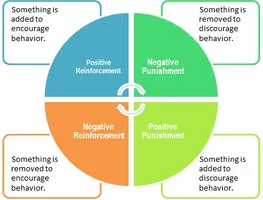
The term “balanced” especially with the zodiac scale icon implies equal +positive and -negative reinforcement/punishment. Albeit operant conditioning as depicted below indicates each quadrant when applied to behaviour impacts wanted and unwanted behaviour EQUALLY. Whereas realistically the temperament, intelligence and innate drive will influence and determine the degree of reinforcement and punishment required — both positive and negative.

Noted psychologist Dr. Stanley Coren in studies regarding intelligence of dog breeds notes that Doberman per se ranks 5 in the top tier of 200+ breeds studied via results of a survey of judges, professional trainers and breeders. Temperament is gauged by the 'dog in front of you' and easily determined by how quickly and if the dog 'shuts down' and how quickly it recovers. Which in turn determines how big or small of a slice of the operant conditioning quadrant is applicable in relation to the desired training objective. In a young pup 2 to 4 months then rarely if ever training needs be outside of the top half of the chart IMHO. As the pup progresses in age then negative reinforcement and positive punishment is introduced only when a wanted/approved behaviour that has been proofed after countless repetitions suddenly the dog balks in performing it.

The bottom line is the dog 'in front of the handler ( i.e. age, temperament, driive) determines the 'balance' as in balanced training lest a handler's 'miscue' in gauging temperament and drive can backfire at the expense of not only a resisting/submissive pup/dog but also a resisting/submissive handler IYKWIM……

Just sayin' ….In the common bond of Dobermans/Dobermanns ….Mikel


1787606780146.webp
 
That is not to imply that correction must be side-stepped — conversely the level of correction is contingent on the soft/hard temperament and level of defiance of the 'instructee' as the case may be.
You are correct, but this quote is especially true. As I've stated in several discussions, before my current dog I had no need for much correction at all with my previous 2 Dobes. They just fell into my life with no defiance whatsoever. They simply didn't ever misbehave. Neither pulled on a leash from day one. I thought is was just this breed, being so smart and all. Then came Asha and it was completely opposite. She could not even play without wanting to make the rules of each game. The only teacher in this town was PP and encouraged me to let her "work it out" or "wait for her to stop" and I gave it a try (my stupidity, I knew it wasn't working!) because we were in her Star Puppy class and I'm not one to go to a class and argue with the teacher. Anyway my puppy just got worse. It took a LOT to control her wild self and to fix all the things that I'd let her "get away with" by waiting on her to stop rather than correcting her in the midst of bad behavior. I absolutely could not believe that this was the same breed that I'd had before, the defiance was real.

I liked this graphic because it describes corrections (which some people take offensively) more as guidance with pressure to do do the right thing by not allowing the dog to practice wrong behavior. I still have friends with dogs that are strictly PP and will not utter the word "no" or correct the dog even when it is terribly out of control. It baffles me why they continue to think the dog will eventually make the right decision when the wrong behavior is so much fun and there is never any indication from their human that it is unwanted.
 
You are correct, but this quote is especially true. As I've stated in several discussions, before my current dog I had no need for much correction at all with my previous 2 Dobes. They just fell into my life with no defiance whatsoever. They simply didn't ever misbehave. Neither pulled on a leash from day one. I thought is was just this breed, being so smart and all. Then came Asha and it was completely opposite. She could not even play without wanting to make the rules of each game. The only teacher in this town was PP and encouraged me to let her "work it out" or "wait for her to stop" and I gave it a try (my stupidity, I knew it wasn't working!) because we were in her Star Puppy class and I'm not one to go to a class and argue with the teacher. Anyway my puppy just got worse. It took a LOT to control her wild self and to fix all the things that I'd let her "get away with" by waiting on her to stop rather than correcting her in the midst of bad behavior. I absolutely could not believe that this was the same breed that I'd had before, the defiance was real.

I liked this graphic because it describes corrections (which some people take offensively) more as guidance with pressure to do do the right thing by not allowing the dog to practice wrong behavior. I still have friends with dogs that are strictly PP and will not utter the word "no" or correct the dog even when it is terribly out of control. It baffles me why they continue to think the dog will eventually make the right decision when the wrong behavior is so much fun and there is never any indication from their human that it is unwanted.
My last girl, Sünje, I worked/trained with very little correction. The first trainer I worked w/ taught to ignore the wrong/bad things and reward the positives/good things. I was actually really impressed w/ how well this worked w/ her--she had so much joy and presence. My last boy Hanno never needed either an e-collar or even a prong. He was so easy to train, cheerful; if you gave him an angry look it would break his heart.

Brio (current boy) on the other hand, needs the prong, needs the e-collar, needs a negative marker ("nope!"). He is very confident and independent, the sort who upon seeing a deer (or a bear or elk or whatever), would say "Nahh, it's fine, Mom! I got this! I can chase this thing down no problem! I'll be fine!" and needs the reprimand, because I KNOW BETTER than he does. I've worked literally daily for years to get him to walk nicely on a leash w/o a prong, using every single method out there, and he still would likely not be able to pass a CGC because he simply can't do it in that context. I've finally gotten him to be able to walk on a buckle collar fairly well w/o too much stopping. After THREE years of working on this.

They are all different, and they all need different tools. What works for one may not work for another. PP only was great for Hanno, and mostly for Sünje (although she did need the prong). Brio needs a much stronger leader, more direction, and occasionally a correction.
 
My last girl, Sünje, I worked/trained with very little correction. The first trainer I worked w/ taught to ignore the wrong/bad things and reward the positives/good things. I was actually really impressed w/ how well this worked w/ her--she had so much joy and presence. My last boy Hanno never needed either an e-collar or even a prong. He was so easy to train, cheerful; if you gave him an angry look it would break his heart.

Brio (current boy) on the other hand, needs the prong, needs the e-collar, needs a negative marker ("nope!"). He is very confident and independent, the sort who upon seeing a deer (or a bear or elk or whatever), would say "Nahh, it's fine, Mom! I got this! I can chase this thing down no problem! I'll be fine!" and needs the reprimand, because I KNOW BETTER than he does. I've worked literally daily for years to get him to walk nicely on a leash w/o a prong, using every single method out there, and he still would likely not be able to pass a CGC because he simply can't do it in that context. I've finally gotten him to be able to walk on a buckle collar fairly well w/o too much stopping. After THREE years of working on this.

They are all different, and they all need different tools. What works for one may not work for another. PP only was great for Hanno, and mostly for Sünje (although she did need the prong). Brio needs a much stronger leader, more direction, and occasionally a correction.
Very similar to my Doberman experience! I was indeed humbled by the challenge of Asha in my life.
 

Back
Top