When to transition to less food.

Josht87

Member
Cato is 6 months old today.

I’ve been feeding him 3 times per day on Origen large breed puppy food. (6 cups per day).

Recently over the past couple of days he has started to leave a little bit of food in his bowl which he has never done before.

My question is at what point should I transition from feeding him 3 meals per day to feeding him twice per day.

And also at which point should I ditch the puppy food and move onto regular dog food.

Thanks
I wouldn’t feed puppy or large breed food so I say switch now to an all life stages food. Feeding 2 or 3 times is really just a matter of convenience for you. If you can feed 3 meals great if it works to just feed twice do that. As puppies I feed as much as they want for about 15 minutes then food gets put up until next feeding time. They learn a routine and when it is time to eat. Once adults it is about healthy weight and keeping them lean so they can compete. All of my dogs get different amounts at feeding time due to different drives and energy levels.
 
I find it varies with every dog. For instance, Drake is going to be 8 in Sept. I still feed him 3 times a day. If I didn't he would be way too skinny. Then there's Rumor who will be 2 in Sept. Her appetite is way over the top but she doesn't have the metabolism to allow that. If I feed her to satisfaction, she'd be a hippo.
Leaving food is the first sign it's time to transition. Just remember dobies are a medium sized dog and shouldn't weigh 100 lbs. Almost nothing harder on a dog than being overweight.
 
I think Nero switched to twice a day about 6m old. It wasn't until after his neuter at 18m though he was actually interested in eating. He was really hard to keep weight on as a young dog with his hormones. Never weighed more than 70 lbs. Now he sits there comfortably at 3cups a day with some coconut oil in the am and fish oil at night. I dont see his ribs or backbone anymore (but still easily felt.)
 
I'm with Genny on this. It really just depends on the dog. I feed twice a day, usually. I only did 3 times a day when Kaizer was really young.

My husky though? I had to have food out all the time or he'd be skin and bones. Kaizer will eat until food is gone no matter what. The lab I can barely keep a notch above "omg, that dog is starving to death", he will eat 3 bites and walk away (yeah, he's a weird lab :p ).

I also don't feed puppy food. I just pay attention to their body. Not the scale, but their actual physical condition. I like my dogs lean but well muscled. And that can read very differently on a scale for every dog. My lab is 75-77 and could add a pound or 2. Kaizer is probably about 115ish and looks good for his age, he'll probably add some once he's over 2 and I really start working him.
 
Each dog is different activity wise (and foods are different), each dog has a different metabolism and on how they metabolize and absorb nutrients. Feeding instructions on foods are just starting points. You need to go by looking at the body of the dog also.
We feed totally a Raw diet. We did start out feeding Kibble for our two boys up until about 3yrs old. Then switched to Raw. Our Female pup just after we got her, we right a way switched to dehydrated raw. She is now 2yrs 3mo still on a base mix of dehydrated food and we add different meat proteins every couple of days.


When I read that you feed 6 cups of Orijen that it seems too much! But for your dog it probably is ok. Puppies need to thrive on a food. This is an important time for growth.
Also feeding 2-3 times a day depends on the dog. If they are going to eat it so fast that they throw up or not process larger meals, then yes smaller meals more times a day would be a good practice. Or incorporate a slow feeder bowl. Or even better use his food while you are training!

Even more so I would not be in a hurry to Neuter (or Spay for Females) him yet. Early Spay/Neuter can affect bone and muscle growth in Large Breed Dogs. As these hormones are very important! This time frame from puppy to about 2-3yrs (in larger breed dogs) old is growth stage. For sure I would Spay/Neuter not until all Bone Growth Plates have closed. Also early Spay/Neuter can or may also lead to Endocrine issues down the road.

Personally I would not Neuter or Spay at all.

Lots of good reading in the Health section on this site.
Or Doberman Nutritional Care

Good read:
Feeding Large Breed Puppies - IVC Journal

Feeding Large Breed Puppies
By Susan Wynn, DVM | March 1, 2013

I see a fat teenager. The owner sees a cute roly poly puppy. I’m thinking OCD, dysplasia, osteoarthritis and chronic pain. The owner can’t see past the fun of having a pup. She’s making a big feeding mistake, but she’s only doing what the breeder told her to do – give the puppy a grainless adult diet, or else the breeder’s warranty is null and void.

“Life stage nutrition” has been questioned when based only on a dog’s numerical age. We all see obese, arthritic ten-year-old dogs that really do need lower fat diets with higher levels of antioxidants and glucosamine; but there are plenty more that look and act younger, and for which these diets are inappropriate. And many breeders have recommended feeding adult foods to puppies to avoid growth problems. To further confuse the issue, we have a plethora of paleolithic diets that incorporate the AAFCO statement that they are complete and balanced for “all life stages”. So how important is feeding a puppy food?

Rapid growth = room for mistakes

The average golden retriever grows from 14 oz to over 65 lbs within one year – a 70 fold increase in size. Human beings take 18 years to accomplish the same thing. At the same time their joints are growing and being exposed to under- or over-nutrition, puppies are susceptible to higher weight stresses, compounding the challenges to normal development.

The most important factors in preventing developmental orthopedic disease (DOD) are rate of growth (which is proportional to the caloric intake) and dietary calcium level.

A common misconception found in many internet articles is the claim that dietary protein should be controlled in large breed puppies to prevent skeletal abnormalities. This theory was disproved some years ago (Nap, 1991). Most commercial puppy foods contain more protein than is thought necessary, but studies have shown that protein contents of 23% to 31% (dry matter) do not have a deleterious effect on growth. The effects of high dietary protein contents in the range of those found in raw diets have not been investigated, to this author’s knowledge.

An overweight body condition is an important risk factor for DOD, and feeding for maximum growth increases that risk. Commercial puppy and adult foods containing 10% to 25% fat (dry matter) are considered adequate for growth. Raw diets tend to range from 20% to 40% fat (dry matter) so it is particularly important to slow growth by maintaining a very lean body condition when these diets are fed. It has been shown that body fat is higher in puppies fed very high fat, low carbohydrate diets during growth.

Body condition score

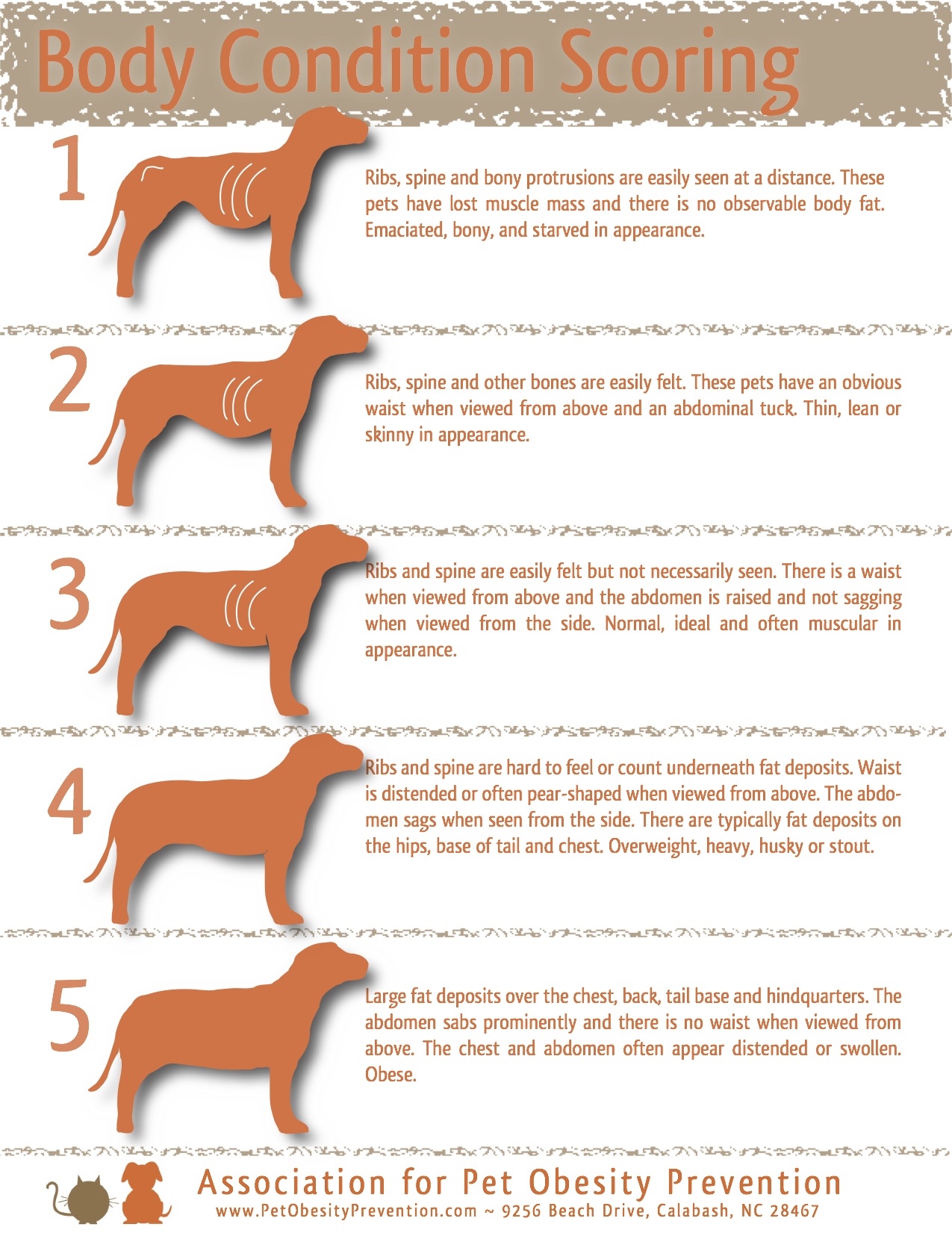
The body condition score (BCS) is an estimation of the body fat content. I recommend the 9-point scale, which is better validated (and in use anyway if one allows “half scores” in the 5-point system). All pet owners should learn how to perform a body condition score for their animals. Training your veterinary support staff to teach clients, having charts and pictures as well as making your own videos can lower the overall obesity level in your patients. Since this is such an important issue, you may also want a bulletin board for photos of your patients’ progress.

In puppies, the BCS should be monitored weekly, since the calorie requirement constantly increases to six to 12 months of age (depending on the breed). Maintain a body condition score of 4/9 in large breed, rapidly growing puppies. Remind clients to ignore the feeding quantities listed on commercial bags and to follow recommended amounts for a fresh food diet.

Dietary considerations

Many pet owners are feeding paleolithic and raw diets – foods that are high in protein and low in starches. Since fat travels with meat, these diets are both high in calcium (which is formulated to balance the high phosphorus content in meats) and in calories. Puppies eating too much of a paleolithic diet can get fat and are likely to get a calcium overdose. Monitoring BCS and keeping it to 4/9 is critically important for giant breed puppies fed a fresh food diet.

Decades ago, we considered some adult diets appropriate for puppies. However, a calorie-calcium mismatch is probably common. Adult maintenance foods are often less calorically dense than puppy foods. Additionally, these diets may have calcium and phosphorus levels that are higher in relation to energy density than a large breed puppy diet. If a rapidly growing puppy has to eat more food to obtain enough calories for growth, a calcium overdose is possible.

On the other hand, paleolithic diets which frequently carry AAFCO statements that guarantee the diet to be complete and balanced for all life stages may or may not have controlled calcium levels in relation to the often high caloric density.

Most nutritionists recommend that large, fast growing puppies eat diets containing at least 30% protein and 9% fat (dry matter basis). The calcium content should be around 1.5% (or 3 grams/1,000 kcal). Diets may have nutrient contents that vary from this guideline and still be appropriate, but you can’t know for sure without in-depth analysis. A very popular raw diet for dogs, carrying the AAFCO statement “formulated to meet the nutritional levels established by the AAFCO Dog Food Nutrient Profiles for All Life Stages” supplies too much calcium for large breed puppies. The calcium content on an as fed basis is 0.56% and the phosphorus content is 0.38%, which conform to AAFCO recommendations for growth. By converting the calcium and phosphorus concentrations to dry matter levels, and correcting for energy density, the calcium content of this diet is 7.5 grams/1,000 kcal. So if a large breed puppy is getting the expected caloric intake, he is eating too much calcium. In another example, a major OTC adult maintenance dry diet contains 22% protein, 1.1% calcium and 0.8% phosphorus as fed. After converting to dry matter content and correcting for energy, the protein content is 24% or 69 grams/1,000 kcal, and the calcium is 3.5 grams/1,000 kcal. The calcium content is correct, and the protein content is adequate but a little marginal for growth. What about treats and supplements?

Remember that treats add calories to the overall diet. Be sure the treats are small, and do not contain added calcium. Owners should be encouraged to use fruits and vegetables, both for the health benefits as well as the fact that they are low in calories. Small pieces of lean meat can also be used, but remember that most dogs are getting plenty of meat from their meals, while fresh vegetables and fruits are not a significant part of the diets of most dogs. Owners should be educated that treats are defined not by their ingredients, but by whether their dogs want them or not, and certainly not by whether they come in a box or bag from the store!

Studies have shown rather definitively that high calcium levels are a risk factor for development of DOD in large breed puppies. Be sure to advise owners to avoid calcium-containing supplements and treats.

There are no studies so far that indicate whether it is effective or harmful to supplement with glucosamine to large breed puppies because of their risk of DOD. In general, I wait until I recognize a risk factor in a dog. Veterinary acupuncturists and physical therapists, veterinary chiropractors, or orthopedic surgeons tend to recognize early signs of joint disease and may institute glucosamine supplementation earlier than general practitioners might. Some holistic veterinarians recommend intermittent use of these supplements in order to monitor for signs of disease that may be masked while using them.

Switching from puppy to adult foods

When the dog is near the adult sized frame and his energy and protein needs lessen, it’s time for a food that is lower in caloric density. This does not happen at an arbitrary age.

It is also important to remember that the metabolic rate, and therefore the caloric requirement, drops after spaying and neutering. Be prepared to reduce the amount of food being given right after surgery, sometimes pretty dramatically, to maintain that BCS of 4/9 or 5/9. I personally don’t recommend early spay/neuter (at three to four months of age) but under these circumstances, a growth diet will be necessary until about six to nine months of age, when full skeletal height is usually reached.

A puppy diet (or one formulated for “all life stages”) can be fed to adult dogs; however, it’s harder to maintain that ideal BCS, since puppy diets are typically more energy dense. By feeding a lower calorie adult diet, a bit more volume can be more satisfying to the adult dog, though continuing to monitor the BCS on a regular basis is critical.

If an adult dog’s metabolic rate and caloric requirement are much lower than expected, it is important to remember that cutting the calories in a formulated diet also cuts nutrients. Some obese-prone adult dogs end up requiring 50% to 60% of the expected caloric intake to approach a normal weight, and since manufacturers formulate their diets so that nutrients are provided in proportion to the calories, some of these dogs may actually experience nutrient deficiencies.

In these cases, the dog should either be fed a lower calorie maintenance or a weight management diet, or eat a homemade food with daily vitamin and mineral supplements calculated to supply the dog’s requirement. An “all life stages diet” with the high energy content of a puppy diet simply won’t do.

Think about that 95 lb golden retriever with a BCS of 7/9, eating two 8 oz patties of raw food daily, and who is still overweight. The daily intake is already low, and would have to be reduced for weight loss. That dog is likely malnourished.

How to recommend food brands

Choose a food designed for large breed puppies, whether a commercial food labeled as such or a homemade diet designed by a nutritionist for this purpose. The most reliable foods have been tested in AAFCO feeding trials, in contrast to those that have simply been designed on a computer. Coach clients to keep their puppies thin – and to show love not by giving more food, but by finding fun activities to keep them occupied!

[sidebar]
Stages of skeletal growth

• Endochondral ossification: Growth, maturation and chondrocyte apoptosis followed by bony replacement of cartilage

• Periosteal growth: Lamellar new bone formation

• Remodeling: Removal of newly formed metaphyseal and endosteal bone to adapt bone shape

Hazewinkel, 2012

[sidebar]
Dietary recommendations for large breed puppies

1. Make sure the diet is complete and balanced for “all life stages” according to AAFCO guidelines, or if homemade, has been analyzed by a veterinary nutritionist. 2. Diets that have been tested in feeding trials are preferred to those that have been formulated according to AAFCO guidelines only. 3. Never free feed. 4. Keep the puppy lean (4/9 or 5/9). 5. Look for these guidelines: a. A dry matter content of about 30% protein, 9% fat, 1.5% calcium and 0.8% to 1% phosphorus. The calcium:phosphorus ratio should be between 1:1 to 1.3:1. b. If the diet deviates from these guidelines, refer back to #1-4.

References

American Association of Feed Control Officials, 2012 Official Publication, Oxford Indiana, 2012.

Hazewinkel H. “Nutritional Management of Orthopedic Diseases”. Applied Veterinary Clinical Nutrition, Fascetti AJ and Delaney SJ, Eds. John Wiley and Sons, Oxford, UK, 2012.

Nap RC, Hazewinkel H, Voorhout G, van den Brom WE, Goedegebuure SA, van ‘t Klooster AT. “Growth and skeletal development in great Dane pups fed different levels of protein intake”. J Nutr. November 1991; 121(11 Suppl): S107-13.

National Research Council, Nutrient Requirements of Dogs and Cats. The National Academies Press, Washington DC, 2006.

[callout]
Most nutritionists recommend that large, fast growing puppies eat diets containing at least 30% protein and 9% fat (dry matter basis). The calcium content should be around 1.5% (or 3 grams/1,000 kcal).

 
Last edited:
Also a good read:
Do You Know What to Feed Your Large or Giant Breed Puppy?

Why "Overgrowing" Your Large Breed Puppy is Dangerous
April 09, 2012


Story at-a-glance
  • Many pet owners still believe a roly poly puppy is a healthy puppy. We need to set that old thinking aside if we’re going to help large and giant breed dogs live longer, healthier lives.
  • Optimal growth for a large or giant breed puppy is very different from maximum growth. Optimal (the best kind of) growth for these pups means controlled growth – it does not mean growing very big, very fast.
  • Serious, debilitating, sometimes crippling health problems develop in large puppies whose bodies grow too fast – problems of the bones, joints, tendons, muscles and nerves.
  • Diets for large and giant breed pups should not encourage rapid growth. Excess mineral content and excess calories, not protein, are the culprits in rapid growth puppy foods.
  • Feed your large or giant breed puppy a portion-controlled, balanced, species-appropriate diet – either homemade or an excellent commercially available formula. If you feed kibble, feed either a food specifically for large-breed puppies, or one that is “Approved for all life stages.”
By Dr. Becker

Today I want to discuss slow growth diets for growing puppies – especially large and giant breed pups.

Contrary to what many people continue to believe, a roly poly puppy is not a healthy puppy.

Optimal growth in a large or giant breed puppy is very different from maximum growth.

The goal of breeders and owners of big dogs should not be to help their puppies grow as big as possible, as fast as possible.

Somehow, we've gotten the idea a large, fast growing puppy is a positive thing for the health of the dog.

Actually, the opposite is true.

And until everyone understands that, sadly, we as dog owners will continue to contribute to the development of orthopedic diseases in large and giant breed dogs.

The definition of a large breed dog, by the way, is a dog that will be over 55 pounds when he's full grown, which usually occurs between 10 and 24 months of age, depending on the breed.

Serious Health Problems Often Develop in Puppies Who Grow Too Fast
There are several factors that contribute to the skeletal development of puppies, including genetics, exercise, trauma and nutrition. One of the most important factors is nutrition.

The good news is that nutrition is something you, as a pet owner, have complete control over.

A number of orthopedic diseases, which are problems with a dog's bones, joints, tendons, muscles and nerves, take root in poor feeding practices during the puppy's growth period. These diseases include osteochondrosis, some forms of hip dysplasia, hypertrophic osteodystrophy and Wobbler's syndrome.

Many large and giant breed dogs are genetically predisposed to grow too fast. Unfortunately, humans continue to help the process along by feeding inappropriate, high-growth pet food formulas to these puppies.

When a puppy's body gets too big, too fast and gains a lot of weight, it puts stress on the developing skeleton. Rapid bone growth can result in structural defects of the bones, which makes the skeleton even less able to bear the increasing body weight.

Sometimes developing cartilage can't keep up with rapid bone growth, and cartilage defects can occur. Also, big dogs have less bone density than smaller breeds, meaning their bones are more fragile and prone to injury.

Diet Influences How Fast a Puppy Grows – It Does Not Influence His Adult Size
Overfeeding an adult dog leads to obesity and serious health conditions like diabetes and heart disease. Overfeeding a puppy during the active, rapid growth period right after weaning leads to skeletal problems.

The goal for large and giant breed puppies should be controlled growth – not overgrowth.

The size a dog ultimately becomes is primarily dictated by genetics. But the time it takes a dog to reach full adult size can be controlled to a large degree by nutrition.

Protein is Not the Culprit -- Excess Calories and Minerals Are
Researchers have studied the diets of large breed dogs for over 30 years to understand the link between improper nutrition and skeletal problems.

Studies have repeatedly concluded dietary protein levels have no effect on the development of skeletal problems in large and giant breed dogs.

But still today, many breeders of large dogs, owners and even some veterinarians will tell you protein is the problem, even though there is no evidence to prove it.

Protein excess is not the problem. In fact, it's often a dietary protein deficiency that contributes to skeletal problems.

The elements of nutrition that have been scientifically proven to negatively impact skeletal development in puppies are excessive calories and high or unbalanced mineral content, specifically calcium and phosphorusi .

Why Excess Mineral Content is a Problem
The bodies of puppies aren't able to control or limit absorption of dietary calcium and certain other minerals.

Absorption, of course, occurs through the intestines. The higher the calcium and mineral content of the diet, the greater the level of absorption and assimilation into the developing bone structure of the puppy. This can disturb the natural process of bone growth and result in lesions in the skeleton and joints.

High mineral concentrations in the diet can quickly cause bone mineral changes that play into skeletal abnormalities in a growing puppy. These include hypertrophic osteodystrophy, also called HOD. This is a severely painful bone disease that affects multiple limbs and causes lameness. Also craniomandibular osteopathy, a disease that affects the bones of the skull, including the lower jaw.

A high mineral content diet has also been shown to cause conformation problems and abnormalities in both stature and weight gain.

Puppies who get too big, too fast and go on to develop orthopedic issues are typically fed a very tasty, high energy, high mineral content diet.

Many of these puppies are free-fed. Others are simply fed too much at each meal. The problematic high energy nutrient in all these diets tends to be too many carbohydrates.

The Right Type of Food for Your Large or Giant Breed Pup
The goal in feeding a large or giant breed puppy is to keep him lean, with controlled growth. A healthy, large or giant breed puppy will thrive on a portion-controlled, balanced, species-appropriate diet. You can feed a spot-on balanced homemade diet or an excellent quality commercially available food.

What about those large breed puppy foods? Traditional puppy foods often provide much higher calorie content than large breed puppies require, causing them to gain too much weight too quickly. This is why pet food manufacturers began producing formulas specifically for large breed puppies.

These are typically diets lower in calorie density (the number of calories per cup or gram of food) than a regular puppy diet. They're also usually lower in calcium on an energy basis.

These are two very important factors for reducing too-rapid growth in big puppies. Some adult foods may also be low calorically, but often they have high calcium content on an energy basis, which is not what you want for a growing large or giant breed pup.

If you're going to feed kibble to a large breed puppy, I recommend you look for special large breed puppy formulas or a formula that is "Approved for all life stages." This means the food is appropriate for growing puppies or adult dogs.

I do not recommend feeding a traditional (high growth) puppy food to large breed puppies.

How Much to Feed
Most vets and breeders agree puppies can be moved to adult foods between six and 10 months of age, depending on the breed, size, and current physical development.

Several factors will play into the amount of food you feed your puppy. They include the dog's age, current weight, anticipated adult weight, her breed, the environment she's in (including the climate), and her activity level.

Puppies eat much more for their weight than adult dogs, and young puppies actually eat quite a bit more than older puppies.

Very young puppies should be fed three to four times a day, in fact, whereas older puppies often do well with twice-daily feedings.

Following feeding guidelines on the back of a dog food bag can give you some guidelines on portions to feed, but remember those are only general guidelines. There's no one-size-fits-all amount that every puppy should be fed, and it certainly depends on what type of food you choose.

Raw-fed puppies need a larger volume of food than kibble-fed puppies, because raw food contains less fat and calories per ounce.

Another common feeding guideline is to allow your pup to eat at her own pace for about 10 minutes three times a day. However, again, there's no one-size-fits-all plan for every puppy, so you need to discuss your own puppy's caloric needs with your vet.

Most importantly, I recommend you feed your puppy the amount of food required to keep him lean, which is about a 2 out of 5 or a 4 out of 9 body condition score.


Remember, you'll need to continually monitor your puppy's condition and activity level. Since puppy appetites go up and down depending on what growth phase they're in, you'll need to adjust the volume of food you feed your puppy and keep him at the appropriate weight throughout his growth period.
 
Wow guys, thanks for all the comments and info!

He’s doing really well on what I’m currently feeding him, he’s lean but well muscled and his ribs aren’t overly visible. He’s been putting on 2kg per week for the past 6 weeks.

Currently weighs approximately 28.5kg.

However, he used to finish every meal I put in front of him and never left anything behind. Lately I’ve noticed a couple of times that he left some food behind in the bowl.

I know you are meant to reduce the amount you feed them as their rate of growth slows, so I thought maybe that was a cue to start feeding him less.

@strykerdobe im not planning to have him neutered at all after I read some of the most recent studies published on the negative affects of it.

If he has serious issues when he grows up I’ll consider it but for the moment he is super chilled and great with people and animals.

Thanks
 
Use his body condition to determine how much food to be feeding - any recent pictures? As for frequency, our lab puppy started waking us up with hunger pukes in the morning so we just started 3 feedings, making sure he gets half his dinner amount later in the evening instead of a breakfast/lunch/dinner type thing. Our dobe does just fine on two feedings a day but has gone through periods where she's just not interested in food and has left food in her bowl (less frequent now that we have another dog!).
 
I believe that at 7 or 8 months is usually the recommended time for cutting back on food. I know this isn't your food but it shows a cut off of 7 months.
blue-basics-dry-puppy-food-turkey-potato-recipe-blue-buffalo-with-regard-to-blue-buffalo-feeding-chart.gif
 

Back
Top