Trotting vs. Pacing

Ravenbird

Moderator
$ Forum Donor $
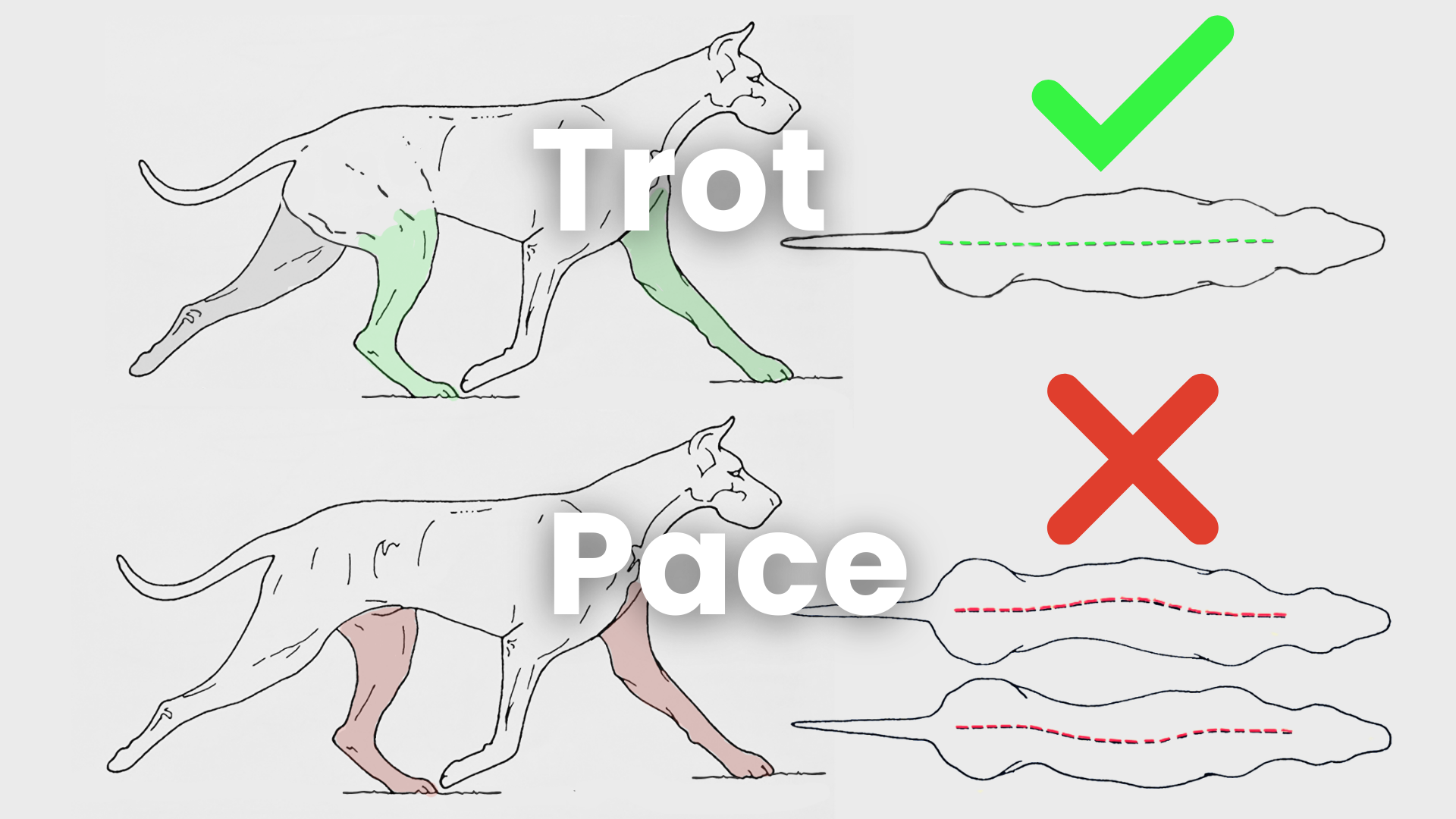
Trotting the two diagonal legs move & land together, Pacing the two legs on the same side move and land together. Asha has only paced after an extra long hike and usually on a hot day. We were on the last mile going home when I noticed she kept alternating between trotting and pacing.

Trotting:


Pacing:

 
Informative and well-videoed.
I wanted (and tried) to get it from the side, but Asha wouldn't stay at a steady forward rate if I tried to go faster to catch up or get even with her, plus with the phone pointed at her, she'd keep glancing at me, go sideways, slow down or speed up. Only time steady was if she was in front without me acting like something was up. :rofl: I did find it interesting that she only does this when pretty tired out and also never did it until the last year or so. Seems we all tire out more as we get older.
 
I looked through my phone and saw some pics of Oji. I only searched back to 2023 and maybe 2022, and that was when he had already developed his hind end problem.

I tried to get a short video to post here, but was unsuccessful. Oji was being walked by my younger daughter :love: and as we walked along, he was in the pacing gait.
 
Trotting the two diagonal legs move & land together, Pacing the two legs on the same side move and land together. Asha has only paced after an extra long hike and usually on a hot day. We were on the last mile going home when I noticed she kept alternating between trotting and pacing.

Trotting:


Pacing:

Oh perfect!
Easy to understand once I saw it in slow-mo...
TY @Ravenbird
 
Easy to understand once I saw it in slow-mo...
Glad it was helpful! Slow motion on the gaits helps me more than drawings....


I can see why pacing can't be tolerated in judging a show dogs movement, as it changes to a side to side movement while moving forward. But can anyone tell me WHY dogs pace? I noticed my dog would pace more at the end of long hikes, so I thought maybe being tired this gave some muscles rest by using different motion. But now in her 7th year I see she does it a little more than she use to, and not when she's tired. In general a non-gaited horse has a walk, trot, canter & gallop. One that just starts pacing when it wants to is unheard of (not impossible I guess, but I never saw it). But lots of dogs pace from the talk that goes on in many breeds of show dogs.

 
But can anyone tell me WHY dogs pace?
I won't pretend to be able to say WHY any dog might pace, but, I will share my experience being judged in the ring with a judge who was super helpful to us as we learned this.

The first thing out of her mouth was "I have a red male at home, I love me a Dobie". She asked us to go around the ring and Z paced. As we approached her corner she said that my dog was pacing, and she knows how that is with her own Doberman, they pace because they're lazy and that's their MO. She told me to open up my own stride and go a little faster and please go around again, so we did, and she yelled out after the first corner "SHE GOT IT, NICE TROT!"

So I gathered from this, that Z was pacing in times that she felt unchallenged by what we were doing, and maybe her comfort level was higher than we wanted it to be for the task at hand?

Just one person's take, and my interpretation of the experience with her. After that, we went on to guardian group and Z trotted nice and took group 2 out of 6 dogs under that judge.
 
Glad it was helpful! Slow motion on the gaits helps me more than drawings....


I can see why pacing can't be tolerated in judging a show dogs movement, as it changes to a side to side movement while moving forward. But can anyone tell me WHY dogs pace? I noticed my dog would pace more at the end of long hikes, so I thought maybe being tired this gave some muscles rest by using different motion. But now in her 7th year I see she does it a little more than she use to, and not when she's tired. In general a non-gaited horse has a walk, trot, canter & gallop. One that just starts pacing when it wants to is unheard of (not impossible I guess, but I never saw it). But lots of dogs pace from the talk that goes on in many breeds of show dogs.
My GSD paces when he's getting tired, has a rest, then trots again. Had one stray that found us, we kept him, and he never trotted, always paced.
 
Pacing can occur for a number of reasons. Too fast for a walk but too slow for a trot (common when leash walking a large dog), tired, structural issues or even injury. Pacing is really only a problem (IMO) if the dog is unable to break into a trot. If that’s the case, I’d be investigating a potential injury.

I’ve also heard square breeds, like Dobermans, are more likely to pace. I’m unsure why this would be. Maybe it has to do with angulation?
 
Pacing can occur for a number of reasons. Too fast for a walk but too slow for a trot (common when leash walking a large dog), tired, structural issues or even injury. Pacing is really only a problem (IMO) if the dog is unable to break into a trot. If that’s the case, I’d be investigating a potential injury.
Injury was my first concern, but then knowing so many do it in the show ring and all they have to do is go faster and the dog trots, it didn't concern me "as much" LOL. If I started walking faster or started jogging, sure enough Asha would change to a trot. So I *think* it is a default to lazy/easier movement for whatever reason? And it makes sense as she gets older that taking the easier movement more often is just what we all do. If anyone is over 50/60 I know you know what I'm talking about... 😜

square breeds, like Dobermans, are more likely to pace. I’m unsure why this would be. Maybe it has to do with angulation?
I think that's what is making me curious. What breeds pace more than others and why. If it's "just because" I certainly don't mind, but if it's from discomfort from the trot I'd like to know what's going on.

Thanks for your input!
 
I think that's what is making me curious. What breeds pace more than others and why. If it's "just because" I certainly don't mind, but if it's from discomfort from the trot I'd like to know what's going on.
The Neapolitan Mastiff breed standard actually allows for pacing as a normal gait. It’s still ideal for them to be trotting in the show ring though. The standard calls for them to be slightly longer than tall, so I’m assuming the pacing in this breed is because of their size?

Here is some info from their standard: “The Neapolitan Mastiff's movement is not flashy, but rather slow and lumbering. Normal gaits are the walk, trot, gallop, and pace. The strides are long and elastic, at the same time, powerful, characterized by a long push from the hindquarters and extension of the forelegs. Rolling motion and swaying of the body at all gaits is characteristic. Pacing in the show ring is not to be penalized. Slight paddling movement of the front feet is normal. The head is carried level with or slightly above the back.”

Since Asha is still trotting, I wouldn’t be concerned! She may just be getting fatigued at the end of hikes.
 
That's quite an interesting read covering multiple species...

Here's one specific on dogs - claiming more of a compensation reason than "just because". I'm not worried about my dog pacing. It might be because I'm more tired and walking slower that Ashas trot is too fast to stay within a reasonable distance and she doesn't want to walk as it might feel too slow for her? So her pace is somewhere in between. I did experiment with speeding up and even the motion of me picking up a very slow jog she immediately went into a trot. So yes, all you people showing, going faster definitely works!

Not ready to believe that pacing is due to discomfort but this article is quite informative and may help someone in the future for diagnosing a sudden preference to pacing in their dog.


Back
Top