

strykerdobe
Hot Topics Subscriber

It’s Not Pet Food, It’s a Waste Disposal System

It isn’t publicly mentioned often (by government), but found within the Federal Register…FDA openly admits the agency allows pet food/animal feed to violate federal law.
http://truthaboutpetfood.com/its-not-pet-food-its-a-waste-disposal-system/

Wishing you and your pet(s) the best,
Susan Thixton
Pet Food Safety Advocate
Author Buyer Beware, Co-Author Dinner PAWsible
TruthaboutPetFood.com
Association for Truth in Pet Food
Become a member of our pet food consumer Association. Association for Truth in Pet Food is a a stakeholder organization representing the voice of pet food consumers at AAFCO and with FDA. Your membership helps representatives attend meetings and voice consumer concerns with regulatory authorities. Click Here to learn more.
What’s in Your Pet’s Food?
Is your dog or cat eating risk ingredients? Chinese imports? Petsumer Report tells the ‘rest of the story’ on over 5,000 cat foods, dog foods, and pet treats. 30 Day Satisfaction Guarantee. Click Here to preview Petsumer Report. www.PetsumerReport.com
It’s Not Pet Food, It’s a Waste Disposal System
By Susan Thixton
- June 3, 2018
It isn’t publicly mentioned often (by government), but found within the Federal Register…FDA openly admits the agency allows pet food/animal feed to violate federal law.
While unknowing consumers believe they are buying ‘food’ for their pet, behind public view is a massive illegal food waste disposal system allowed by a little discussed privilege of government – selective enforcement. Wikipedia defines selective enforcement as: “In law, selective enforcement occurs when government officials such as police officers, prosecutors, or regulators exercise enforcement discretion, which is the power to choose whether or how to punish a person who has violated the law.”
Most consumers assume the Food and Drug Administration (FDA) is enforcing law, assume the pet food they purchase is a legal, safe product. The reality is many – probably most – pet foods contain one more more ingredients that violate federal law.
For most pet food consumers, this is very difficult to accept. It couldn’t be true. The FDA – our government – wouldn’t knowingly allow illegal pet food products to sell on store shelves.
The doubt is understandable, mainly because the illegal system of pet food/animal feed isn’t often admitted to. Ten years ago – in 2008 – the FDA made some significant admissions in the Federal Register (U.S. government publication). Back in 2008, the FDA strengthened regulations to prevent the spread of Mad Cow Disease publishing “Substances Prohibited From Use in Animal Food or Feed; Final Rule”. Bovine spongiform encephalopathy (BSE) or commonly known as Mad Cow Disease is fatal to cattle and humans consuming the meat from sick animals. Cats can be sickened by a version of Mad Cow (Feline spongiform encephalopathy) – to date it is believed dogs cannot contract the disease.
The short version of the 2008 rule FDA implemented to prevent the spread of Mad Cow Disease is the agency required specified risk materials (brain and spinal column) be removed from diseased and/or dead non-slaughtered animals before they would be allowed to be processed into any animal feed ingredient. The rest of the diseased animal, and the rest of a dead decomposing animal that died other than slaughter – even though both are a violation of law – would be allowed into any animal feed ingredient.
Quoting the Federal Register document:
This rule, however, should not be construed to mean that it is legal to use any portion of an animal that is adulterated under the Federal Food, Drug, and Cosmetic Act (the act) in animal food or feed.
FDA notes that, for cattle not inspected and passed that are diseased or that died otherwise than by slaughter, the entire carcass of such animals is adulterated under section 402(a)(5) of the act.
FDA has traditionally exercised enforcement discretion with regard to the use of such animals in animal feed. For example, see Compliance Policy Guide 675.400. FDA intends to continue exercising such discretion for the use in animal feed of: (1) The remaining material from cattle that are diseased or that die otherwise than by slaughter when the brain and spinal cord are effectively removed or effectively excluded from animal feed use and (2) the entire carcass from cattle that are diseased or that die otherwise than by slaughter if such cattle are shown to be less than 30 months of age.
The FDA openly admits these types of animal feed/pet feed ingredients are illegal – remain illegal. But the agency makes it clear they are CHOOSING not to enforce law. The agency is CHOOSING to allow pets to consume diseased animal material, CHOOSING to allow pets to consume decomposing, dead, non-slaughtered animal material. The agency is CHOOSING to allow the pet feed industry to profit from the sale of illegal ingredients. And significantly – illegal ingredients are allowed by FDA with no disclosure on the pet food label. No warning to any consumer.
Who in their right mind would allow this?
It’s not just pets that are consuming diseased and decomposing dead non-slaughtered animal material – livestock animals are fed the same material in processed livestock feed. As insane as it is, the FDA allows cattle to consume rendered diseased cattle material, chickens to consume rendered diseased chicken material, and pets to consume any diseased or decomposing dead animal. Why would the agency allow this? It’s waste disposal.
Again, from the Federal Register document:
Some comments stated that rendering is the best disposal option and that burial, composting, and incineration are undesirable alternatives. One comment said that if SRMs and deadstock are diverted from animal feed use, FDA will no longer have control over this material. Another comment pointed out that it takes 14 months to properly compost a 1500-pound (lb) cow. (Response) FDA believes this final rule appropriately controls materials to be rendered for animal feed. FDA intends to work with relevant local, State, and other Federal agencies concerning disposal issues.
The FDA estimated that ONLY brain and spinal cord from diseased or dead non-slaughtered cattle (material FDA was not permitting in animal feed) is “approximately 670 million pounds” a year. We can safely times that amount by 20 (a very conservative estimate of brain and spinal cord to be 1/20th of the weight of the entire animal carcass) to estimate what IS allowed into pet feed/animal feed. Which means more than 13 billion pounds of illegal cattle material is processed each year into pet feed/animal feed.
And that 13 billion pounds is just cattle material. We can estimate an equal 13 billion pounds of illegal poultry material and another 13 billion pounds of illegal pig material is also allowed to be processed into pet feed/animal feed for a grand illegal total of 40 billion pounds a year.
Why? Because any other disposal method is costly to industry and could pose a risk to human health (contamination of water and land from billions of pounds of decomposing dead animals).
It’s allowed – law is ignored – because the FDA feels the best place to dispose of 40 billion pounds of diseased, decomposing, dead, non-slaughtered animals is pet feed/animal feed. As insane as it is – the FDA holds the authority to do this through selective enforcement.
But…the question remains if the agency actually has the authority to operate in such an opposite direction of law – and if the agency has the authority to selectively enforce law with no warning on pet food labels alerting consumers to the violation of law risk.
In October 2016, we (Association for Truth in Pet Food) officially requested the FDA to stop allowing these illegal ingredients into pet food. And in July 2017, we submitted an addendum to our request asking the agency to require pet products to be clearly labeled as “pet feed” or “pet food” depending if ingredients used in the products are illegal (feed) or legal (food). To read our official requests published on the government website – visit: Regulations.gov. (First item is our original request, second item is our addendum.) Or click Here and Here to view the documents in a separate window.
To date – 19 months after we submitted the request – FDA has not responded.
And…
Any pet food that does not meet the full requirement of human grade pet food (100% ingredients and supplements human edible, manufactured in a licensed human food facility) – could contain ingredients sourced from a diseased or decomposing, non-slaughtered, dead animal. No particular style of pet food is guaranteed safer than another from these types of ingredients. However – just how FDA takes enforcement discretion allowing these ingredients into pet feeds, the agency takes an opposite enforcement discretion with raw pet food.
Within the FDA Guidance document titled “Manufacture and Labeling of Raw Meat Pet Foods” the FDA tells industry that raw pet foods “should” be sourced from human edible meats…
All meat- and poultry-derived ingredients should be United States Department of Agriculture (USDA)/Food Safety and Inspection Service (FSIS)-inspected and passed for human consumption.
In other words, FDA openly allows all other styles of pet feed (kibble, canned, dehydrated, and so on) to utilize illegal ingredients sourced from diseased/non-slaughtered animals with NO disclosure to the consumer – BUT tells raw pet food all meats should be sourced from human grade/human edible sources. Completely opposite standards.
Until we receive a response from FDA on our request, consumers are left to trust their pet food manufacturer (excluding human grade pet foods). Ask your pet food manufacturer: “Are meats/meat meals sourced from USDA inspected and passed animals?” If they cannot guarantee you they are – you are taking a risk of feeding your pet diseased and/or decomposing, dead, non-slaughtered animal material.
With human grade pet foods, consumers can trust the claim stated on a pet food label – trust that 100% of this pet food is human edible (NOT sourced from diseased or non-slaughtered animals). Consumers cannot trust the claim on a pet food website; regulatory authorities do not scrutinize pet food websites for honest/accurate claims. With raw pet foods, the human grade claim cannot be made. Ask raw pet food manufacturers if the product was manufactured “under constant USDA inspection”.
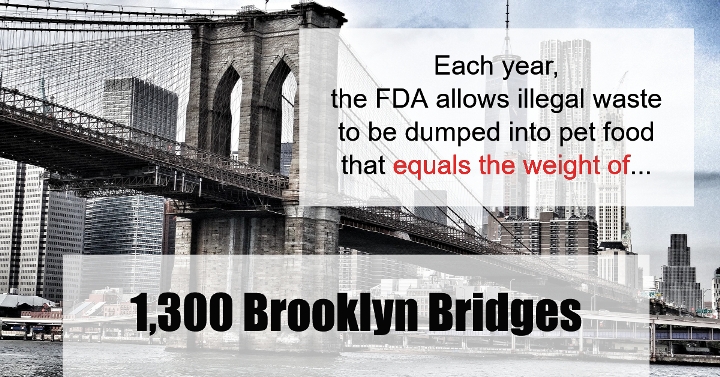
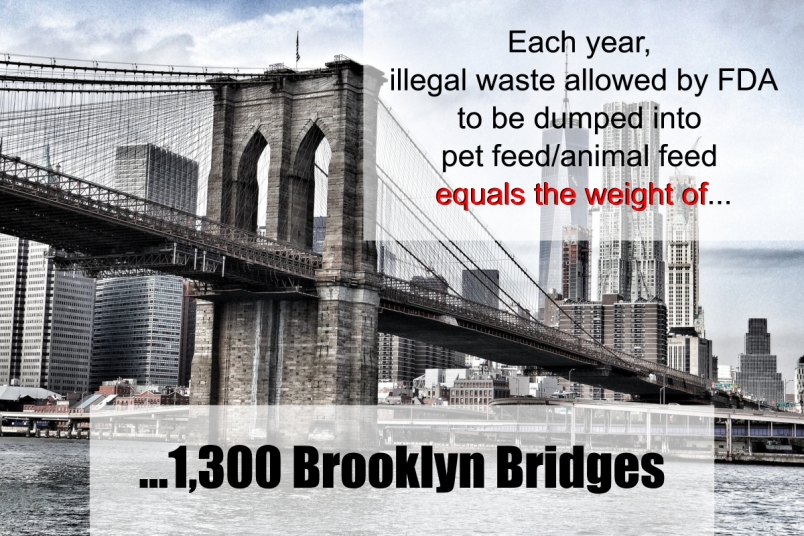
And if you are furious at the thought of the weight of 1,300 Brooklyn Bridges worth of illegal waste allowed to be dumped into pet feed/animal feed (though labeled as ‘food’) each year – tell the FDA how you feel.
You can email the Center for Veterinary Medicine (division of FDA that oversees pet food/animal feed) at: [email protected]. You can call the agency at: 240-402-7002.
Tell them to stop allowing diseased and non-slaughtered animals into pet food, animal feed. At the VERY least, pet food labels should be clearly marked if the product contains diseased or non-slaughtered animal material (clearly marked as “feed” or “food”). Tell them you support Docket ID: FDA-2016-P-3578 (our request to the agency to label products as feed or food and to stop the use of illegal ingredients in pet foods).
Wishing you and your pet(s) the best,
Susan Thixton
Pet Food Safety Advocate
Author Buyer Beware, Co-Author Dinner PAWsible
TruthaboutPetFood.com
Association for Truth in Pet Food

Become a member of our pet food consumer Association. Association for Truth in Pet Food is a a stakeholder organization representing the voice of pet food consumers at AAFCO and with FDA. Your membership helps representatives attend meetings and voice consumer concerns with regulatory authorities. Click Here to learn more.
What’s in Your Pet’s Food?
Is your dog or cat eating risk ingredients? Chinese imports? Petsumer Report tells the ‘rest of the story’ on over 5,000 cat foods, dog foods, and pet treats. 30 Day Satisfaction Guarantee. Click Here to preview Petsumer Report. www.PetsumerReport.com

The 2018 List
Susan’s List of trusted pet foods. Click Here to learn more.
Have you read Buyer Beware? Click Here
Cooking pet food made easy, Dinner PAWsible
Find Healthy Pet Foods in Your Area Click Here


