

strykerdobe
Hot Topics Subscriber

Double Dose of Pet Food Toxins

An annual survey of mycotoxin risks of grain ingredients in North America found 80% of samples tested contained two dangerous mycotoxins. Add to this risk, mycotoxins can increase the absorption of endotoxins – and vice versa.
http://truthaboutpetfood.com/double-dose-of-pet-food-toxins/

Wishing you and your pet(s) the best,
Susan Thixton
Pet Food Safety Advocate
Author Buyer Beware, Co-Author Dinner PAWsible
TruthaboutPetFood.com
Association for Truth in Pet Food
Become a member of our pet food consumer Association. Association for Truth in Pet Food is a a stakeholder organization representing the voice of pet food consumers at AAFCO and with FDA. Your membership helps representatives attend meetings and voice consumer concerns with regulatory authorities. Click Here to learn more.
What’s in Your Pet’s Food?
Is your dog or cat eating risk ingredients? Chinese imports? Petsumer Report tells the ‘rest of the story’ on over 5,000 cat foods, dog foods, and pet treats. 30 Day Satisfaction Guarantee. Click Here to preview Petsumer Report. www.PetsumerReport.com
Double Dose of Pet Food Toxins
By Susan Thixton
- April 13, 2018
An annual survey of mycotoxin risks of grain ingredients in North America found 80% of samples tested contained two dangerous mycotoxins. Add to this risk, mycotoxins can increase the absorption of endotoxins – and vice versa.
Biomin.net – a company that provides products to support the animal feed industry – recently provided the following infographic:
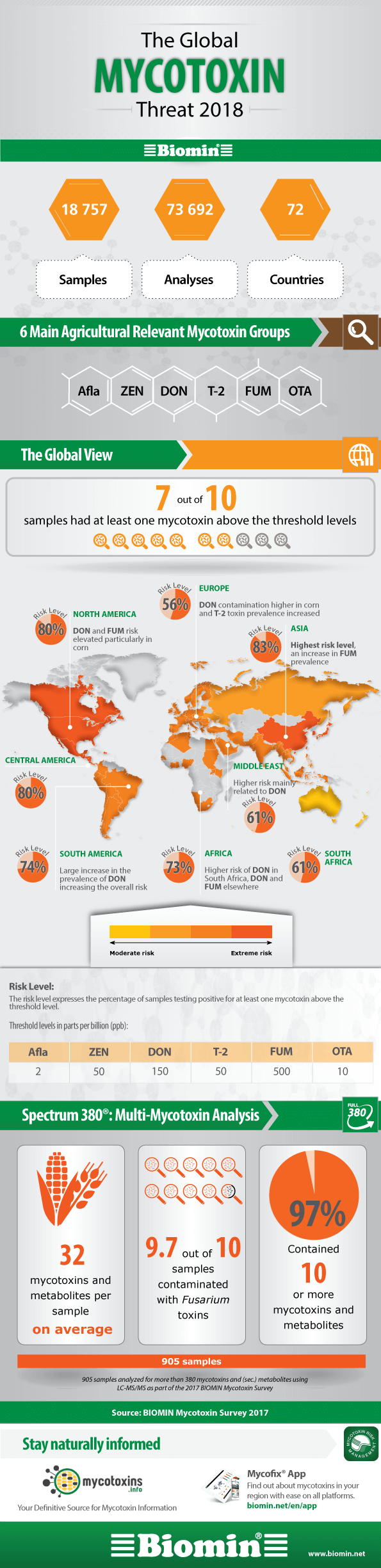
Of concern to pet food consumers in North America, grains tested here were classified as “Extreme Risk”.
In this image provided by Biomin.net, their survey found the two most prevalent mycotoxins found in North America were deoxynivalenol (DON) and fumonisins (FUM).

Dr. Judy Morgan provides the following information on mycotoxin toxicity in pets:
Symptoms of mycotoxin toxicity may include elevated liver enzymes, vomiting, muscle tremors, seizures, weakness, increased heart rate, anorexia, increased thirst and urination, liver failure, hemorrhage, and death. When the mother animal eats food contaminated with mycotoxins, the toxins are passed through the milk to the offspring. Mycotoxins are considered class 1 carcinogens, which means they do cause cancer. Mycotoxins have a cumulative effect on the body; chronic ingestion leads to higher levels in tissue samples.
Dr. Karen Becker provides the following information on mycotoxins toxicity in pets:
Symptoms of Mycotoxin Poisoning in Pets
The severity and type of symptoms your dog or cat displays depends on the amount and type of mycotoxin ingested. Some of the more common symptoms associated with mycotoxicosis include:
Panting Weakness
Hyperactivity Loss of coordination
Vomiting Increased heart rate
Lack of appetite Increased body temperature
Dehydration Seizures
Muscle tremors
Mycotoxin poisoning is a true medical emergency, and your pet will need immediate treatment and hospitalization. Your veterinarian must take early and aggressive action to remove the toxic substances from your pet’s body.
Most vets may not correlate these symptoms to mycotoxins in pet food, so make sure you voice your thoughts if you suspect your pet has been poisoned by her food.
Common Food Sources of Mycotoxins
Corn Peanuts
Wheat (bread, cereal, pasta) Cottonseed and cottonseed oil
Barley (cereal) Rye
Sugar cane and sugar beets (which also feed fungi) Sorghum (found in a variety of grain-based products)
The above foods can be found in many commercially available pet food formulas. I recommend you study the ingredients in the food you buy your pet, and avoid brands containing grains or corn in any form, including corn gluten meal, whole grain corn, corn flour, etc.
And then…to make the concern worse…the presence of mycotoxins in a pet food/animal feed could increase the absorption of another toxin into your pet’s bloodstream – endotoxins, and vice versa.
Two different types of toxins.
The Food and Agriculture Organization of the United Nations (FAO) defines mycotoxins as: “Mycotoxins are poisonous chemical compounds produced by certain fungi. There are many such compounds, but only a few of them are regularly found in food and animal feedstuffs such as grains and seeds. Nevertheless, those that do occur in food have great significance in the health of humans and livestock.”
Defined by Merriam-Webster, endotoxins are: “a toxic heat-stable lipopolysaccharide substance present in the outer membrane of gram-negative bacteria that is released from the cell upon lysis.”
Mycotoxins are toxins produced by mold growth on food ingredients, endotoxins are toxins released when gram-negative bacteria such as Salmonella or E.coli are killed (such as cooking of pet food). And when both endotoxins and mycotoxins are found in an animal food…the synergy of the two toxins increases the risk of each.
From Biomin.net (this post mainly written of the risk to livestock):
Mycotoxins and Endotoxins can also have an impact on the intestinal barrier function and so increase the risk of endotoxin uptake into the bloodstream. Similarly, the negative effect of endotoxins on the rumen epithelium may increase the uptake of mycotoxins, increasing the risk to the animal of even hard-to-absorb mycotoxins such as fumonisins. Both mycotoxins and endotoxins can trigger inflammatory and immunosuppressive effects (through reducing response or directly affecting immune cells) and both toxin types can affect, and be exacerbated by, liver damage.
The concerning question is…
Part 1. Feed grade pet food meat ingredients, specifically meats sourced from animals that have died other than by slaughter (openly allowed by FDA and each State Department of Agriculture even though this is a direct violation of federal law) that are prone to extreme high levels of gram-negative bacteria which results in extreme levels of exdotoxins.
Added with Part 2…grains that testing proved are at “Extreme Risk” in North America.
Is this combination sickening and killing pets?
Unfortunately, because FDA does not acknowledge the risk of endotoxins to pets – it is unlikely that any regulatory authority will confirm this is the case. And just how “Most vets may not correlate these symptoms to mycotoxins in pet food” (from Dr. Karen Becker above), veterinarians may not consider endotoxins and the dangerous synergy of of both toxins in pet foods – furthering the unknown of how many pets this toxin combination sickens. However – with the known risk of both toxins, the known use of waste meats prone to high levels of endotoxins and with the known risk of mycotoxin contamination (80% of samples tested) in grain ingredients – we can safely assume many pets are suffering from this deadly toxin combination.
What can consumers do?
Listen to your pet. If your pet walks away from a meal – especially a new bag or can of food – listen to them. Discard or return the food. Your pet might be more aware the food contains endotoxins and/or mycotoxins than you.
Know the symptoms of mycotoxin and endotoxin poisoning. Symptoms of mycotoxin poisoning explained above, symptoms of endotoxin poisoning explained here: The Elephant in the Pet Food: Endotoxins. If your pet shows these symptoms, address the potential of ‘toxin’ exposure with your veterinarian. Report the illness to your State Department of Agriculture and FDA.
Wishing you and your pet(s) the best,
Susan Thixton
Pet Food Safety Advocate
Author Buyer Beware, Co-Author Dinner PAWsible
TruthaboutPetFood.com
Association for Truth in Pet Food

Become a member of our pet food consumer Association. Association for Truth in Pet Food is a a stakeholder organization representing the voice of pet food consumers at AAFCO and with FDA. Your membership helps representatives attend meetings and voice consumer concerns with regulatory authorities. Click Here to learn more.
What’s in Your Pet’s Food?
Is your dog or cat eating risk ingredients? Chinese imports? Petsumer Report tells the ‘rest of the story’ on over 5,000 cat foods, dog foods, and pet treats. 30 Day Satisfaction Guarantee. Click Here to preview Petsumer Report. www.PetsumerReport.com

The 2018 List
Susan’s List of trusted pet foods. Click Here to learn more.
Have you read Buyer Beware? Click Here
Cooking pet food made easy, Dinner PAWsible
Find Healthy Pet Foods in Your Area Click Here


