Doberman History

I think these pages are from a dog encyclopedia from the 1930s-1940s era but I don't remember now. It's interesting reading though. I wish that they hadn't removed the faults and point system in 1969.

View attachment 163357View attachment 163359View attachment 163360View attachment 163361View attachment 163362View attachment 163363
This is great @Nordika
This bit:

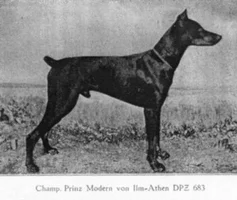
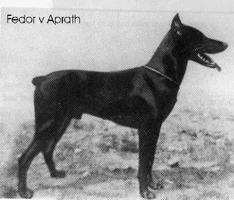
"The Doberman of this time was a short-headed
1926, Lotte II von Simmenau. Both of these came dog with a heavy body. The breeders were using in-
to the United States, as did Lux himself. Lux sired tense inbreeding to establish type, or chiefly color
dogs of excellent class, and his offspring in the
and sharpness. They now added in the Manchester
United States, at least, were of good nature.
to improve color, to lengthen the head, and finally
Both Mars von Simmenau, and his brother,
to get a short, hard coat.
Modern, came to the United States. They were born
I hese characteristics were achieved in part 1r
at the kennels of C. Winkler of Mertschnetz in 1927.
'rinz von Iln-Athen, born in 1899, and Fedor voi
The temperament of Mars already has been men- Aprath, born in 1go6. The latter in particular had
tioned. Modern appears to have been of a gentler
the desired longer head. This was further accen-
lisposition. This, coupled with his unusual beauty,
tuated by the introduction of Greyhound blood be-
nade him a successful sire in this country
tween the years 1900 and 1908."

I rarely see current "breed history" summaries in the generic dog sites mention the Manchester or the Greyhound outcrosses.

Greunig was quite frank about Stella the Greyhound (who was chosen for a more black black, vs speed per se) because it took three generations to fix the stupid (my words) she contributed, and why he insisted look carefully for three generations before repeating again as you never know what you get from that outcross along with the desired characheristic...

Which reminds me of your Gordon Setter comment, and the FKC Outcross Project to fix DCM, including the Gordons as one of four breeds ...

What do you think the Gordon brings, btw, in addition to low heart problems? What would be the downside of Gordons, if any to the FKC Dobe project?

 
What do you think the Gordon brings, btw, in addition to low heart problems? What would be the downside of Gordons, if any to the FKC Dobe project?
Gordon Setter was bred into the Doberman in 1902. They are the largest of the Setter breeds, and as far as I'm aware the only one to work close to the gun. They bring good aspects to temperament; nerve, drive, focus and intelligence, as well as retentive memory (they remember where they found game previously) and typically loyal devotion to one person dog. The drawbacks are coat, length and set of the ears.

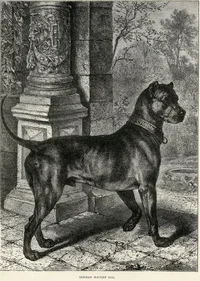
It would good to remember that Otto Goeller told us that the German Mastiff was one of the main dogs Dobermann used in the creation, aka the Great Dane. Nobody wants to mention that 😆
1000028780.webp
 
Gordon Setter was bred into the Doberman in 1902. They are the largest of the Setter breeds, and as far as I'm aware the only one to work close to the gun. They bring good aspects to temperament; nerve, drive, focus and intelligence, as well as retentive memory (they remember where they found game previously) and typically loyal devotion to one person dog. The drawbacks are coat, length and set of the ears.

It would good to remember that Otto Goeller told us that the German Mastiff was one of the main dogs Dobermann used in the creation, aka the Great Dane. Nobody wants to mention that 😆
View attachment 163366
This explains why Bonnie remembers where I set aside the old tennis balls or favorite burl-sticks she finds on her own while hiking on trails.

The OG Dane was a bit fiercer than the gentle giant pet companions of today, no? Interesting how that is lost as well in typical breed histories. I wonder why?

AKC includes the Weims, German Pinschers, and Greyhounds. But no Danes.

There was some speculation about a white hunting dog in the county fairs that was highly sought after for intelligence...

Maybe Schnuppe came from that?

 
Last edited:
Greunig was quite frank about Stella the Greyhound (who was chosen for a more black black, vs speed per se) because it took three generations to fix the stupid (my words) she contributed,
I think of Greyhounds (most any sighthounds that I've personally known) as cat-like. Extremely intelligent but on a level that doesn't abide obedience to their human companions. They may act stupid but they are simply ignoring our stupid idea of them obeying us. 😅 When you ride a horse 12 miles and the greyhounds gallop with you, take off after a deer and then catch up with you 3 miles later, you witness their brilliance and devotion on their terms. ;) They were not bred to obey humans, they were bred for that independence to hunt along side of us without instruction, but they have a great desire to hang out at your den and go with you on your adventures.

No offense taken at your wording, I use to think they were dumb as a stick, but after knowing them for several years, riding horses when they came along I have nothing for admiration for them. quite a unique breed of dog. I use to say I'd like a Doberman for my personal dog and a Borzoi or Greyhound to just lay by the fireplace and look good.
 
This explains why Bonnie remembers where I set aside the old tennis balls or favorite burl-sticks she finds on her own while hiking on trails.

The OG Dane was a bit fiercer than the gentle giant pet companions of today, no? Interesting how that is lost as well in typical breed histories. I wonder why?

AKC includes the Weims, German Pinschers, and Greyhounds. But no Danes.

There was some speculation about a white hunting dog in the county fairs that was highly sought after for intelligence...

Maybe Schnuppe came from that?


In short, while not quite the dog we know today, the 1880s marked the German Mastiff's pivot from working boarhound to aristocratic companion and national emblem, with guarding and showing replacing the hunting role that had defined it for centuries. They were still in use at that time for bodyguard to the Elite: Chancellor Otto von Bismarck kept them as personal bodyguards, cementing the breed's association with the highest echelons of the newly unified German state, and the older tradition of keeping them as Kammerhunde (chamber dogs) that slept in bedchambers to protect sleeping lords from assassins also persisted among the aristocracy too.

The AKC link you provided gives:
The Rottweiler was one plausible source of the black-and-tan pattern that became inextricably linked with the Doberman, contributing strength and natural guarding ability. The German Pinscher – the latter word means “terrier” in German – likely added pluck and speed. And that all-around favorite hunting breed, the Weimaraner, may have provided the scenting ability

Plausible, likely and may have....

According to Otto Göller, the Doberman’s ancestry consisted of the ancestors of the German Shepherd Dog, the blue mastiff, the German smooth-haired Pinscher(short haired version of the standard schnauzer-known today as the German Pinscher) and short-haired hunting dogs. Göller also credited the unofficial breeders from the Apolda area for the breed's foundation, noting that local crossbreeding of these types produced the Thuringian type butcher dog that Karl Friedrich Louis Dobermann initially utilized.
While Herr Dobermann didn't leave records, Otto Göller knew Dobermann personally, as he noted in his 1910 book Der Dobermannpinscher in Wort und Bild.
After Dobermann's death in 1894, Göller became his successor in the breed's development, inheriting dogs from Dobermann's stock, refining the type, and founding the National Dobermann Pinscher Club in 1899. He is widely regarded as the breed's "chief architect" after its founder, having taken Dobermann's rough prototype and stabilized it into the recognizable, trainable breed known today. I am often baffled about the unwillingness to take Otto Göller at his word. Everyone wants to speculate about this or that breed, and here's the guy responsible for the breed we know today and...they argue or just disregard. There was someone, don't recall his name atm, said that the blue doberman isn't the same color as the blue mastiff, therefore it must be Weimaraner. Seriously. What I take away from Göller is that there were some known breeds, some random working hunting dogs and a lot of mixing. I think maybe they don't like the idea of a breed development from mutts, but I never understood the lack of any mention anywhere of the German Mastiff, aka Great Dane, it's just very curious...
 
@BGpa I decided to ask AI why...

The rejection of Göller was based entirely on phenotypic reasoning in the early 1900s — Dr. Dorn's arguments about size discrepancy and the rarity of the blue coat in Dobermans.

The consensus shifted toward the Pinzer/Rottweiler/shepherd/terrier combination, which is what the AKC and most modern sources now cite.

In short: Göller did say it, but he was the minority voice, and the breed establishment moved away from that. The Great Dane contribution was effectively voted out of the official narrative.

Lol. Voted out by the majority. Crazy.
 
Philipp Gruenig in his book THE DOBERMAN PINSCHER, I quote, “The blue color of the Doberman was more firmly fixed by cross breeding to the German Mastiff and the hunting dogs indigenous to Weimar.

Weimaraner also were big game hunting dogs of mixed origin that included the blue mastiff, i.e. blue great dane.

Obviously, the blue color was already there in the early Doberman, if they outcrossed to firmly fix. And again we have another source that blue great danes were bred in. We also know today that the blue is dilute black, not sure they knew that back then?

Anyway...the late 1800s and early 1900s German Mastiff (Great Dane) is in there, and the more they breed for larger size in Europe the more you see that genetic influence being brought out.

Someone made an observation about Gamon di Campovalano, saying his descendants being bred to Jivago(or Zivago?)vh Wantij produced the molossoid types seen today in Eastern Europe. I might have to go look and see what dogs are being linebred on in there, just curiosity...
 

Back
Top