Doberman Feet

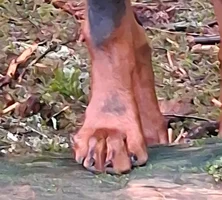
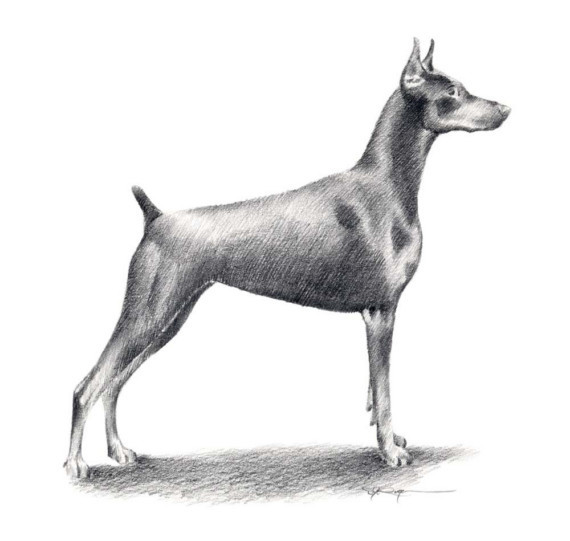
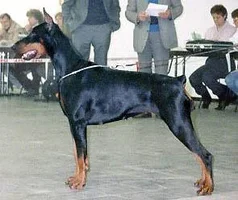
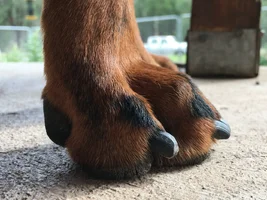
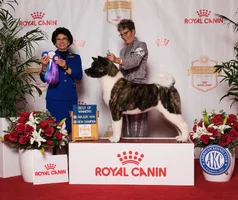
Here's Ashas and how her pads lift so they don't look like the one in the AKC picture. Someone did a terrible job cutting & pasting that dog to a white background, or it's a terrible foot. Either way it's really hard to look at!

I think Asha has a pretty foot, but it tends not be very tight and when she was a puppy her pads / feet were so big it was the opposite of looking at the AKC picture above. I have always thought her feet were a bit too big for the rest of her, but she has no trouble with being athletic: jumping, turning, running (25 mph Fast Cat average) so I no longer worry about it.

View attachment 136388View attachment 136389
Asha has nice cat err dobe feet!!
 
The reason for cat feet:

Cat feet in the Dobermann serve to provide stability, endurance, and energy efficiency during movement. According to breed standards and anatomical analysis, these compact, well-arched paws with short third digital bones require less energy to lift, allowing the dog to conserve stamina for long-distance trotting or working.

Key functional benefits include:

Shock Absorption: The compact structure acts as a biological shock absorber, protecting bones, tendons, and ligaments from the impact of running and jumping.

Traction and Balance: The tight, rounded shape offers a firm base that improves balance on uneven terrain and prevents the paws from turning in or out, which ensures efficient forward motion.

Endurance: By minimizing the energy expenditure required to move the feet, this paw type supports the Dobermann’s historical role as an athletic, enduring working dog.

I had to look it up because these feet aren't particularly well suited for our wet rocky terrain. The nails never get engaged because they're set too high, and pads slip. I've never had to trim a dogs nails while living here, ever. 11 year old dogs that have never had their nails cut, including dew claws. The dogs have always used their nails to traverse over the rocks and get worn down naturally.

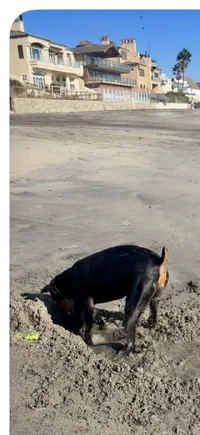
I've managed to get this boy to dig holes in the gravely sand to keep his nails from getting too sharp. BTW, I don't readily buy those reasons for a cat foot; I haz doubts! 😆

1000031837.webp
 
Yes I have had questions too, and defer to the experts.

I've only heard of "cat feet" since reading deeply on the breed on this second one, but then again most of my dogs have been mutts, rescues, none ever shown, all from working/hunting breeds with a job to do, simply beloved pets, with home defense side gig.

This is the first dog I've had where trimming to a nub is considered correct (for show fashion).


Some breed standards quoted describe cat feet as bred for agility, others consider it a fault.

Since Bonnie needs nails for traction on hikes on dirt and rocky semi-desert socal trails, we trim when the nails start to click on floor per guidance of multiple dobe experienced vet, and a dobe experienced groomer.

She loves to dig and we encourage it on command "dig-dig!" where safe,
for exercise and satisfaction of "nose drive"...

She's a nut.
 

Attachments

  • IMG_1803.webp
    IMG_1803.webp
    130.5 KB · Views: 1
Last edited:
I appreciate a good cat foot, but like so many other things it can get exaggerated until it's not functioning as intended.

Seriously.

View attachment 163073
Because of the structure of the foot...trust me, there is much more nail there than it appears. Like a cat, because of the tight, upright toes, the nails practically disappear. But... if you were to extend the toes out (like when running) surprise! There is a decent amount of nail! And it DOES make contact with the earth. When I dremel nails I have to wear eye protection to avoid pieces of sand/dirt flying into my eye.
 
I'm agreeing with the standard. A cat foot is not a bad thing! Abusing standards by exaggeration is not ok, I don't care if it's a flat face on a Boston or over-angulated back legs on a GSD. When it stops being an advantage to the breed and their reason for existing, it needs to not be rewarded by judges. More this or more that stops being better at some point!

I'm not a judge, nor an expert so anyone can toss my opinion, but I personally think some cat feet I'm seeing - not all! - are becoming too exaggerated to the point of not being beneficial to the athletic abilities of the Doberman.

Alida: What I consider a "normal" cat foot. Normal everything to me, but not sure she'd make the grade in today's world. Again, what do I know? I only know what I like. 🤷‍♀️

VDH/D CH BD/DV Sgn Alida v Flandrischen Lowen ADPr FH SchH3 ZVA-1A


Alida.webp
 
I'm agreeing with the standard. A cat foot is not a bad thing!
Oh sorry, my mistake. I thought you were talking about the nail length on the dog in that photo. 😅

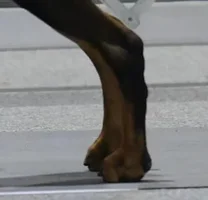
Yes, Alida's feet, more so her rear, in that particular photo, appear to be collapsed and are not as well arched like a cat foot. I personally am not as critical on this as I think there are other areas that need more attention to but I do want a foot that is well arched, compact, and catlike, turning neither in nor out as the standard states. It could also be due to poor handler placement but it looks like she may be standing on her own in this photo. I personally think she could do well today! The areas I see that could use improvement are mostly in her rear. She could use a little more angulation in her rear. Something else that drives people nuts as it is a growing issue today are the skinny thighs because it doesn't look powerful. Her tail is docked a vertebrae too short too but that is simply cosmetic and not a result of her breeding.

This is about her feet but to not make this only about the one "negative" I'll add that her topline is lovely! Her depth of body is wonderful and she looks powerful there and her front is beautiful to see on a working dog. I often see straight fronts and straight rears and bumpy toplines on working lines so shes very pleasing to the eye, imo.

1788407633032.webp

1788407671843.webp

Sorry for the blurry image when zoomed in but you can see the arch removed and toes are more flattened. Again, there is no perfect dog and while this may not be her best feature, she has a lot of good quality elsewhere that I wouldn't be afraid to use her today.
1788407852697.webp
 
Here's Ashas and how her pads lift so they don't look like the one in the AKC picture. Someone did a terrible job cutting & pasting that dog to a white background, or it's a terrible foot. Either way it's really hard to look at!

I think Asha has a pretty foot, but it tends not be very tight and when she was a puppy her pads / feet were so big it was the opposite of looking at the AKC picture above. I have always thought her feet were a bit too big for the rest of her, but she has no trouble with being athletic: jumping, turning, running (25 mph Fast Cat average) so I no longer worry about it.

View attachment 136388View attachment 136389
Since this is an older thread (2023) I went back and re-read the earlier comments and nodded my head in agreement with what was previously said. I also wanted to mention that Asha's feet are perfect!

1788409645231.webp
 
blurry image when zoomed in but you can see the arch removed and toes are more flattened.
Yeah, since it was a photo from the 80's or 90's, I couldn't make it big without it getting pixelated.

My question is if the dogs from several generations ago were not born with extremely tight & upright feet but could do extreme athletic skills for years, why would breeders tend toward "more"?

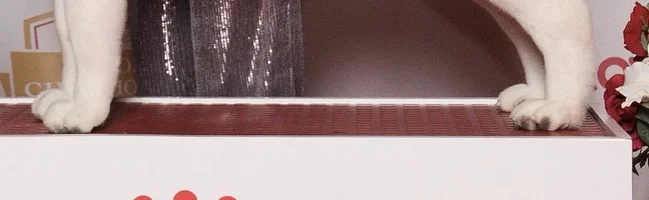
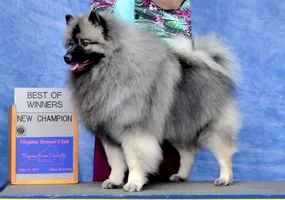
I was looking for other medium to large breeds with cat feet standards to compare to and they were mostly hairy 😅. Best feet pics I could find to show in another breed in a show stack is this Akita and Keshond. These look like normal feet to me, rounded and cat-like.

Screenshot 2026-09-03 at 7.01.31 AM.webp

Akita.webp

Screenshot 2026-09-03 at 6.47.25 AM.webp

669705_orig-37008565.webp

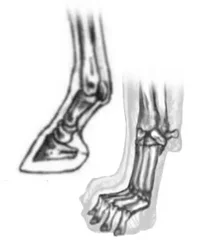
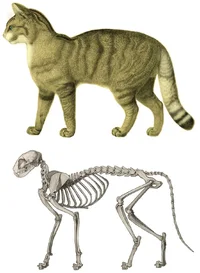
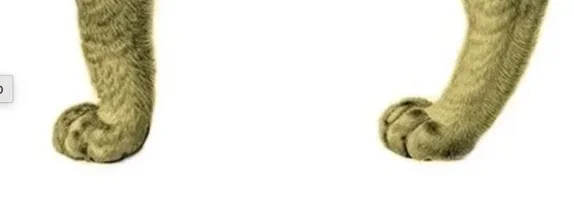
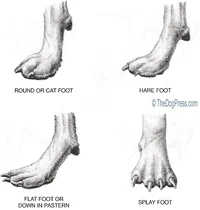
and this illustration is what I always considered a cat foot to look like - even Asha's is too boxy for what I consider "normal looking".

feet-dog-splayed-pr-flat-ss_orig-2923443711.webp
 
Yeah, since it was a photo from the 80's or 90's, I couldn't make it big without it getting pixelated.

My question is if the dogs from several generations ago were not born with extremely tight & upright feet but could do extreme athletic skills for years, why would breeders tend toward "more"?

I was looking for other medium to large breeds with cat feet standards to compare to and they were mostly hairy 😅. Best feet pics I could find to show in another breed in a show stack is this Akita and Keshond. These look like normal feet to me, rounded and cat-like.

View attachment 163121

View attachment 163118

View attachment 163119

View attachment 163120

and this illustration is what I always considered a cat foot to look like - even Asha's is too boxy for what I consider "normal looking".

View attachment 163122
I like the illustration, and in general when a standard calls for a round/cat foot, that is what you'd expect. Newfoundland standard states.
Feet are proportionate to the body in
size, webbed, and cat foot in type.

But there is additional clarification on the Doberman:
AKC: The feet are well arched, compact and catlike, and the toes are short, well arched and tight.

FCI: The feet are short and tight. The toes are arched towards the top (cat like). Nails short black.

The difference between feet i can speak to are that the Doberman has highly arched and shorter toes, and more compact foot than the Newfoundland. This is probably why his nails never make contact while traveling over rock.

In American Dobermans those descriptive well arched short toes are why they look boxy? The feet should suit the size of the dog, a finer boned dog is likely to have smaller feet. I don't believe it is something that is being overdone, however I think you can see just by the words of the AKC standard vs FCI standard why American Doberman might have more arch and shorter digits. Don't readily understand the necessity of emphasis on the feet, but if I had to guess, there likely were many dogs with incorrect feet, so they added verbiage to make clear what was correct to the club.

Feet are important as they represent the foundation of a house, you have to start with a good foundation to build upon. Supposedly, those compact cat feet expend less energy to pick up, thereby contributing to the endurance of the dog. I haven't scoured scientific journals to confirm that as fact, so I don't know.

Anyhow, that's my 2 cents worth.

 

Back
Top