

strykerdobe
Hot Topics Subscriber
TruthaboutPetFood.com
Complete and Balanced? Maybe…Maybe Not

Complete and Balanced pet food is significantly important. Unfortunately, a pet is only receiving complete and balanced nutrition IF they happen to be consuming the right amount of food. An AAFCO failure that millions of pets are paying the price for.
http://truthaboutpetfood.com/complete-and-balanced-maybe-maybe-not/
Complete and Balanced? Maybe…Maybe Not
By Susan Thixton
- February 5, 2018

Complete and Balanced pet food is significantly important. Unfortunately, a pet is only receiving complete and balanced nutrition IF they happen to be consuming the right amount of food. An AAFCO failure that millions of pets are paying the price for.

This is Rover. He is a lovable 30 pound couch potato. Walking ten foot out into the back yard several times a day to ‘go potty’ is the most exercise Rover gets.
Rover’s family pays close attention to his weight. They have found that feeding Rover 25% less pet food is the perfect serving size to maintain Rover’s waistline.
What Rover’s family doesn’t realize however, is the result of feeding 25% less pet food could result in Rover getting only 75% of the nutrients he needs. Overtime, Rover could get sick from nutrient deficiencies.
Complete and Balanced? Only if you are feeding the right amount.
The claim is on almost every bag or can of pet food, assuring consumers that said bag or can provides all the nutrients your pet needs.

The FDA tells pet food consumers: “To have “complete and balanced” in the nutritional adequacy statement, a dog or cat food must either:

So…if a puppy food meets the nutritional requirements of the Growth and Reproduction column per 1,000 kcal – the puppy food is “Complete and Balanced” per AAFCO. And if an adult dog food meets the nutritional requirements in the Adult column per 1,000 kcal – the dog food is “Complete and Balanced” per AAFCO.
But there is a problem. Or two.
The ‘Complete and Balanced’ claim on a pet food label is NOT required to be based on the manufacturer suggested feeding amount – what consumers would base how much food to provide their cat or dog (to actually provide the pet with a Complete and Balanced diet). And…the ‘Complete and Balanced’ claim is not based on calorie requirements a high energy level dog needs or the low calorie requirements a couch potato cat needs.
Instead, AAFCO regulation for Complete and Balanced requires a pet food to meet specific nutrient requirements per 1,000 kcal.
Complete and Balanced =
all the nutrients (protein, fat, fiber, vitamins and minerals) in the proper amount –
per 1,000 kcal of pet food.
This sounds like a good system, until you realize that pets have different calorie per day (energy) needs while having the same level of nutrient need (vitamins and minerals) for their physical size.

A ten pound dog requires a particular level of calcium, copper, magnesium, Vitamin A, and numerous other nutrients based on his body weight. The 10 pound dog’s need of calcium, copper, magnesium, Vitamin A and numerous other nutrients is NOT based on his activity level. These nutrient needs are the same whether the dog is an active ten pound dog or an inactive ten pound dog.
But…an active ten pound dog will need higher calorie consumption based on his energy needs. And an inactive ten pound dog will need less calorie consumption based on his lesser energy needs.
The problem…AAFCO Nutrient Profiles do not recognize varied energy needs/calorie requirements of cats and dogs. Ignoring calorie requirements of active or inactive pets causes some pets to consume higher levels of vitamins and minerals for their body size, and causes some pets to consume insufficient levels of vitamins and minerals for their body size.
The National Research Council has established generalized calorie/energy needs for dogs based on activity level. Simply put, the more active the dog is – the more calories the dog needs for fuel.
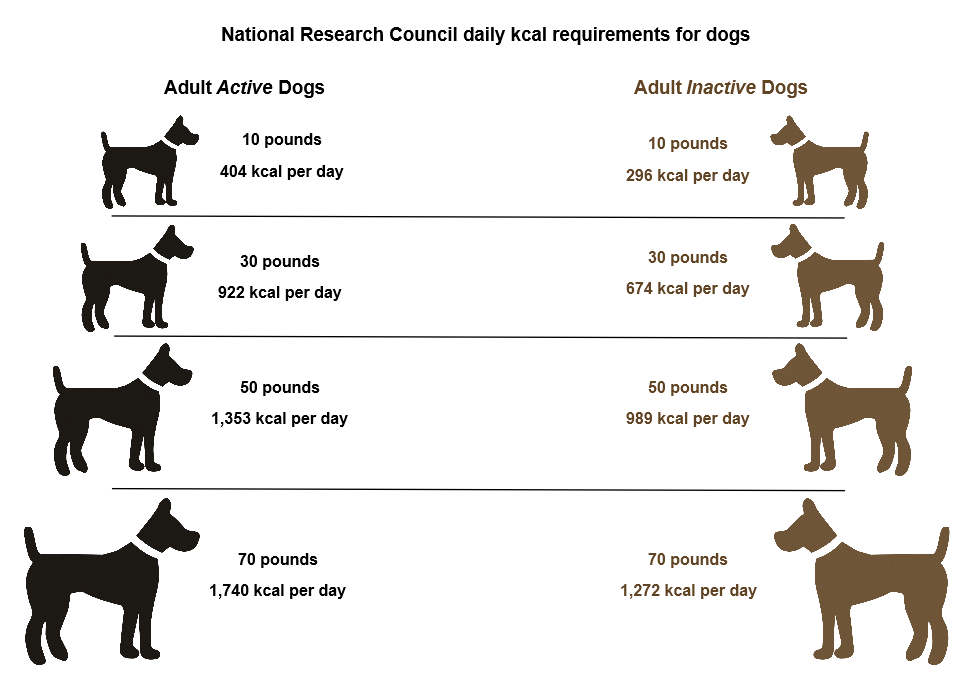
The problem…

 Mr. Zip and Zoom is a 5 year old, ten pound active dog. His calorie requirements – because of his activity level – is around 400 kcal per day.
Mr. Couch Potato is also a 5 year old, ten pound dog. But Mr. Couch Potato gets no exercise. His calorie requirements – because of his decreased activity level – is around 300 kcal per day. One hundred calories less per day than Mr. Zip (same size/weight dog).
Even though these two dogs have different calorie requirements per day – because of their size/weight, they have the exact same daily requirement for most other nutrients per day. Such as…
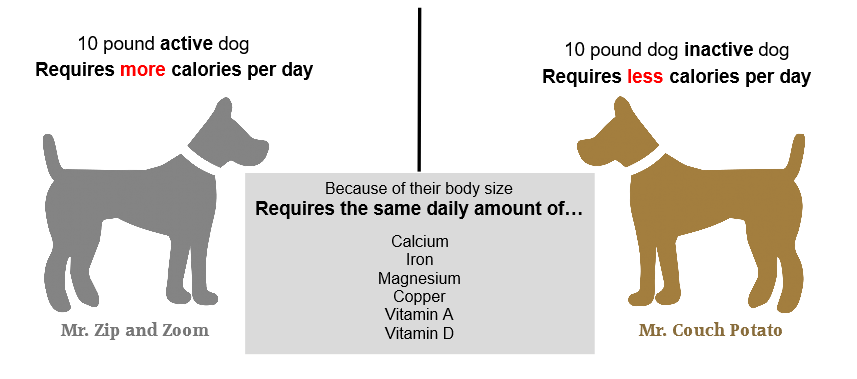
When Mr. Zip and Zoom consumes more food – to meet his calorie/energy needs – he is consuming more vitamins and minerals than his physical size needs.
Because the ‘Complete and Balanced’ system does not recognize the high calorie need of some pets…
Mr. Zip’s need for high calorie consumption results in –
Consuming more pet food, which results in –
Consuming more vitamins and minerals his body size requires.
When Mr. Couch Potato consumes less food – to meet his calorie/energy needs – he is consuming less vitamins and minerals than his physical size needs.
Because the ‘Complete and Balanced’ system does not recognize the low calorie need of some pets…
Mr. Couch Potato’s need for low calorie consumption results in –
Consuming less pet food, which results in –
Consuming less vitamins and minerals his body size requires.
Over time, both of these dogs could suffer from health issues relating to excess vitamin/mineral consumption or health issues relating to nutrient deficiency.
And we have the same concerns with ‘Complete and Balanced’ cat food. The National Research Council has established generalized calorie/energy needs for cats based on lean or overweight.
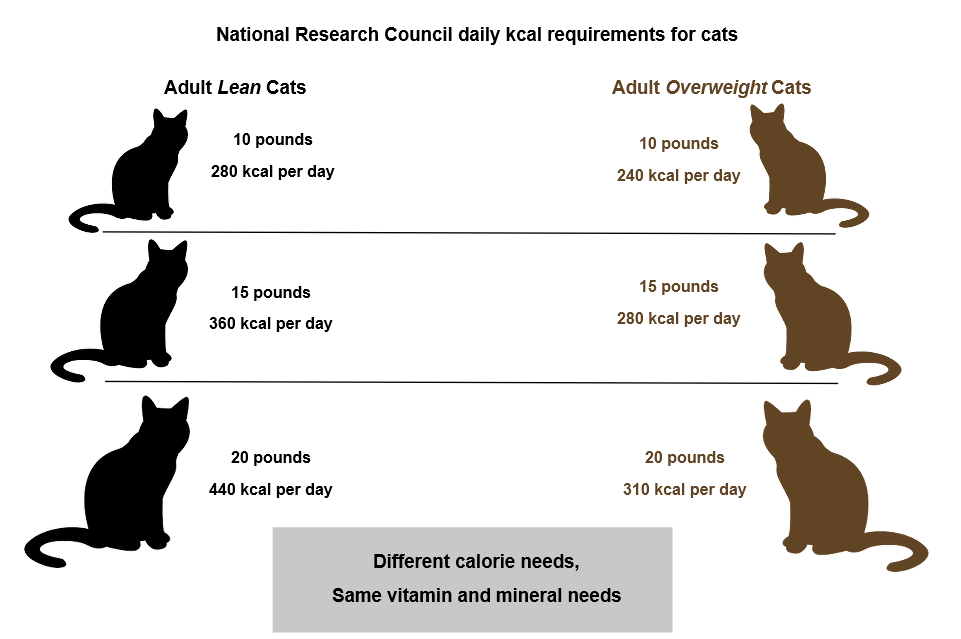
We need a better system.
The AAFCO Complete and Balanced system is flawed. It neglects to consider the energy differences of pets. And the AAFCO Complete and Balanced system is not directly linked to the feeding directions on pet food labels (more on this below).
The European pet food industry organization FEDIAF has a much better system than AAFCO.
Nutrient requirements (to base the Complete and Balanced claim on) under AAFCO for dogs have only two categories.
Dog Food per AAFCO
Dog Food per FEDIAF
Cat Food per AAFCO
Cat Food per FEDIAF
The US – AAFCO – does not.
To read the FEDIAF nutritional guidelines for complete and balanced pet food, Click Here.
Unfortunately, the only resolve to this issue will need to come from AAFCO. Nutrient profiles need to be added for active and inactive dogs and cats, and senior cats and dogs. We will be making a proposal to AAFCO to add this topic to the July 2018 meeting.
We will also be adding to our request for discussion the vast variation of feeding directions on pet food labels. Below are a few examples of dramatic variations to manufacturer feeding directions for cat food…
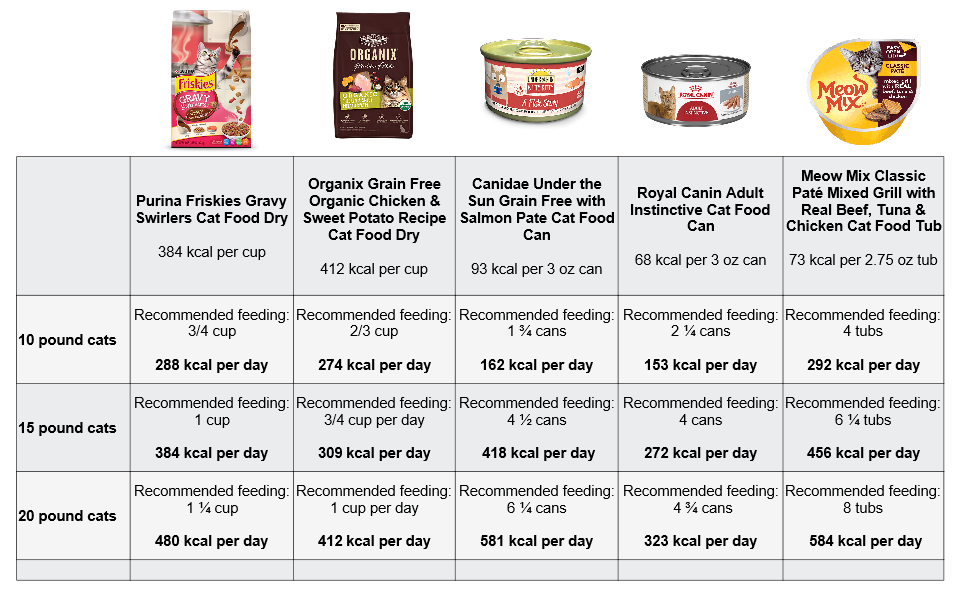
And a few variations to manufacturer feeding directions for dogs…
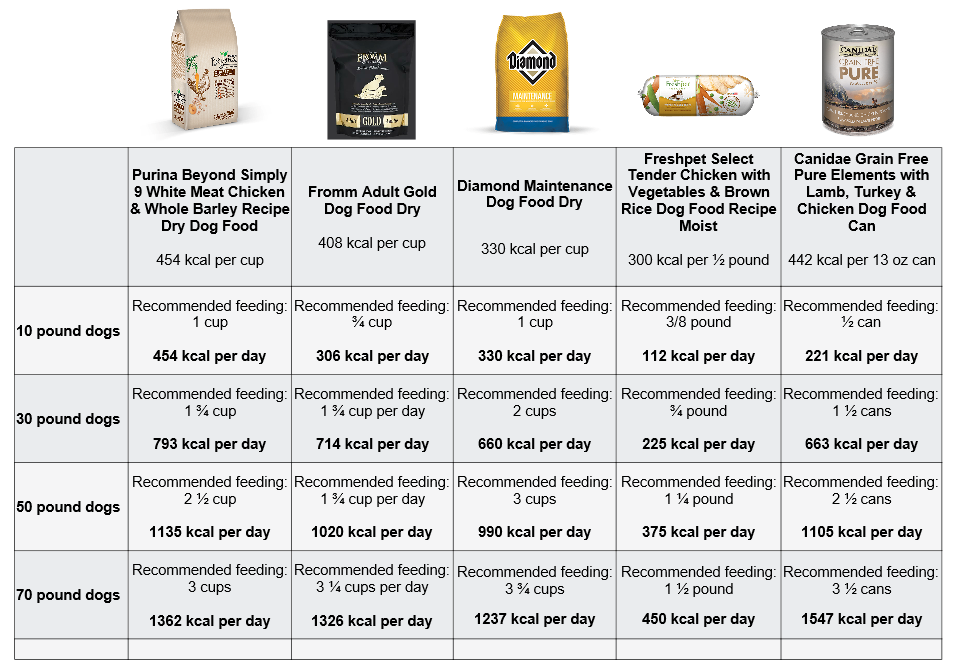
These issues – Complete and Balanced ignoring the calorie requirements of active or inactive pets, feeding directions being all over the map – are AAFCO failures. It is unknown why these issues have been ignored. All we know with certainty is AAFCO must do better with existing regulations. We will ask – and of course we will keep consumers updated to AAFCO’s decisions.
AAFCO Pet Food Committee co-chair Kristen Green was emailed January 29, 2018 with my initial questions on this issue. She promised a response within the week. That response was not received.
Wishing you and your pet(s) the best,
Susan Thixton
Pet Food Safety Advocate
Author Buyer Beware, Co-Author Dinner PAWsible
TruthaboutPetFood.com
Association for Truth in Pet Food

Become a member of our pet food consumer Association. Association for Truth in Pet Food is a a stakeholder organization representing the voice of pet food consumers at AAFCO and with FDA. Your membership helps representatives attend meetings and voice consumer concerns with regulatory authorities. Click Here to learn more.
What’s in Your Pet’s Food?
Is your dog or cat eating risk ingredients? Chinese imports? Petsumer Report tells the ‘rest of the story’ on over 5,000 cat foods, dog foods, and pet treats. 30 Day Satisfaction Guarantee. Click Here to preview Petsumer Report. www.PetsumerReport.com

The 2018 List
Susan’s List of trusted pet foods. Click Here to learn more.
Have you read Buyer Beware? Click Here
Cooking pet food made easy, Dinner PAWsible
Find Healthy Pet Foods in Your Area Click Here
Complete and Balanced? Maybe…Maybe Not
Complete and Balanced pet food is significantly important. Unfortunately, a pet is only receiving complete and balanced nutrition IF they happen to be consuming the right amount of food. An AAFCO failure that millions of pets are paying the price for.
http://truthaboutpetfood.com/complete-and-balanced-maybe-maybe-not/
Complete and Balanced? Maybe…Maybe Not
By Susan Thixton
- February 5, 2018
Complete and Balanced pet food is significantly important. Unfortunately, a pet is only receiving complete and balanced nutrition IF they happen to be consuming the right amount of food. An AAFCO failure that millions of pets are paying the price for.
This is Rover. He is a lovable 30 pound couch potato. Walking ten foot out into the back yard several times a day to ‘go potty’ is the most exercise Rover gets.
Rover’s family pays close attention to his weight. They have found that feeding Rover 25% less pet food is the perfect serving size to maintain Rover’s waistline.
What Rover’s family doesn’t realize however, is the result of feeding 25% less pet food could result in Rover getting only 75% of the nutrients he needs. Overtime, Rover could get sick from nutrient deficiencies.
Complete and Balanced? Only if you are feeding the right amount.
The claim is on almost every bag or can of pet food, assuring consumers that said bag or can provides all the nutrients your pet needs.
The FDA tells pet food consumers: “To have “complete and balanced” in the nutritional adequacy statement, a dog or cat food must either:
- Meet one of the Dog or Cat Food Nutrient Profiles established by the Association of American Feed Control Officials (AAFCO); or
- Pass a feeding trial using AAFCO procedures.”
So…if a puppy food meets the nutritional requirements of the Growth and Reproduction column per 1,000 kcal – the puppy food is “Complete and Balanced” per AAFCO. And if an adult dog food meets the nutritional requirements in the Adult column per 1,000 kcal – the dog food is “Complete and Balanced” per AAFCO.
But there is a problem. Or two.
The ‘Complete and Balanced’ claim on a pet food label is NOT required to be based on the manufacturer suggested feeding amount – what consumers would base how much food to provide their cat or dog (to actually provide the pet with a Complete and Balanced diet). And…the ‘Complete and Balanced’ claim is not based on calorie requirements a high energy level dog needs or the low calorie requirements a couch potato cat needs.
Instead, AAFCO regulation for Complete and Balanced requires a pet food to meet specific nutrient requirements per 1,000 kcal.
Complete and Balanced =
all the nutrients (protein, fat, fiber, vitamins and minerals) in the proper amount –
per 1,000 kcal of pet food.
This sounds like a good system, until you realize that pets have different calorie per day (energy) needs while having the same level of nutrient need (vitamins and minerals) for their physical size.
A ten pound dog requires a particular level of calcium, copper, magnesium, Vitamin A, and numerous other nutrients based on his body weight. The 10 pound dog’s need of calcium, copper, magnesium, Vitamin A and numerous other nutrients is NOT based on his activity level. These nutrient needs are the same whether the dog is an active ten pound dog or an inactive ten pound dog.
But…an active ten pound dog will need higher calorie consumption based on his energy needs. And an inactive ten pound dog will need less calorie consumption based on his lesser energy needs.
The problem…AAFCO Nutrient Profiles do not recognize varied energy needs/calorie requirements of cats and dogs. Ignoring calorie requirements of active or inactive pets causes some pets to consume higher levels of vitamins and minerals for their body size, and causes some pets to consume insufficient levels of vitamins and minerals for their body size.
The National Research Council has established generalized calorie/energy needs for dogs based on activity level. Simply put, the more active the dog is – the more calories the dog needs for fuel.
The problem…
Mr. Couch Potato is also a 5 year old, ten pound dog. But Mr. Couch Potato gets no exercise. His calorie requirements – because of his decreased activity level – is around 300 kcal per day. One hundred calories less per day than Mr. Zip (same size/weight dog).
Even though these two dogs have different calorie requirements per day – because of their size/weight, they have the exact same daily requirement for most other nutrients per day. Such as…
When Mr. Zip and Zoom consumes more food – to meet his calorie/energy needs – he is consuming more vitamins and minerals than his physical size needs.
Because the ‘Complete and Balanced’ system does not recognize the high calorie need of some pets…
Mr. Zip’s need for high calorie consumption results in –
Consuming more pet food, which results in –
Consuming more vitamins and minerals his body size requires.
When Mr. Couch Potato consumes less food – to meet his calorie/energy needs – he is consuming less vitamins and minerals than his physical size needs.
Because the ‘Complete and Balanced’ system does not recognize the low calorie need of some pets…
Mr. Couch Potato’s need for low calorie consumption results in –
Consuming less pet food, which results in –
Consuming less vitamins and minerals his body size requires.
Over time, both of these dogs could suffer from health issues relating to excess vitamin/mineral consumption or health issues relating to nutrient deficiency.
And we have the same concerns with ‘Complete and Balanced’ cat food. The National Research Council has established generalized calorie/energy needs for cats based on lean or overweight.
We need a better system.
The AAFCO Complete and Balanced system is flawed. It neglects to consider the energy differences of pets. And the AAFCO Complete and Balanced system is not directly linked to the feeding directions on pet food labels (more on this below).
The European pet food industry organization FEDIAF has a much better system than AAFCO.
Nutrient requirements (to base the Complete and Balanced claim on) under AAFCO for dogs have only two categories.
Dog Food per AAFCO
- “Adult Maintenance” (active adult dogs, inactive adult dogs and senior dogs)
- “Growth and Reproduction” (puppies and nursing females)
Dog Food per FEDIAF
- “Recommended nutrient levels for early growth and reproduction” (young puppies and nursing females)
- “Recommended nutrient levels for late growth” (older puppies)
- “Recommended nutrient levels for adult dogs based on a MER of 110 kcal/kg BW” (active adult dogs)
- “Recommended nutrient levels for adult dogs based on a MER of 95kcal/kg BW” (inactive adult dogs)
Cat Food per AAFCO
- “Adult Maintenance” (active adult cats, inactive adult cats and senior cats)
- “Growth and Reproduction” (kittens and nursing females)
Cat Food per FEDIAF
- “Recommended nutrient levels for feline growth and reproduction” (kittens and nursing females)
- “Recommended nutrient levels for adult cats based on a MER of 100kcal/kg BW” (active adult cats)
- “Recommended nutrient levels for adult cats based on a MER of 75kcal/kg BW” (inactive adult cats)
The US – AAFCO – does not.
To read the FEDIAF nutritional guidelines for complete and balanced pet food, Click Here.
Unfortunately, the only resolve to this issue will need to come from AAFCO. Nutrient profiles need to be added for active and inactive dogs and cats, and senior cats and dogs. We will be making a proposal to AAFCO to add this topic to the July 2018 meeting.
We will also be adding to our request for discussion the vast variation of feeding directions on pet food labels. Below are a few examples of dramatic variations to manufacturer feeding directions for cat food…
And a few variations to manufacturer feeding directions for dogs…
These issues – Complete and Balanced ignoring the calorie requirements of active or inactive pets, feeding directions being all over the map – are AAFCO failures. It is unknown why these issues have been ignored. All we know with certainty is AAFCO must do better with existing regulations. We will ask – and of course we will keep consumers updated to AAFCO’s decisions.
AAFCO Pet Food Committee co-chair Kristen Green was emailed January 29, 2018 with my initial questions on this issue. She promised a response within the week. That response was not received.
Wishing you and your pet(s) the best,
Susan Thixton
Pet Food Safety Advocate
Author Buyer Beware, Co-Author Dinner PAWsible
TruthaboutPetFood.com
Association for Truth in Pet Food
Become a member of our pet food consumer Association. Association for Truth in Pet Food is a a stakeholder organization representing the voice of pet food consumers at AAFCO and with FDA. Your membership helps representatives attend meetings and voice consumer concerns with regulatory authorities. Click Here to learn more.
What’s in Your Pet’s Food?
Is your dog or cat eating risk ingredients? Chinese imports? Petsumer Report tells the ‘rest of the story’ on over 5,000 cat foods, dog foods, and pet treats. 30 Day Satisfaction Guarantee. Click Here to preview Petsumer Report. www.PetsumerReport.com
The 2018 List
Susan’s List of trusted pet foods. Click Here to learn more.
Have you read Buyer Beware? Click Here
Cooking pet food made easy, Dinner PAWsible
Find Healthy Pet Foods in Your Area Click Here


