• Disclaimer: Hello Guest, Doberman Chat Forums presents the opinions and material on these pages as a service to its membership and to the general public but does not endorse those materials, nor does it guarantee the accuracy of any opinions or information contained therein. The opinions expressed in the materials are strictly the opinion of the writer and do not represent the opinion of, nor are they endorsed by, Doberman Chat Forums. Health and medical articles are intended as an aid to those seeking health information and are not intended to replace the informed opinion of a qualified Veterinarian.”

DOBERMANDCM

BG1

Hot Topics Subscriber
Found this a few days ago, highly useful compendium of Dobe DCM stuff. No contact info or author info on the About page, or elsewhere but someone did a good job on this site. A couple good links I haven't seen here or elsewhere,
And I think there are a couple more studies/academic groups not yet included
But all in all
its a pretty level headed treatment,
at layman's level understanding...

So kudos and thanks to whomever put this together and hosted it.

 
Just for fun, as an example of using AI as a search tool, on a complicated and debated topic here are resukts on a query using SuprGrok (currently highest rated AI in use in science and health care data searches, asking...

What is the current science based consensus on diet caused DCM in dobermans?

"The current science-based consensus (as of 2026) on diet-caused (nutritional or diet-associated) dilated cardiomyopathy (DCM) in Doberman Pinschers distinguishes it clearly from the breed’s well-established primary/hereditary/genetic DCM.


Doberman DCM Basics


Doberman Pinschers have one of the highest genetic predispositions to primary DCM among dog breeds. This is a progressive, inherited myocardial disease (often linked to specific genetic variants) that typically affects males more, begins in middle to older age, and leads to ventricular dilation, reduced systolic function, arrhythmias, and eventual congestive heart failure or sudden death. Lifetime prevalence can be high (estimates range 20–50% or more in some populations), and it does not reliably reverse with diet changes or taurine supplementation. Screening via echocardiography and Holter monitoring is standard for the breed, with early medical intervention (e.g., pimobendan) used to delay progression.42


Diet-Associated (Nutritional) DCM in Context


Starting around 2018, the FDA and veterinary researchers noted an apparent rise in DCM cases, many involving “non-traditional” diets (often labeled grain-free or “BEG” — boutique, exotic, or grain-free). These diets frequently featured high levels of pulses/legumes (peas, lentils, chickpeas, beans) and sometimes potatoes/sweet potatoes as main ingredients (top 10 on the label). Over 90% of reported cases involved grain-free formulas, and ~93% had peas/lentils.20


Key points on the consensus:


  • Association exists, but causality is complex and not fully proven: Multiple peer-reviewed studies show correlations between these diets and DCM-like changes (e.g., increased left ventricular dimensions, reduced fractional shortening/contractility, elevated cardiac biomarkers like troponin I or NT-proBNP). Some dogs (especially subclinical/early cases) show partial or significant improvement in heart function after switching to traditional grain-inclusive diets low in pulses, with or without taurine supplementation. This suggests a reversible “nutritional” or “diet-associated” component in some cases.9
  • Not primarily taurine deficiency: Early hypotheses focused on low taurine (an amino acid important for heart muscle), as seen in some breeds like Golden Retrievers or American Cocker Spaniels. However, many affected dogs (including Dobermans) have normal taurine levels. Taurine may play a secondary role in some cases, but it does not explain the majority. Other proposed mechanisms include metabolic effects from high-pulse diets (e.g., altered bile acid excretion, amino acid imbalances, or interference with nutrient bioavailability), and a 2025 study identified a potential urinary biomarker (di-22:6-BMP) linked to phospholipidosis (lipid accumulation in cells) in dogs on high-pulse diets with DCM.13
  • Applies to Dobermans too: While primary genetic DCM dominates in Dobermans, diet can act as a contributing or predisposing factor. Studies have included Dobermans in screenings of apparently healthy dogs, showing subtle cardiac changes (e.g., higher troponin) in those eating high-pulse/grain-free diets versus traditional ones. Some Dobermans on implicated diets have shown echocardiographic improvements after diet change, suggesting an overlay of nutritional influence on their genetic baseline. However, diet alone does not cause the classic hereditary form, and genetic DCM does not reverse with diet.1019
  • Not limited to “grain-free”: The issue centers more on high inclusion of pulses/legumes than the absence of grains. Some grain-inclusive diets high in peas/lentils have also been implicated. Short-term feeding trials (e.g., 28 days with wrinkled pea diets) have induced early DCM-like changes in non-predisposed breeds, supporting a link, though longer studies in predisposed breeds are ongoing.21
  • FDA stance: The investigation (ongoing in a low-key way) found the association complex, potentially involving multiple factors (diet, genetics, individual metabolism). Case reports dropped after 2020 (possibly due to formulation changes by manufacturers or reduced reporting), but the FDA has not declared any specific cause, recalled foods, or banned ingredients. They emphasize it’s not a simple “grain-free = DCM” equation.2
  • Ongoing research and nuances: Veterinary cardiologists and nutritionists (e.g., via AKC Canine Health Foundation, Tufts, UC Davis) continue studying mechanisms. Some studies show no major taurine drop or cardiac changes in controlled short-term trials with certain grain-free diets, highlighting that formulation quality, processing, and overall balance matter. Conflicting data exist, and not all high-pulse diets produce issues. However, the weight of evidence from clinical cases, prospective studies, and biomarker work supports caution with high-legume non-traditional diets, especially in at-risk breeds like Dobermans.7

Practical Recommendations from Veterinary Consensus


  • For Dobermans: Prioritize genetic/hereditary screening (echo, Holter). Feed a complete-and-balanced diet formulated by a veterinary nutritionist (ideally meeting WSAVA guidelines for transparency in formulation, feeding trials, and manufacturing). Avoid or minimize diets with peas, lentils, chickpeas, or beans as top/main ingredients. Traditional grain-inclusive diets from established brands are generally viewed as lower risk.
  • If feeding a suspect diet: Consider switching and monitoring via cardiology workup (echo, biomarkers). Taurine supplementation may help in some cases but is not a cure-all.
  • Diet-associated DCM appears more reversible (especially if caught early/subclinical) than primary genetic DCM.

The consensus is that diet can contribute to or exacerbate DCM in Dobermans (via nutritional mechanisms tied to high-pulse ingredients), but it is secondary to the breed’s strong genetic component. The exact “why” (beyond associations) remains under active investigation, with phospholipidosis and other metabolic pathways as emerging clues. Consult a board-certified veterinary cardiologist and/or nutritionist for individualized advice, as individual dogs vary.


If you have details about a specific Doberman’s diet, symptoms, or test results, I can help contextualize further!"

Important disclaimer; I am not suggesting this is accurate, in detail or not. I use AI as a starting point- the summary is helpful but a function of the question asked and the AIs ability to collate only among the public domains of data it has access to...so, if I asked Gemini; supported by Googles data and ai handlers training- I would get a different answer.

I use Grok to quickly find source material that I in turn read myself and apply my own brainpower to decide whats useful.

Then I compare it to trusted expert help and experiential data, opinions, like here. That might give another context or point me to other useful info.

Fun! (Well, if you are a sciencey dog nerd...🤣)

PS: note that on the above linked site there is no "author" name, contact info, and hosting name was anonymized on whois. Not unusual, but also no way to evaluate the maker. (Cue the Twilight Zone music you conspiracy fans...🧐)

The linked info is pretty good, imho, and there are a couple studies missing, maybe since this website was made...

 
Last edited:
Found this a few days ago, highly useful compendium of Dobe DCM stuff. No contact info or author info on the About page, or elsewhere but someone did a good job on this site. A couple good links I haven't seen here or elsewhere,
And I think there are a couple more studies/academic groups not yet included
But all in all
its a pretty level headed treatment,
at layman's level understanding...

So kudos and thanks to whomever put this together and hosted it.

@BG1 …..thank you Kevin for providing a highly informative and detailed source of information aimed at both the newbie and seasoned Doberman/Dobermann aficionado alike pertaining to the complex issue of DCM within our breed from a Q&A standpoint on a multitude of pertinent issues in need of answers from a layman’s perspective : — i.e. factors to consider prior to potentially becoming a first time Dobe puppy purchaser —> leading to becoming lifelong devotee to our majestic breed that is endowed with three 'givens' of beauty, brains and brawn with the added hope of longevity.

A day into your post and 'traction' regarding viewing/interest appears to be slow for a week-end leisure viewing as indicated by the lacking number of “likes”. Hopefully your effort to share and provide thoughtful insight on a critical issue does not go unoticed and will be discovered on this highly popular and informative Doberman/Dobermann forum where the issue of DCM is ongoing and has been addressed a countless number of times here as well as elsewhere. Sounds like 'I'm blowing smoke up where the sun don't shine' — nope, just 'callin it the way I 'seez-it'.

I accepted your invite to explore the content of the linked-to source and was immediately taken in by the detail provided and like you, impressed by the effort the author — even if it might possibly be Ai sourced — put into generating that DCM relevant source. Allow me to add IMHO a RELIABLE source as per my opinion is hinged on 3 plus decades of active involvement/experience on a near 24/7 day-in day-out commitment to our breed that enables that personal opinion to be 'unapologetically' stated in confidence. Allow me to add on a personal belief and emphasis on “personal” is the Bruce-Lowe-Mendelian concept on line breeding as outlined in Gruenig’s “History of the Dobermann” has served me well where the common related ancestor on both the top and bottom of the pedigree indicated longevity as per research culminating in BFL as can be found on Dobequest for American bred Dobermans or through Euro pedigree data basis.

Having stated such, then that aligns with the your linked anonymous source on the topic of COI — especially the question of low COI and the question of “does it impact the prevalence of DCM?” Please do not misconstrue any implication of a pretentiousness of genetic authority on my part in this highly controversial issue. As stated prior and as always emphasized “ it has served me well” and comes with the caveat not to be considered as 'gospel'.

In the common bond of Dobermans/ Dobermanns …..Mikel
 
  • Like
Reactions: BG1
Thanks @MikeP glad to see you posting again.

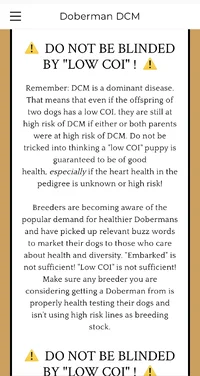
Yup, still chipping away and trying to learn here; the DOBERMANDCM site has some good explanations on newb level on pedigrees, and a caution on COIs...

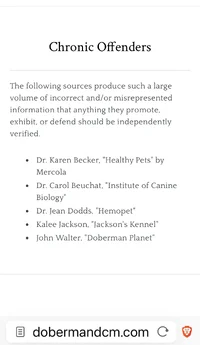
IMG_9018.webp and I noticed a couple of sources warned against in one list, couple names disparaged at the other website, so there is maybe a hint as to authorship- old school showline breeder viewpoints, updated as of say 3 years ago.
IMG_9017.webp

Btw, I asked about Expected Breeding Values (EBVs) at a germanshepherd webforum and

Like here and at the other forum-

learned its not used much unless you have a lot of data- like at Guide Dogs, Or raising cattle where its used a lot.

So I guess thats another data project to ask breeders if they are contributing their dna/$$$ at UCDavis if they are getting more on dobes, and how much value to breeders from using that tool to compare litters to VGLs info on their large database...

I wonder how many dobe samples VGL actually has now, and if the averages are meaningful- @Rits ?

 
COI is still vastly important and not to be ignored. For breeds like the original Jack Russel Terrier that a 10% COI is considered high, no, it's not a concern. (The original JR is NOT the Parsons Jack Russel that is AKC version) The average Doberman now being high 30's to mid 40's is a huge concern for multiple reasons. I'd bet of all the lines of Dobermans who carry the most chance of DCM - Euro Show/Pet/Huge Kennel Lines - you'd find very few with COI less than 30. Correlation is not causation, but the more you stack the deck with the same genes, the more likely you'll have genes that double up your chances at getting what you want AND don't want. I wish like hell breeders would post their Embark COI on Dobequest. Nobody should be thinking it's OK to be breeding towards the 50% mark in any breed.
 
I'd bet of all the lines of Dobermans who carry the most chance of DCM - Euro Show/Pet/Huge Kennel Lines
That's sort of why we started moving away from Euro lines after Albert. There are so many breeders over there who don't even consider health testing and the results are starting to show through with so many dying way too young. And like you said, so many are way too closely related when they find certain lines who excel at working.
 
Correlation is not causation, but the more you stack the deck with the same genes, the more likely you'll have genes that double up your chances at getting what you want AND don't want. I wish like hell breeders would post their Embark COI on Dobequest. Nobody should be thinking it's OK to be breeding towards the 50% mark in any breed.
Absolutely agree here…..ironically, science/unknown factors dispute the logic we share as we would like to hope in the sense that 'stacking the deck ' in our favour as outlined above should weigh in our favour and increase the chances of sidestepping DCM. The evidence is profound that low COI as well as high COI relative to the common ancestor and the breed in general are irrelevant in prediction of occurrence or non-occurrence of DCM. Hence the caveat I alluded to and emphasized in my post pertaining to 3-2 linebreeding as per my example and associated Dobequest BFL as not being 'gospel' — yet it is one I ascribe longevity to in current and past. Nevertheless @BG1 brings good discussion to the table.

I'd be remiss if I neglected to say I appreciate participation/learning/sharing in this premier forum regarding Doberman exclusive content as well as other related working breeds.

In the common bond of Dobermans/Dobermanns …..Mikel
 
Last edited:
There are so many breeders over there who don't even consider health testing and the results are starting to show through with so many dying way too young. And like you said, so many are way too closely related when they find certain lines who excel at working.
It's more the show/pet and those kennels who produce literally hundreds of puppies. True that the European working lines and American show lines have DCM too, but from what I observe it's the BYB mass producers that created the overdone heavy Dobermans that have the highest incidence and at the youngest ages.

ironically, science/unknown factors dispute the logic we share as we would like to hope in the sense that 'stacking the deck ' in our favour as outlined above should weigh in our favour and increase the chances of sidestepping DCM. The evidence is profound that low COI as well as high COI relative to the common ancestor and the breed in general are irrelevant in prediction of occurrence or non-occurrence of DCM.
That's one reason why I'm curious about the COI of the general population on Dobequest. I'm curious if dogs that look insanely inbred on paper are not that much different than the ones who have no common ancestors for 4 generations. As I understand it, the COI covers all the genetic commonalities, so may look very different than the pedigree. Seems to me that a Doberman with a 40 COI has a bigger chance at all diseases than one with a 20 COI due to immune deficiencies. I'm no scientist but I think across all animal species inbreeding has been proven to be detrimental to health. It would be so interesting to know the COI of one Doberman pedigree I found on Dobequest that by the 6th generation, one dog appeared in something over half the sire lines. If that COI is similar to a pedigree that has a more diverse pedigree then it would be clear that our dogs are all in trouble due to bottlenecks further back and nothing will ever fix it short of crossing out to other breeds. Also it would be interesting to look at the LOW COI pedigrees and see what dogs are in there that must not have been part of the bottleneck. Most likely BYB dogs, which of the few I know of, seem to be split with some very nice dogs that live with few health problems to those who have extreme health and mental problems.

People here are probably tired of hearing it, but I'm old enough to remember the dogs of the 70's and 80's and they didn't have the mental or physical problems they seem to have today. DCM was there, but it was something dogs got when 10+ years old, same with cancer. I worked at a vet clinic in the 80's and don't recall a single bloat ever in a Doberman. Now it's fairly common. They use to be built with a mildly deep chest and a pretty non-existent front, so that (to me) is a clear cause. They wanted to be with you but didn't whine, didn't have a need to follow you to the bathroom, separation anxiety was not a thing. Everyone these days just says that's a breed thing, and they're right. But it wasn't always like that and we've come to a point of no return.
 

Back
Top