• Disclaimer: Hello Guest, Doberman Chat Forums presents the opinions and material on these pages as a service to its membership and to the general public but does not endorse those materials, nor does it guarantee the accuracy of any opinions or information contained therein. The opinions expressed in the materials are strictly the opinion of the writer and do not represent the opinion of, nor are they endorsed by, Doberman Chat Forums. Health and medical articles are intended as an aid to those seeking health information and are not intended to replace the informed opinion of a qualified Veterinarian.”

Amdovirus in Doberman

Nordika

Member
There has been an emergence of a new amdovirus that has affected the Doberman breed in Russia and abroad. In March and April 2026, the world’s first confirmed case of Raccoon Dog and Fox Amdoparvovirus (RFAV) in domestic dogs was identified in a Doberman Pinscher breeding facility near Novi Sad, Serbia. The outbreak, likely introduced via dogs imported from Russia, affected four Dobermans with symptoms including conjunctivitis, weight loss, liver damage, and neurological signs.

The virus is a parvovirus previously known only in wildlife (raccoon dogs, foxes, minks) and showed 97% genetic similarity to known RFAV strains.

Currently the only specialized laboratory testing the identified virus as part of a research project is a laboratory:

"Zaitsev+"

107023, Moscow, st. Malaya Semenovskaya, house 9с8
 
Do we know if this has been reported in other breeds?
My vet commented to me years ago when my Thor (Bernese Mountain dog) had parvo, that it was looking like tan-pointed dogs were more likely to contract regular Parvo. I don't know if that's true, it's just true that my vet said it.
 
It appears to be Doberman specific at this time.

Dear Members and Dobermann Enthusiasts,
The Dobermann Verein e.V. has taken careful note of the reports currently circulating regarding Amdoparvovirus infections at a Dobermann kennel in Serbia. We understand that these reports may raise questions and concerns within the Dobermann community.
We are therefore monitoring developments very closely. Based on current information, these appear to be localized and isolated individual cases. The affected dogs were epidemiologically linked. Scientific investigation and assessment of the situation are not yet complete.
Amdoparvovirus (RFAV) is a type of virus belonging to the genus *Amdoparvovirus*; it was originally discovered and described primarily in fur-bearing animals such as raccoon dogs and foxes. The virus particularly affects raccoon dogs and foxes. A recently published study suggests that such amdoparvoviruses can potentially also spread to domestic dogs.
To date, there have been no official warnings from veterinary professionals, competent authorities, or health organizations in Germany indicating a specific risk.
To assess the situation on a sound basis, the Dobermann Verein has contacted scientific and technical experts. Our goal is to obtain further reliable and well-documented information. We will, of course, inform our members as soon as new, scientifically validated, and officially confirmed findings become available.
We are aware that such reports spread very quickly, particularly via social media. We therefore ask that you view unverified information with the necessary caution and refrain from drawing hasty or sweeping conclusions. Current knowledge warrants heightened attention but does not justify general alarm. A proper assessment requires scientific review, reliable contextualization, and consideration of the specific circumstances.
As with any potential risk of infectious disease, it is recommended to follow standard health guidelines, check vaccination status, and obtain boosters if necessary.
This situation once again highlights the importance of handling information from social media responsibly. The speed at which such information spreads often outpaces the time required for careful expert analysis and scientific validation.
We will closely monitor further developments and provide updates on all significant new findings. Our communications will be based exclusively on verifiable scientific data and officially confirmed health information.
We thank all members who contribute to a responsible understanding and contextualization of the situation through their input, questions, and objective contributions.
DV Executive Board
 
This situation once again highlights the importance of handling information from social media responsibly. The speed at which such information spreads often outpaces the time required for careful expert analysis and scientific validation.
I dont do TikTok, IG or FakeBook, but it will be interesting to see if/how this becomes another "social contagion" for clicks.

I remember when the fear spread much faster/further on the "zoo-flu" a couple years ago, than the actual disease.

This appears to be the study mentioned:

 
Last edited:
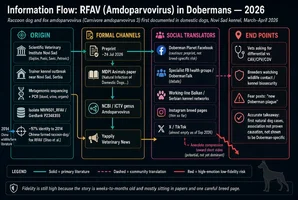
I used GrokAI to generate a network map of info flow. Since this IS a valid science based concern, with careful discussion in specialized breed forums/FB I expect that sober discussion with education, in places like Doberman Chat Forum will supplant social media contagion as fear porn, as in the "mysterious canine flu" thing...
 

Attachments

  • IMG_1989.webp
    IMG_1989.webp
    124.5 KB · Views: 1
t was looking like tan-pointed dogs were more likely to contract regular Parvo. I don't know if that's true, it's just true that my vet said it.
I've not ever heard of that before, but it is interesting, because when I first heard about this "new" strain, seemingly being seen only in Dobermans my first thought was that viruses aren't usually picky about breed. Species yes, breeds or color, not so much.
 
I've not ever heard of that before, but it is interesting, because when I first heard about this "new" strain, seemingly being seen only in Dobermans my first thought was that viruses aren't usually picky about breed. Species yes, breeds or color, not so much.
All I have is anecdotal, but that vet, and several techs at our clinic, and the receptionist all seem to believe it. It could be true at our clinic but still kind of random, based on area and clientele of that particular clinic (maybe we just have more tan pointed dogs up north here?).
 
T
All I have is anecdotal, but that vet, and several techs at our clinic, and the receptionist all seem to believe it. It could be true at our clinic but still kind of random, based on area and clientele of that particular clinic (maybe we just have more tan pointed dogs up north here?).
Certain breeds, such as Rottweilers, Doberman Pinschers, and Pit bull terriers as well as other black and tan colored dogs may be more susceptible to CPV2(parvo), this is known throughout veterinary science.

They are also in the group of moderately large black or black-and-tan dogs that have a marked increase in susceptibility to subungual squamous cell carcinoma, the most common type of toe cancer in dogs. Breeds with this high genetic risk include Giant Schnauzers, Standard Schnauzers, Gordon Setters, Black Standard Poodles, Kerry Blue Terriers, and Rottweiler.

Doberman Pinschers are specifically called out is for malignant melanoma of the toes — the more aggressive type with a higher metastatic rate. Their dark skin and fur are a recognized risk factor for this cancer.

So in short: they carry some elevated risk for both types of cancer, but the strongest breed-specific association is with melanoma, not the more common (and less aggressive) subungual SCC.
 
All I have is anecdotal, but that vet, and several techs at our clinic, and the receptionist all seem to believe it. It could be true at our clinic but still kind of random, based on area and clientele of that particular clinic (maybe we just have more tan pointed dogs up north here?).
Who knows? But sometimes I observe things and start seeing things click, but no way to prove anything.

I was working at the vet clinic in the early 80's when Parvo had just become a major issue, and I can tell you that almost every dog that wasn't vaccinated, especially puppies, got Parvo and about 90% of them died no matter what we did. It was horrible. It has a smell that is seared into my brain.
 
Certain breeds, such as Rottweilers, Doberman Pinschers, and Pit bull terriers as well as other black and tan colored dogs may be more susceptible to CPV2(parvo), this is known throughout veterinary science.

They are also in the group of moderately large black or black-and-tan dogs that have a marked increase in susceptibility to subungual squamous cell carcinoma, the most common type of toe cancer in dogs. Breeds with this high genetic risk include Giant Schnauzers, Standard Schnauzers, Gordon Setters, Black Standard Poodles, Kerry Blue Terriers, and Rottweiler.

Doberman Pinschers are specifically called out is for malignant melanoma of the toes — the more aggressive type with a higher metastatic rate. Their dark skin and fur are a recognized risk factor for this cancer.

So in short: they carry some elevated risk for both types of cancer, but the strongest breed-specific association is with melanoma, not the more common (and less aggressive) subungual SCC.
I knew about the carcinomas but not about the CPV2. Very interesting, thank you!
 
I can tell you that almost every dog that wasn't vaccinated, especially puppies, got Parvo and about 90% of them died no matter what we did. It was horrible.
That's why I'm so darn picky about not letting them down on the ground going anywhere like the vet until they've had their full set of parvo shots. And I will wipe the soles of my shoes down with bleach after going somewhere that some infected dogs could have been. Maybe I'm paranoid but like you said, when you see a pup suffering from it, it etches a spot in your brain.
 

Back
Top