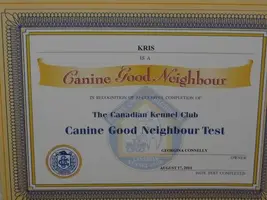
Thank you for the feedback. This is good to know. In San Diego it seems like this is a racket that vets and now different groups are all getting involved in. It's actually very hard to find a place where I can just take the test.
Here's one link I found...
http://www.hvoc.org/cgc.php
What is the Canine Good Citizen Program?
AKC's Canine Good Citizen certification program is designed to reward dogs who have good manners at home and in the community. The Canine Good Citizen Program is a two-part program that stresses responsible pet ownership for owners and basic good manners for dogs. All dogs who pass the CGC test can receive a certificate from the American Kennel Club and they are automatically recorded in the AKC's Canine Good Citizen Archive.
The purpose of the CGC Program is to ensure that our favorite companion, the dog, can be a respected member of the community.
All dogs, including both purebred and mixed breed dogs are welcome to participate in the CGC program. Dogs must be old enough to have received necessary immunizations such as rabies vaccines, and there is no age limit on the test. A dog is never too old to be a good citizen.
Canine Good Canine Good Citizen® Becomes a Title!
As of January 1, 2013, Canine Good Citizen® will become an official AKC title that can appear on the title records of dogs registered or listed with AKC. Dog owners who complete the CGC as a Title process may list the suffix “CGC” after the dog’s name.
Since the program began in 1989, CGC™ has been considered an “award,” meaning that it has not been listed on a dog’s title record.
As a result of frequent, ongoing requests from dog owners and instructors for AKC to recognize CGC as a title, dog owners will have the option of having CGC added to their dog’s title record and appear as a part of the dog’s titled name.
Evaluators will be distributing a new CGC Test/Registration Form which includes the option to select one of these two choices:
- CGC as a Title.
The processing fee is $20. You will receive the CGC certificate, you may use the suffix “CGC” after the dog’s name, and CGC will be added to the dog’s title record. The dog must be registered or listed with AKC (an AKC number, PAL, or AKC Canine Partners)
- CGC certificate only.
The processing fee is $8. CGC will not be added to the dog’s title record.
What is the CGC Test?
To receive the CGC certificate, dogs must pass all ten items of the test. Handlers may talk to their dogs throughout the test.
Test 1
Accepting A Friendly Stranger
This test demonstrates that the dog will allow a stranger to approach it and speak to the handler in a natural, everyday situation. The evaluator and handler shake hands and exchange pleasantries. The dog must show no sign of resentment or shyness.
Test 2
Sitting Politely For Petting
This test demonstrates that the dog will allow a friendly stranger to touch it while it is out with its handler. With the dog sitting at the handler's side, the evaluator pets the dog on the head and body only. The dog must not show shyness or resentment.
Test 3
Appearance And Grooming
This test demonstrates that the dog will welcome being groomed and examined and will permit a stranger, such as a veterinarian, groomer, or friend of the owner, to do so. The evaluator inspects the dog, then combs or brushes lightly, examines the ears and each front foot.
Test 4
Out For A Walk (Walking on a loose lead)
This test demonstrates that the handler is in control of the dog. The dog may be on either side of the handler, whichever the handler prefers. There must be a left turn, a right turn, and about turn, with one stop in between and one at the end. The dog need not be perfectly aligned with the handler and need not sit when the handler stops.
Test 5
Walking Through A Crowd
This test demonstrates that the dog can move about politely in pedestrian traffic. The dog and handler will walk close to several people. The dog may show some interest without appearing overexuberant, shy or resentful.
Test 6
Sit and Down On Command (Staying in Place)
This test demonstrates that the dog has training, will respond to the handler's command to sit and down and will remain in place. The handler may take a reasonable amount of time and use more than one command to make the dog sit and then down. The handler tells the dog to stay and walks to the end of a 20-foot line and returns. The dog must remain in place, but may change positions. Handler may choose to leave the dog in either a sit or a down.
Test 7
Coming When Called
This test demonstrates the dog will come when called by the handler. With dog on 20-foot line from Test 6, handler walks 10 feet from the dog, turns and faces the dog, and calls the dog.
Test 8
Reaction To Another Dog
This test demonstrates that the dog can behave politely around other dogs. Two handlers and their dogs approach each other from a distance of about 10 yards, shake hands and exchange pleasantries, and continue on. The dogs should show no more than a casual interest in each other.
Test 9
Reactions to Distractions
This test demonstrates that the dog is confident at all times when faced with common distractions. The dog may express a casual interest and may appear slightly startled, but should not panic, show aggressiveness, or bark.
Test 10
Supervised Separation
This test demonstrates that a dog can be left alone with a trusted person and will maintain its good manners. Dog will be on a 6-foot leash; leash is held by an evaluator while handler is out of sight for three minutes.



 ) I wouldn't have to touch him any longer so no one could tell if I trained him positive or not. Unless there is something I'm unaware of with positive training, I can't see how anyone would know how I trained my dog as I give him commands.