
• Disclaimer: Hello Guest, Doberman Chat Forums presents the opinions and material on these pages as a service to its membership and to the general public but does not endorse those materials, nor does it guarantee the accuracy of any opinions or information contained therein. The opinions expressed in the materials are strictly the opinion of the writer and do not represent the opinion of, nor are they endorsed by, Doberman Chat Forums. Health and medical articles are intended as an aid to those seeking health information and are not intended to replace the informed opinion of a qualified Veterinarian.”

Thyroid Question - now allergies

Caloni

Active Member
My breeder just informed me that one of her dobes might have a thyroid problem. He is eating a ton, gaining weight, and loosing some hair on his sides and back. The male is my pup's dad, so I am a little worried about my boy.

Is there a test that I need to have done on my puppy now or when he gets older? I am not going to breed him, but will be using him as a Service dog if all goes well.

If he does have a bad thyroid what is the course of treatment and diagnosing the disease. I just want to be prepared if I have to battle this too.

Last question....if I would have gone with a breeder that both parents were tested and clear would my dog then never get thyroid disease?
 
I would not be overly concerned. I also would not test now as unless there are symptoms or problems it is usually a waste at this point. Dobermans usually do not show signs of thyroid problems until later in life which makes it hard to evaluate. If you have concerns then you can start to check thyroid at 4 unless symptoms present earlier. It is usually treated with a small pill twice a day to level out thyroid with no major problems and the dogs system returns to normal with the treatment.

There are no guarantees on the future unless we have a DNA test to identify and completely eliminate the gene that causes the problem. As in many other things not all puppies even from low thyroid parents are guaranteed to ever have a problem but it is more likely they will as if both parents test low then you have doubled up on genes and the chances.

To test for it the vet will draw blood and send it in to an approved lab to have thyroid levels evaluated and to run the T3 and T4 which are important for the Doberman.
 
Ok, thanks. I think his dad just turned 4 or 5....can't remember. But he just started showing signs over the last week. Luca has no signs and the female (mom) has no signs either.
 
Ok, thanks. I think his dad just turned 4 or 5....can't remember. But he just started showing signs over the last week. Luca has no signs and the female (mom) has no signs either.
Not saying this is right or wrong but my vet refuses to administer the thyroid tests as he calls them unreliable and prefers to diagnose the symptoms.. I personally don't agree with this bit I'd never tell him that as he would likely ask for my credentials.. But I did want to mention that although thyroid can be hereditary there seem to be more and more cases of it popping up in Dobermans then I ever recall in the past indicating to me at least that some other underlining problems are at work here.. Also if I recall properly there are three different thyroid tests and in order to get any type of value out of any one of them you will need to administer all three tests..
 
Not saying this is right or wrong but my vet refuses to administer the thyroid tests as he calls them unreliable and prefers to diagnose the symptoms.. I personally don't agree with this bit I'd never tell him that as he would likely ask for my credentials.. But I did want to mention that although thyroid can be hereditary there seem to be more and more cases of it popping up in Dobermans then I ever recall in the past indicating to me at least that some other underlining problems are at work here.. Also if I recall properly there are three different thyroid tests and in order to get any type of value out of any one of them you will need to administer all three tests..
I agree, it is popping up a lot more recently. And not just in dogs. I am seeing it in cats and many people too. Wonder why? Food? Genes? Not sure.
 
Von good point as I read an article a couple months ago about the possibility of the flouride in water being a possible cause of increased thyroid problems.

And as above in Dobermans you do have to test the thyroid and the T3 and T4 levels as that is what you are probably speaking of but I personally would not rely solely on symptoms for diagnosis. If they do the T3 and T4 levels it has been my experience that the test is very reliable.
 
So are you saying that even if both parents test normal for Thyroid before breeding that a puppy can still have a thyroid problem? Just trying to be clear.
 
I believe Thyroid can pop up in any dog regardless of the parents conditions. Although it not as common in puppies and symptoms are usually seen in middle aged dogs. Most breed able dogs are bred before thyroid symptoms present themselves.
 
So are you saying that even if both parents test normal for Thyroid before breeding that a puppy can still have a thyroid problem? Just trying to be clear.

Definitely, although there is often a hereditary component. There are several different factors that can bring about hypothyroidism and almost all of them have genetic components. It isn't the kind of disease where one genetic marker can tell all. Like anything else, man's selective breeding plays a significant role in the increase of the disease.

The current thyroid lab tests for abnormal levels of hormones which only change when the disease is active. That's when you will see symptoms. You can have 2 parents who are very likely to develop the disease who won't test positive on a lab test until they actually develop the disease because their hormone levels won't change until then.

We've never had prophylactic testing done. The moment someone seems sluggish or has unexplained hair loss, we get them tested.
 
If you remember, we're going through this with Spock. The vet gave us two testing options, the T4 that she could do in house or a more advanced one that they send away to a lab. For the first test we opted for the advanced as it would give a fuller picture. After they are diagnosed with thyroid issues my understanding is that you can go with the T4 test alone. They go on a pill twice a day and you retest in a month to see if their levels are adequate. For Spock, his levels after month 1 were too high so we are trying a lower dose and going to test again later this month. The pills are really cheap as far as medication goes. Even from this expensive vet they are less than .50/pill.
 
If you remember, we're going through this with Spock. The vet gave us two testing options, the T4 that she could do in house or a more advanced one that they send away to a lab. For the first test we opted for the advanced as it would give a fuller picture. After they are diagnosed with thyroid issues my understanding is that you can go with the T4 test alone. They go on a pill twice a day and you retest in a month to see if their levels are adequate. For Spock, his levels after month 1 were too high so we are trying a lower dose and going to test again later this month. The pills are really cheap as far as medication goes. Even from this expensive vet they are less than .50/pill.
Luca started loosing hair this month so I am scheduling him in to get tested. He is only 16 months old and is on Acana food for the last 3 months to rule out any allergies. He does not have zits like in the spring when allergies were thought to be some of his problem. He also had 2 skin scrapings by 2 different vet offices. Both came back negative for Demodex. Not to say he doesn't have that or allergies, but NOTHING relating to either one of those is making his hair grow back.
 
It's good you're having Luca tested Caloni. Our vet nailed Albert's meds the first time around last winter and he's remained on the same dosage of two .08 mg tablets per day and the levels have remained consistent since then.

Let us know how it goes!
 
Luca started loosing hair this month so I am scheduling him in to get tested. He is only 16 months old and is on Acana food for the last 3 months to rule out any allergies. He does not have zits like in the spring when allergies were thought to be some of his problem. He also had 2 skin scrapings by 2 different vet offices. Both came back negative for Demodex. Not to say he doesn't have that or allergies, but NOTHING relating to either one of those is making his hair grow back.
Is his hairloss generalized? Hairloss from hypothyroidism has pretty typical patterns.

It still could be Demodex. They can be hard to find if in low population, especially with a skin scraping that does not go deep enough.

It could also still be food allergies. Which Acana are you on? It is not a hypoallergenic diet. Archer had major hairloss when he was on it due to malabsorbtion from dietary indescretion. I would advise a LID vs the Acana before you rule out an allergy.

At 16 months he would have to have a pretty strong genetic component to have thyroid disease. At this point it would be considered juvenile hypothyroidism which would mean there would be mire than likely something attacking his thyroid instead of it originating in the thyroid gland. That is a far worse scenario.

How is his weight and energy level? Typically hypothroidism presents with more than one symptom?

Be sure that they test his T4, T3 and FT4 otherwise it's pointless.

Keep us posted on his results.
His hair loss seems to be just on his back. There is some behind his ears too, but that has always been thin there. I noticed a few places on his elbows and butt, although I am not sure if they are pressure sores or hair loss. I am taking some pics I could upload later if you like.

Both the vets that did the skin scrapings did them on 2 different areas of his body and did get blood when they did it :( OUCH....but I guess things can still be missed. I just hate to keep having his skin scraped and finding nothing, he REALLY hates it. Is there anything that I could use to effectively treat OTC to rule out Demodex?
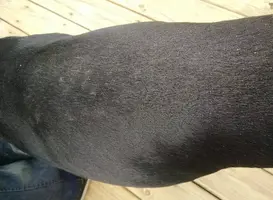
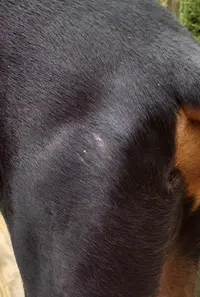
I agree, it could still be food and or environmental allergies which is why it could have flared up in spring and fall. But there are way too many variables in his live at both times to rule that out or in as what could/couldn't be going on. I am trying to take all/most of those variables out come spring to see what happens. What exactly is a "LID". I thought the ACANA (wild prairie) was a good food and have had awful results with food like California Natural before, so I would not want to use it again. His skin and coat got a LOT better after being on the ACANA and grain free treats for about 3-4 months. Which is why I would be surprised that he would be allergic to something, yet do better on it. I guess it could be one of the treats that I am giving him and would be more than happy to go back to just giving his food as treats when training (he will eat anything!)

His energy level is through the roof and he ALWAYS wants to be doing something. He will take breaks and naps in his crate if I make him, or after a long day of training will crash on his bed....but it takes a LOT to wear this guy out. The friend that suggested the Thyroid tests is a life long doberman owner and does agree that it mostly is seen in adults, but with the hair loss, minimal itching (nor more than a normal dog) and all the dandruff that it is smart to at least test. His weight is stable (about 70-75 lbs) and he is around 27 inches no more than 27.5....hard to get when he is wiggling. He will gain weight though if I feed him more than 2 cups per day of the food but mainly that is because he is also on the raw goat's milk which has a lot of fat and a raw egg per day.

The blood work will either be sent out to a place called Diagnostic Center For Population and Animal Health or Hemopet. I am unsure if one is better than the other but I need to call both later today. If you have any opinions or suggestions on this please let me know.
 
The Acana is a good food, no doubt!! I feed Orijen to my girls, which is it's sister line and made by the same company. It is not allergy friendly as the protien sources they offer are the ones typically that cause allergies.

They can still be allergic to a food they do mildly improve on. The symptoms can be minimal at first and then will worsen, but it takes time as the body's immune system has to have time to respond to the stimulus. Archer did fine on the Acana at first too, and then went downhill. It could be the treats too. With Archer, he gets his kibble for training treats and I make a treat batter out of crushed kibble, pumpkin, peanut butter and water so he can have something other than just his food for a treat. If he gets anything else by mouth, we have diarrhea issues.

A LID is a limited ingredient diet, meaning there is typically a single protein source and a single carb source. The protein and carbs used are ones that have been proven to be easily digested (low residue) and show minimal allergy problems. Typically you will see a protein like duck, fish, pork or venison. They have even started using bison and buffalo. The carb is typically potato as the chance for an allergy to it is uncommon and it's a better carb fuel source than rice. The Acana wild prairie has chicken as a main source of protein. Alot of dogs are allergic to chicken. I'm suprised your vet hasn't suggested feeding a LID if she/he suspected allergies. good foods to try if you ever want to switch is the Wellness Simple line, Merrick and Natural Balance LID. We feed the Wellness Simple Salmon and potato to Archer, who required both a LID and Low residue diet. It's fantastic food.

Luca may be a high drive Dobe. Typically dogs with hypothyroidism have lethargy as a primary symptom, but not always. His weight isn't typical for it either, as weight gain is also a common symptom.

There is nothing OTC to treat Demodex. It's treated with a moderately high dose of Ivomectin, which requires a vet to dose for you. It is dangerous to give and has high neurological risks when used appropriately at the dose required, so most vets won't treat with it without a confirmed case of Demo.

I would love to see pics of his hairloss. Post some if you have them.
Hair.webp 2014-10-25 10.51.57.webp
 
The Acana is a good food, no doubt!! I feed Orijen to my girls, which is it's sister line and made by the same company. It is not allergy friendly as the protien sources they offer are the ones typically that cause allergies.

They can still be allergic to a food they do mildly improve on. The symptoms can be minimal at first and then will worsen, but it takes time as the body's immune system has to have time to respond to the stimulus. Archer did fine on the Acana at first too, and then went downhill. It could be the treats too. With Archer, he gets his kibble for training treats and I make a treat batter out of crushed kibble, pumpkin, peanut butter and water so he can have something other than just his food for a treat. If he gets anything else by mouth, we have diarrhea issues.

A LID is a limited ingredient diet, meaning there is typically a single protein source and a single carb source. The protein and carbs used are ones that have been proven to be easily digested (low residue) and show minimal allergy problems. Typically you will see a protein like duck, fish, pork or venison. They have even started using bison and buffalo. The carb is typically potato as the chance for an allergy to it is uncommon and it's a better carb fuel source than rice. The Acana wild prairie has chicken as a main source of protein. Alot of dogs are allergic to chicken. I'm suprised your vet hasn't suggested feeding a LID if she/he suspected allergies. good foods to try if you ever want to switch is the Wellness Simple line, Merrick and Natural Balance LID. We feed the Wellness Simple Salmon and potato to Archer, who required both a LID and Low residue diet. It's fantastic food.

Luca may be a high drive Dobe. Typically dogs with hypothyroidism have lethargy as a primary symptom, but not always. His weight isn't typical for it either, as weight gain is also a common symptom.

There is nothing OTC to treat Demodex. It's treated with a moderately high dose of Ivomectin, which requires a vet to dose for you. It is dangerous to give and has high neurological risks when used appropriately at the dose required, so most vets won't treat with it without a confirmed case of Demo.

I would love to see pics of his hairloss. Post some if you have them.
So would you lean more towards food allergies or Thyroid problems?
 
That actually screams allergy to me. No whether it be food or contact/inhalant is up to your vet to diagnose.

The areas his hair is thinner are not typical for thyroid issues and the thinning tends to be generally all over the body, not just on the top line like with Luca. His entire hair coat would be thin, especially on his sides, lumbar region of his back, back of the thighs and the neck down to the chest.

Honestly, his hair coat looks a lot like Archer's did prior to his diagnosis of allergies and malabsorbtion due to dietary issues. Archer's was far worse though. It took taking him off the Acana and putting him on a Low Residue LID kibble for him to improve. His coat is now the nicest of my three dogs. I am not saying that this is Luca's issue. I am just saying that with my experience, this does not look like an issue with his thyroid, but I could be wrong.

How old is Luca? I also just wanted to point out that my dog's coats all changed at around 12-18 months of age. They became a bit thinner and less soft than their puppy coat. I know mine are red and not black and reds have less hair per sq inch, but I think Dobies of all color go through a coat change as they mature.

I know you posted this in another thread, but what kind of Omega-3 supplement do you use and how much? Also, how much are you bathing? His skin is borderline seborrheic. Is he dandruffy everywhere, or just the spot on his upper back?
 
He had his first flare up (much worse than this at 9 months) and now he is about 16/17 months and started this flare up about a month ago.....so at 14/15 months. He will be 18 months in the beginning of December. I agree with the allergies, but I was highly urged to do the full blood panel for the Thyroid. At least now we can rule it out.

A friend and former Vet Tech. sent me this link. I was thinking about doing it for testing out allergies. What are your thoughts on it? Have you used it before? I do not want to spend hundreds of dollars right now allergy testing. If it is something like chicken, or an ingredient that might be both in the LID food and ACANA then switching foods won't work. I am researching different diets right now but not sure which LID food to go with. Which one worked for Archer the best? I just need a starting point.

As the weather has gotten colder and I have been keeping the area clean (especially with a few zits popping up) the hair loss has seemed to be limited and may be starting to come back where it first fell out. It has started to get very cold here over the past few days and even snowed! Maybe if it is outdoor allergies it will clear up.....but I still want to consider food changes too.

I try to bathe him once a month, but sometimes that goes a bit longer :( I use a special shampoo for dogs with acne and it seems to help for a day or two, but then gets bad again with the dandruff. You have to leave it on once worked in for 5 minutes. I think it is called Subulox.....I have used another that I like better (also from the vet) but can't remember the name. It is a medicated shampoo. The dandruff is only on his back where the hair loss is. Also, the skin is very oily feeling there and you get this residue on your hands when you pet him...gross. It is not like that right after a bath, but comes back after a week.

I can get labels and such of the supplements I was giving him. I currently stopped all supplements while we are trying to figure things out. The fish oils were from Wallgreens since the pet store did not carry what my vet suggested to give him. She said that it was ok to give him the human ones, but I am wondering now if it is necessary to give the supplements if he is on a well balanced diet.
 
I FINALLY think I have an answer. We got back allergy testing on him and he is allergic to CHICKEN! Among other things such as white potatoes, white rice, peas, and a few other food items. Most of which were in his food and or treats :( He also tested that he is super sensitive/allergic to plastic (polymides) OMG, his crate is an air liner crate made of plastic :( Well, his crate was getting a bit too small for him as his back is only a half inch from the top any way. I cannot justify buying him a Veri-Kennel 300 size any how (the biggest they make) so that helps with that decision. I bought him a 48 in metal crate and a Karunda bed (opted for the fabric for skin sensitive dogs). I have him on a Sweet Potato and fish food now too with NOTHING in it that he is allergic to. I give him either that or tried sweet potatoes for a snack. He is finally gaining weight and you would not believe how quickly his hair is coming back. While the allergy testing does not show that he is sensitive to anything like dust, pollen, etc. I am still on edge about another flare up this spring :( They also warned me against vaccinating him every year, so I got in with a vet that follows the AHA rules for only vaccinating pets every 3 years. So this is at least a start on the road to recovery. It still doesn't explain as to why switching from Diamond Large Breed Puppy to ACANA Wild Prarie back in June helped to grow his coat back in temporarily....but it could have also been the antibiotics he was on. So here's hoping to no more issues!
 

Back
Top