

First, two disclaimers... 1) I don't like dewclaws on a dog. 2) You can find anything on the internet to support a point of view. But these articles made me think.
Do the Dew(claws)?
M. Christine Zink DVM, PhD, DACVSMR
I work exclusively with canine athletes, developing rehabilitation programs for injured dogs or dogs that required surgery as a result of performance-related injuries. I have seen many dogs now, especially field trial/hunt test and agility dogs, that have had chronic carpal arthritis, frequently so severe that they have to be retired or at least carefully managed for the rest of their careers. Of the over 30 dogs I have seen with carpal arthritis, only one has had dewclaws.
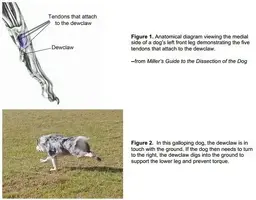
If you look at an anatomy book (Miller's Guide to the Anatomy of Dogs is an excellent one – see Figure 1 below)
you will see that there are 5 tendons attached to the dewclaw. Of course, at the other end of a tendon is a muscle, and that means that if you cut off the dew claws, there are 5 muscle bundles that will become atrophied from disuse.
Those muscles indicate that the dewclaws have a function. That function is to prevent torque on the leg. Each time the foot lands on the ground, particularly when the dog is cantering or galloping (see Figure 2), the dewclaw is in touch with the ground. If the dog then needs to turn, the dewclaw digs into the ground to support the lower leg and prevent torque. If the dog doesn't have a dewclaw, the leg twists. A lifetime of that and the result can be carpal arthritis, or perhaps injuries to other joints, such as the elbow, shoulder and toes. Remember: the dog is doing the activity regardless, and the pressures on the leg have to go somewhere.
Perhaps you are thinking, "None of my dogs have ever had carpal pain or arthritis." Well, we need to remember
that dogs, by their very nature, do not tell us about mild to moderate pain. If a dog was to be asked by an
emergency room nurse to give the level of his pain on a scale from 0 o 10, with 10 being the worst, their scale
would be 0, 0, 0, 0, 0, 6, 7, 8, 9, 10. Most of our dogs, especially if they deal with pain that is of gradual onset, just deal with it and don't complain unless it is excruciating. But when I palpate the carpal joints of older dogs without dewclaws, I frequently can elicit pain with relatively minimal manipulation.
As to the possibility of injuries to dew claws. Most veterinarians will say that such injuries actually are not very common at all. And if they do occur, then they are dealt with like any other injury. In my opinion, it is far better to deal with an injury than to cut the dew claws off of all dogs "just in case."
http://www.caninesports.com/uploads/1/5/3/1/15319800/dewclawexplanation.pdf
----------------------------------------------------------------------
With A Flick of the Wrist by Chris Zink, DVM, PhD
(as seen in Dogs In Canada – September 2003)
In the hundreds of agility trials I have attended over the years, only rarely have I seen a dog suffer an acute, serious injury. An exception happened in early May this year. I was relaxing at ringside, enjoying one of the rare rain free moments this spring offered, watching a bi-black Sheltie named 'Shadow' ne- gotiate the Open Jumpers course with smooth abandon. Suddenly the dog took a misstep, completely misjudged where he should take off, and crashed into the jump. As he fell, his front legs landed on the fallen jump bars, and he immediately let out an agonized scream. He was still crying as he was carried out of the ring. I ran over to help and examined the dog in a shady area some distance from the ring.
Shadow's left front leg was extremely painful and he held it stiffly away from his body. In a few minutes he had relaxed enough for me to determine that there were no major bone breaks. In fact, the main problem appeared to be a severe sprain of the carpus (wrist). Later X-rays not only confirmed my finding, but interestingly showed that the dog had preexisting arthritic changes in the carpal joints of both front legs. Thus, although this dog did have an acute agility injury, he had chronic problems, too. In fact, it is possible that the arthritis contributed to his lack of coordination in approaching the jump.
Once Shadow was on the mend, his human teammate had many questions for me. How common is carpal arthritis in performance dogs? How painful is carpal arthritis and what can be done to relieve the pain? Will Shadow still be able to play agility, obedience and other fun doggie games? Since carpal arthritis is quite common, I thought I would share the answers in this column.
In the last several years, while doing sports-medicine consultations for performance dogs across Canada and the United States, I have seen many canine athletes with carpal arthritis. Interestingly, this condition is much more common in dogs that have had their front dewclaws removed. To understand why, it is helpful to understand the structure of the carpus. This joint consists of seven bones that fit together like fieldstones that are used to build the walls of a house (Figure 2).
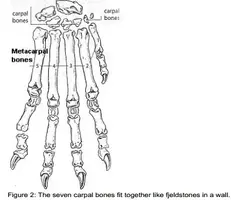
The carpus joins to the radia and ulnar bones (equivalent to our lower arm) above, and to the metacarpal bones (equivalent to our hand) below.
Each bone of the carpus has a convex or concave side that matches a curve on the adjacent bone. Unlike the bones of the elbow, for example (Figure 3),
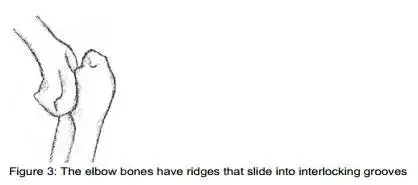
the bones of the carpus do not have ridges that slide into interlocking grooves on the adjacent bone. The
relatively loose fit of the carpal bones is supported by ligaments that join each of the carpal bones to the
adjacent bones.
With so many carpal bones that don't tightly interlock with the adjacent bones, the ligaments of this joint
can be easily stretched and even torn when torque (twisting) is applied to the leg. The dewclaws have the
important function of reducing the torque that is applied to the front legs, especially when dogs are
turning at a canter (the main gait used in agility).
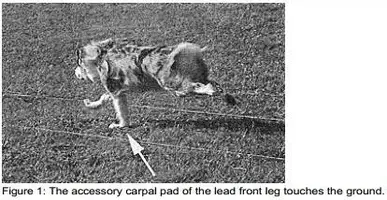
In the canter, there is a moment during each stride when the dog's accessory carpal pad (on the back of
the carpus) of the lead front leg touches the ground (Figure 1) and the rear legs and other front leg swing forward to prepare for the next stride. At this point, the dewclaw is in contact with the ground and if the dog turns, the dewclaw can dig in for extra traction to prevent unnecessary torque on the front leg. Without the gripping action of the dog's 'thumbs’ there is more stress on the ligaments of the carpus. This may cause the ligaments to stretch and tear over time, resulting in joint laxity and ultimately, arthritis.
There are many more options for treating dogs with arthritis today than there were just a few years ago.
Here are some of them.
1) Weight reduction. The more weight your dog carries around, the more stress there will be on the
joints. This is a particular problem in dogs with carpal arthritis, because the front legs bear 65 per cent of
the dog's weight.
2) Massage. This is an excellent way to prevent excess scar tissue from forming and to keep your dog's
joints flexible. Make an appointment with a canine massage therapist and learn how to do massage that is
targeted to your dog's carpi. You can do the massage while you watch television in the evenings.
Afterward, gently flex and extend your dog's front legs two to three times to help promote flexibility.
3) Acupuncture. Acupuncture is often very helpful in relieving joint pain and slowing the progression of
arthritis.
4) Chiropractic adjustments. Many dogs with painful joints will benefit from regular chiropractic
adjustments because they are using their muscles unevenly to avoid pain on one side or the other
5) Joint-protective nutraceuticals. There are many products on the market, and all are not created equal, so be sure to buy a product from a reputable company. For best results use a combination of glucosamine, chondroitin, methylsulfonylmethane (MSM) and cetylmyristolate (CM).
6) Antioxidant and anti-inflammatory food and supplements. Feed your dog natural antioxidant
foods such as fresh vegetables and fruits that contain vitamin C. Supplement his diet with vitamins E and
B and an appropriate combination of omega-6 and omega-3 fatty acids.
7) Anti-inflammatory drugs.
8) Moderate ongoing exercise. Dogs with arthritis need enough exercise to keep their muscles strong
so that they support the joints, but not so much that it causes excessive wear and tear on the joints and
the ligaments that support them. Moderation is the key. Dogs should get a moderate amount of balanced exercise each day, and avoid being weekend warriors. Avoid high-impact exercise as much as possible. For example, don't use stairs as a way to exercise your dog because of the impact on descending, and don't let him run over rough, uneven ground.
Have your dog jump full height only about 10 per cent of the time during training, and only on surfaces
that are smooth and appropriately cushioning, such as thick grass or properly prepared dirt (arena)
surfaces. Swimming is a great exercise for arthritic dogs.
Even if your dog doesn't currently suffer from arthritis, keep this article for later. If you should be lucky
enough to have your canine companion in his senior years, these tips may make it possible for him to
keep running and playing like a youngster.
http://www.woodhavenlabs.com/documents/dewclaws-injury.pdf
Do the Dew(claws)?
M. Christine Zink DVM, PhD, DACVSMR
I work exclusively with canine athletes, developing rehabilitation programs for injured dogs or dogs that required surgery as a result of performance-related injuries. I have seen many dogs now, especially field trial/hunt test and agility dogs, that have had chronic carpal arthritis, frequently so severe that they have to be retired or at least carefully managed for the rest of their careers. Of the over 30 dogs I have seen with carpal arthritis, only one has had dewclaws.
If you look at an anatomy book (Miller's Guide to the Anatomy of Dogs is an excellent one – see Figure 1 below)
you will see that there are 5 tendons attached to the dewclaw. Of course, at the other end of a tendon is a muscle, and that means that if you cut off the dew claws, there are 5 muscle bundles that will become atrophied from disuse.
Those muscles indicate that the dewclaws have a function. That function is to prevent torque on the leg. Each time the foot lands on the ground, particularly when the dog is cantering or galloping (see Figure 2), the dewclaw is in touch with the ground. If the dog then needs to turn, the dewclaw digs into the ground to support the lower leg and prevent torque. If the dog doesn't have a dewclaw, the leg twists. A lifetime of that and the result can be carpal arthritis, or perhaps injuries to other joints, such as the elbow, shoulder and toes. Remember: the dog is doing the activity regardless, and the pressures on the leg have to go somewhere.
Perhaps you are thinking, "None of my dogs have ever had carpal pain or arthritis." Well, we need to remember
that dogs, by their very nature, do not tell us about mild to moderate pain. If a dog was to be asked by an
emergency room nurse to give the level of his pain on a scale from 0 o 10, with 10 being the worst, their scale
would be 0, 0, 0, 0, 0, 6, 7, 8, 9, 10. Most of our dogs, especially if they deal with pain that is of gradual onset, just deal with it and don't complain unless it is excruciating. But when I palpate the carpal joints of older dogs without dewclaws, I frequently can elicit pain with relatively minimal manipulation.
As to the possibility of injuries to dew claws. Most veterinarians will say that such injuries actually are not very common at all. And if they do occur, then they are dealt with like any other injury. In my opinion, it is far better to deal with an injury than to cut the dew claws off of all dogs "just in case."
http://www.caninesports.com/uploads/1/5/3/1/15319800/dewclawexplanation.pdf
----------------------------------------------------------------------
With A Flick of the Wrist by Chris Zink, DVM, PhD
(as seen in Dogs In Canada – September 2003)
In the hundreds of agility trials I have attended over the years, only rarely have I seen a dog suffer an acute, serious injury. An exception happened in early May this year. I was relaxing at ringside, enjoying one of the rare rain free moments this spring offered, watching a bi-black Sheltie named 'Shadow' ne- gotiate the Open Jumpers course with smooth abandon. Suddenly the dog took a misstep, completely misjudged where he should take off, and crashed into the jump. As he fell, his front legs landed on the fallen jump bars, and he immediately let out an agonized scream. He was still crying as he was carried out of the ring. I ran over to help and examined the dog in a shady area some distance from the ring.
Shadow's left front leg was extremely painful and he held it stiffly away from his body. In a few minutes he had relaxed enough for me to determine that there were no major bone breaks. In fact, the main problem appeared to be a severe sprain of the carpus (wrist). Later X-rays not only confirmed my finding, but interestingly showed that the dog had preexisting arthritic changes in the carpal joints of both front legs. Thus, although this dog did have an acute agility injury, he had chronic problems, too. In fact, it is possible that the arthritis contributed to his lack of coordination in approaching the jump.
Once Shadow was on the mend, his human teammate had many questions for me. How common is carpal arthritis in performance dogs? How painful is carpal arthritis and what can be done to relieve the pain? Will Shadow still be able to play agility, obedience and other fun doggie games? Since carpal arthritis is quite common, I thought I would share the answers in this column.
In the last several years, while doing sports-medicine consultations for performance dogs across Canada and the United States, I have seen many canine athletes with carpal arthritis. Interestingly, this condition is much more common in dogs that have had their front dewclaws removed. To understand why, it is helpful to understand the structure of the carpus. This joint consists of seven bones that fit together like fieldstones that are used to build the walls of a house (Figure 2).
The carpus joins to the radia and ulnar bones (equivalent to our lower arm) above, and to the metacarpal bones (equivalent to our hand) below.
Each bone of the carpus has a convex or concave side that matches a curve on the adjacent bone. Unlike the bones of the elbow, for example (Figure 3),
the bones of the carpus do not have ridges that slide into interlocking grooves on the adjacent bone. The
relatively loose fit of the carpal bones is supported by ligaments that join each of the carpal bones to the
adjacent bones.
With so many carpal bones that don't tightly interlock with the adjacent bones, the ligaments of this joint
can be easily stretched and even torn when torque (twisting) is applied to the leg. The dewclaws have the
important function of reducing the torque that is applied to the front legs, especially when dogs are
turning at a canter (the main gait used in agility).
In the canter, there is a moment during each stride when the dog's accessory carpal pad (on the back of
the carpus) of the lead front leg touches the ground (Figure 1) and the rear legs and other front leg swing forward to prepare for the next stride. At this point, the dewclaw is in contact with the ground and if the dog turns, the dewclaw can dig in for extra traction to prevent unnecessary torque on the front leg. Without the gripping action of the dog's 'thumbs’ there is more stress on the ligaments of the carpus. This may cause the ligaments to stretch and tear over time, resulting in joint laxity and ultimately, arthritis.
There are many more options for treating dogs with arthritis today than there were just a few years ago.
Here are some of them.
1) Weight reduction. The more weight your dog carries around, the more stress there will be on the
joints. This is a particular problem in dogs with carpal arthritis, because the front legs bear 65 per cent of
the dog's weight.
2) Massage. This is an excellent way to prevent excess scar tissue from forming and to keep your dog's
joints flexible. Make an appointment with a canine massage therapist and learn how to do massage that is
targeted to your dog's carpi. You can do the massage while you watch television in the evenings.
Afterward, gently flex and extend your dog's front legs two to three times to help promote flexibility.
3) Acupuncture. Acupuncture is often very helpful in relieving joint pain and slowing the progression of
arthritis.
4) Chiropractic adjustments. Many dogs with painful joints will benefit from regular chiropractic
adjustments because they are using their muscles unevenly to avoid pain on one side or the other
5) Joint-protective nutraceuticals. There are many products on the market, and all are not created equal, so be sure to buy a product from a reputable company. For best results use a combination of glucosamine, chondroitin, methylsulfonylmethane (MSM) and cetylmyristolate (CM).
6) Antioxidant and anti-inflammatory food and supplements. Feed your dog natural antioxidant
foods such as fresh vegetables and fruits that contain vitamin C. Supplement his diet with vitamins E and
B and an appropriate combination of omega-6 and omega-3 fatty acids.
7) Anti-inflammatory drugs.
8) Moderate ongoing exercise. Dogs with arthritis need enough exercise to keep their muscles strong
so that they support the joints, but not so much that it causes excessive wear and tear on the joints and
the ligaments that support them. Moderation is the key. Dogs should get a moderate amount of balanced exercise each day, and avoid being weekend warriors. Avoid high-impact exercise as much as possible. For example, don't use stairs as a way to exercise your dog because of the impact on descending, and don't let him run over rough, uneven ground.
Have your dog jump full height only about 10 per cent of the time during training, and only on surfaces
that are smooth and appropriately cushioning, such as thick grass or properly prepared dirt (arena)
surfaces. Swimming is a great exercise for arthritic dogs.
Even if your dog doesn't currently suffer from arthritis, keep this article for later. If you should be lucky
enough to have your canine companion in his senior years, these tips may make it possible for him to
keep running and playing like a youngster.
http://www.woodhavenlabs.com/documents/dewclaws-injury.pdf
Last edited by a moderator:


 What the heck does a circumcision have to do with tendons connected to dew claws in sporting dogs?


