Layback of Shoulder

Ravenbird

Moderator
$ Forum Donor $
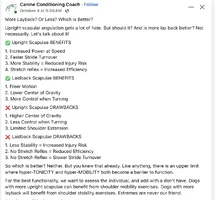
I thought this was an interesting bit of information, considering the concentration on fronts and layback of scapula that I'm seeing in confo conversations. It makes total sense to me, structure-wise, and yet another bid for that last sentence "extremes are never our friend".


Screenshot 2026-10-09 at 9.54.13 AM.webp
 
I thought this was an interesting bit of information, considering the concentration on fronts and layback of scapula that I'm seeing in confo conversations. It makes total sense to me, structure-wise, and yet another bid for that last sentence "extremes are never our friend".


View attachment 164728
Very useful! Is Asha more upright or more laidback?

I need a picture to grok this.
Or a diagram of the scapula in side profile showing range in both extremes.
 
At least w/ horses, you want as close to 45 deg as possible--better conformation and overall a smoother ride. I've ridden horses with a steeper shoulder angle and they are definitely less comfortable w/ a shorter stride. I'd think in dogs too you'd want ideally 45 deg without extremes in either direction. Although I don't think I've ever seen an animal with a shoulder angle shallower than 45 deg.
 
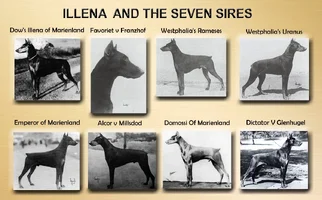
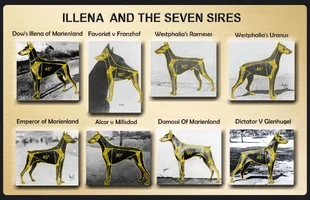
I'm not especially good at seeing perfect angles on dogs, especially when not stacked the same or the photo angle is not the same. I'll drop this here so we can comment on dogs that aren't current - most every dog in this country has one or more of these dogs in its pedigree.

Illena and seven sires.webp
 
TY @Sunje
So "layback" extreme would be a more acute angle, ie something less than 45 degrees on top half of the 90 degree?

And if so, then I can sort of guess where "more upright" is coming from-
- the "look" thats almost toward show GSDs where taller front, more out thrust chest, slanted back,
esp when stacked to show that pose?

Correct or?
That's a good point--I don't know if those extreme show GSDs have a shallower shoulder angle. I had a GSD that I showed a bit in the early 90s, and the judge would have put him up for the points if I hadn't been in an obedience class and missed the Winner's class. Back then some judges were moving away from that extreme angulation in the hind end, and I think overall that is going away in the breed, thank God. When the GSD is stacked in the conformation ring, the inside leg should be back and straight from hock to ground, and the outside leg should be forward underneath the dog. But on many dogs at one point, the angulation was so severe that the outside leg was pretty much laying on the ground from hock forward, and the dogs' movement with that extreme conformation were basically dragging their butts on the ground when they trotted around the ring.
 
I'm not especially good at seeing perfect angles on dogs, especially when not stacked the same or the photo angle is not the same. I'll drop this here so we can comment on dogs that aren't current - most every dog in this country has one or more of these dogs in its pedigree.

View attachment 164733
I think most of these have a shoulder angle close to 45 deg. Sadly, I believe that those were the dogs that cemented DCM in our breed.
 
Thanks @Sunje I was doing some reading at a VS owned webforum on GSDs...very useful, and I think it was there or at another VS owned UK golden forum that pointed out that last year at Crufts the UK show vets disqualled two GSD showdogs for excessive low hindquarters.

I'd hate for the standard to devolve in dobes, from the square structure that makes for strength plus agilty, with athleticism.
 
Last edited:
I believe that those were the dogs that cemented DCM in our breed.
I think 3 of them for sure were listed as heart related deaths. I'd have to go back to Dobequest to verify if it was more than 3.

I'm glad you verified that they appear to be correct in the shoulder angles. And I definitely agree on horses - if they are too straight it's definitely a red flag to me. And with horses almost every straight shoulder is accompanied by straight pasterns. And some horses with really laid back shoulders will have long (weak) pasterns... so wondering if that also relates to dogs. I can't seem to find a dog picture that is overly laid back but I've been looking at Dobe photos.
 
I'm not especially good at seeing perfect angles on dogs, especially when not stacked the same or the photo angle is not the same. I'll drop this here so we can comment on dogs that aren't current - most every dog in this country has one or more of these dogs in its pedigree.

View attachment 164733
Thanks @Ravenbird
I'm merely an interested consumer, maybe.
Anyone who looks at my " signature" knows I defer to experienced owners of titled dogs, breeders and judges.
But, as I am a visual learner,
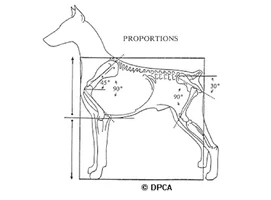
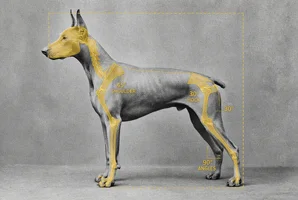
For the heck of it I ran a request of grok to create an overlay based on the DPCA graphic
And then overlay on the photos you provided to help me visualize...its obviously not a perfect fit nor any replacement for the human eye...
But it helps understand the terminology...

I use GrokAI for a search engine,
and then read for myself at the cited source...

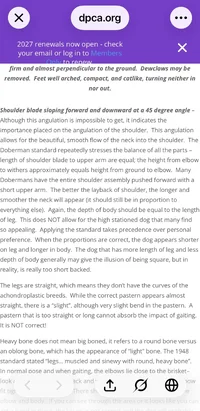
The screenshot is one of the cited DPCA judging sources that discussed "how the 45 degree angle is an ideal but not always easy to achieve"IMG_3919.webp

As a courtesy to @JanS iI'm avoiding links, as too many embedded in comments that take one's eyeballs elsewhere hurt SEO,
but
you all lurking noibs and fellow dog nerds can easily search using your own desktop or mobile device browsers search engines for "dpca judging standards" for the excellent stuff accessible there on the open to public education section.

PS: yes, the results were imperfect fer sure...

 

Attachments

  • IMG_3916.webp
    IMG_3916.webp
    258.4 KB · Views: 1
  • IMG_3917.webp
    IMG_3917.webp
    211.4 KB · Views: 1
Last edited:
Thanks @Ravenbird
I'm merely an interested consumer, maybe.
Anyone who looks at my " signature" knows I defer to experienced owners of titled dogs, breeders and judges.
But, as I am a visual learner,
For the heck of it I ran a request of grok to create an overlay based on the DPCA graphic
And then overlay on the photos you provided to help me visualize...its obviously not a perfect fit nor any replacement for the human eye...
But it helps understand the terminology...

I use GrokAI for a search engine,
and then read for myself at the cited source...

The screenshot is one of the cited DPCA judging sources that discussed "how the 45 degree angle is an ideal but not always easy to achieve"View attachment 164736

As a courtesy to @JanS iI'm avoiding links, as too many embedded in comments that take one's eyeballs elsewhere hurt SEO,
but
you all lurking noibs and fellow dog nerds can easily search using your own desktop or mobile device browsers search engines for "dpca judging standards" for the excellent stuff accessible there on the open to public education section.

PS: yes, the results were imperfect fer sure...
Thanks, this is helpful. I'm definitely not as good at assessing conformation in dogs as I am in horses. But then, dogs come in SO many different conformation types!
 
Thanks, this is helpful. I'm definitely not as good at assessing conformation in dogs as I am in horses. But then, dogs come in SO many different conformation types!
You're welcome! I was blessed to get to hang out around horses and learn from some really neat people during my daughters hunter-jumper years.

But for the life of me, I could never "get" or "see" changing leads...and
Now I'm still struggling picking up on dog gaits...
it sure would be nice if there were different terms- for dogs vs horses...🧐
"Do dogs canter?"

Lol
some kind of a mental block I guess.
Oh well!
I Better stick to geeking out on wx!

🤪🤣😉
Yes they do canter! Although perhaps it's called a lope. I've also seen several pace and do a soft gait (running walk, stepping pace type gait). And if you look elsewhere in the animal world, you will see that some animals naturally pace (elephants, giraffes), and maned wolves would probably do a really nice soft gait, as they are very long-legged and short in body/square.

Leads and lead changes are pretty easy to see--just look at which front leg is "leading" as the horse moves. I know most of the soft gaits in gaited horses pretty well--running walk, stepping pace, rack, saddle rack. The foxtrot throws me though, and the paso gaits I don't know. It's just a matter of developing the eye.

According to AI, horses can do a double suspension gallop in certain situations, at high speeds. But it's the sighthounds and a few other breeds that really shine at that. And cheetahs. 🙂
 
But for the life of me, I could never "get" or "see" changing leads.
Can you skip? As you go along, skipping down your beach, you can do it "leading" with either the right or left leg. Try that the next time you go out to walk your dog. And give us your feedback on it. You are basically cantering with 2 legs instead of 4 and can do lead changes every few strides, or every other stride like they ask a horse in highest level dressage.
 
Can you skip? As you go along, skipping down your beach, you can do it "leading" with either the right or left leg. Try that the next time you go out to walk your dog.
I can still do it but that is a good explanation.
I still have to laugh at this one.
 
According to AI, horses can do a double suspension gallop in certain situations, at high speeds.
I agreed with your post, but still not 100% agreeing with this statement. The fastest racehorses in the world are now filmed and can be played in slo-mo and I have yet to see a double suspension. The paintings of race horses in the 1800's were shown mostly in double suspension but when photography came into play via motion pictures it was debunked. They couldn't film a horse in true DS. They do have all four legs off the ground at a point, but not the forelegs stretched forward while both back legs extended equally backward. As far as I know, but welcome further education, as always!

I know most of the soft gaits in gaited horses pretty well--running walk, stepping pace, rack, saddle rack. The foxtrot throws me though, and the paso gaits I don't know. It's just a matter of developing the eye.
I can see the different gaits with my eyes but I never was into gaited horses so I never knew what any of it was called. I did ride an Arab with a running walk (what I called it, not sure if that's what it was). It was like a 4 beat walk but super fast and had a rhythm of speed to it.
 

Back
Top